answer.
Ask question
Login Signup
Ask question
All categories
  • English
  • Mathematics
  • Social Studies
  • Business
  • History
  • Health
  • Geography
  • Biology
  • Physics
  • Chemistry
  • Computers and Technology
  • Arts
  • World Languages
  • Spanish
  • French
  • German
  • Advanced Placement (AP)
  • SAT
  • Medicine
  • Law
  • Engineering
mel-nik [20]
2 years ago
12

Describe how a chemist should set up his or her stoichiometric calculation to predict the mass of CuSO4 that forms when a specif

ied mass of CuSO4•5H2O is heated.
Chemistry
2 answers:
stich3 [128]2 years ago
7 0

Convert mass of CuSO4•5H2O to moles using molar mass of CuSO4•5H2O.

Convert moles of CuSO4•5H2O to moles of CuSO4 using a mole ratio.

Convert moles of CuSO4 to mass of CuSO4 using molar mass of CuSO4.

DanielleElmas [232]2 years ago
5 0
1) Calculate the number of moles of Cu SO4 . 5H20 by dividing the specified mass by the molar mass.

2) The ratio of production given by the equation is 1 mol of Cu SO4 . 5 H2O to 1 mol of Cu SO4=> 1:1, meaning that the number of moles of Cu SO4 produced is the same number of moles of Cu SO4.5H20 heated.

3) Finally mutiply the number of moles of Cu SO4 by its molar mass and there you have the mass of Cu SO4 produced.


You might be interested in
Which pair of statements below is correct? Multiple Choice An octet is formed via ionic bonding when one or more valence electro
tresset_1 [31]

Answer:

An octet is formed via ionic bonding when one or more valence electrons are transferred from one atom to another.

An octet is formed via covalent bonding when valence electrons are shared between atoms.

An octet is always formed via ionic bonding

Explanation:  The essence of bonding is stability. An octet or duplet state is formed when one or more valence electrons are shared. when the electrons are shared, the type of bond formed is a covalent bond. An octet is formed via ionic bonding when one or more valence electrons are transferred from one atom to another.

3 0
2 years ago
Read 2 more answers
What would be the composition and ph of an ideal buffer prepared from lactic acid (ch3chohco2h), where the hydrogen atom highlig
Mashutka [201]

Answer:

P_H =2.86

c=1.4\times 10^{-4}

Explanation:

first write the equilibrium equaion ,

C_3H_6O_3  ⇄ C_3H_5O_3^{-}  +H^{+}

assuming degree of dissociation \alpha =1/10;

and initial concentraion of C_3H_6O_3 =c;

At equlibrium ;

concentration of C_3H_6O_3 = c-c\alpha

[C_3H_5O_3^{-}  ]= c\alpha

[H^{+}] = c\alpha

K_a = \frac{c\alpha \times c\alpha}{c-c\alpha}

\alpha is very small so 1-\alpha can be neglected

and equation is;

K_a = {c\alpha \times \alpha}

[H^{+}] = c\alpha = \frac{K_a}{\alpha}

P_H =- log[H^{+} ]

P_H =-logK_a + log\alpha

K_a =1.38\times10^{-4}

\alpha = \frac{1}{10}

P_H= 3.86-1

P_H =2.86

composiion ;

c=\frac{1}{\alpha} \times [H^{+}]

[H^{+}] =antilog(-P_H)

[H^{+} ] =0.0014

c=0.0014\times \frac{1}{10}

c=1.4\times 10^{-4}

6 0
2 years ago
Four different solutions (I, II, III, and IV) are labeled on the pH scale below. A p H scale is shown, fading from red at the le
andreyandreev [35.5K]

Answer: It has the highest number of hydroxide ions

Explanation: I took the review

6 0
2 years ago
Read 2 more answers
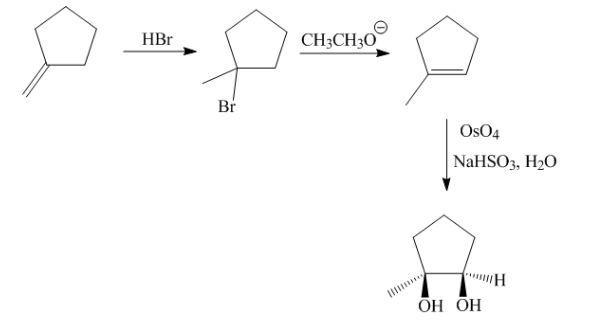
The target diol is synthesized in one step from 1-methylcyclopentene, but your lab partner exhausted the supply of that alkene.
andrezito [222]

Answer:

The reagents are CH_{3}CH_{3}O^{-},OsO_{4},NaHSO_{3}and H_{2}O.

Explanation:

1-Methylenecyclopentene is treated with HBr form 1-bromo-1-methylcyclopentane, which is treated with strong base ethoxide ion and forms 1-methylcyclopent-1-ene.

This alkene is treated with osmium tetraoxide in the presence of sodium bisulfite to form target product.

The chemical reaction is as follows.

4 0
2 years ago
Calculate the amount of work done against an atmospheric pressure of 1.00 atm when 500.0 g of zinc dissolves in excess acid at 3
ZanzabumX [31]

Answer:

19,26 kJ

Explanation:

The work done when a gas expand with a constant atmospheric pressure is:

W = PΔV

Where P is pressure and ΔV is the change in volume of gas.

Assuming the initial volume is 0, the reaction of 500g of Zn with H⁺ (Zn(s) + 2H⁺(aq) → Zn²⁺(aq) + H₂(g)) produce:

500,0g Zn(s)×\frac{1molZn}{65,38g}×\frac{1molH_{2}(g)}{1molZn} = 7,648 moles of H₂

At 1,00atm and 303,15K (30°C), the volume of these moles of gas is:

V = nRT/P

V = 7,648mol×0,082atmL/molK×303,15K / 1,00atm

V = 190,1L

That means that ΔV is:

190,1L - 0L = <em>190,1L</em>

And the work done is:

W = 1atm×190,1L = 190,1atmL.

In joules:

190,1 atmL×\frac{101,325}{1atmL} = <em>19,26 kJ</em>

I hope it helps!
5 0
2 years ago
Other questions:
  • When 200 grams of water cools from 50.°C to 25°C, the total amount of heat energy released by the water is?
    7·1 answer
  • You are on a field trip to a nearby lake for biology class and want to perform a quick analysis of the water’s approximate pH le
    6·2 answers
  • In the preceding information section there is a "bohr's diagram" of an atom. Which atom is it?
    9·1 answer
  • Identify the reaction type for each generic chemical equation
    15·2 answers
  • Leaded gasoline contains an additive to prevent engine knocking. On analysis, the additive compound is found to contain carbon,
    13·1 answer
  • A glass cup of orange juice is found to have pOH of 11.40. Calculate the concentration of the hydrogen ions in the juice.​
    15·1 answer
  • gypsum is insoluble in water. you are asked to purify a sample of gypsum that is contaminated with a soluble salt.
    6·1 answer
  • A metal crystallizes with a face-centered cubic lattice. The edge of the unit cell is 417 pm. The diameter of the metal atom is:
    15·1 answer
  • What type of radioactive decay will the isotopes 13B and 188Au most likely undergo?
    11·1 answer
  • What is the herbivore in the following food chain: algae → fish → herons?
    8·1 answer
Add answer
Login
Not registered? Fast signup
Signup
Login Signup
Ask question!
