answer.
Ask question
Login Signup
Ask question
All categories
  • English
  • Mathematics
  • Social Studies
  • Business
  • History
  • Health
  • Geography
  • Biology
  • Physics
  • Chemistry
  • Computers and Technology
  • Arts
  • World Languages
  • Spanish
  • French
  • German
  • Advanced Placement (AP)
  • SAT
  • Medicine
  • Law
  • Engineering
skelet666 [1.2K]
2 years ago
14

List the following aqueous solutions in order of decreasing freezing point: a. 0.040 m glycerin (C3H8O3) b. 0.020 m potassium br

omide (KBr)c. 0.030 m phenol (C6H5OH).
Chemistry
1 answer:
jek_recluse [69]2 years ago
3 0

Answer:c>b>a

Explanation:

Freezing point depends on relative molecular mass and nature of intermolecular forces. In glycerin, the relative molecular is the least of the the molecules are held together only by weak Vanderwaals forces. Phenol has stronger dipole interactions and higher relative molecular mass. Potassium bromide is ionic and posses very strong bonds hence it has the highest freezing point.

You might be interested in
A sample of an unknown compound was decomposed and found to be composed of 1.36 mol oxygen, 4.10 mol hydrogen, and 2.05 mol carb
Flura [38]

Answer:

C3H6O2

Explanation:

To find the empirical formula of the compound, we divide the amount in moles of each of the elements by the amount in mole of the element with the smallest number of mole. In this question, the element with the smallest number of moles is oxygen with 1.36 mole. Hence, we divide the number of moles of each element by this.

H = 4.10/1.36 = 3

O = 1.36/1.36 = 1

C = 2.05/1.36 = 1.5

We then multiply through by 2 to yield the compound with the empirical formula C3H6O2

7 0
2 years ago
A precipitate forms when mixing solutions of sodium fluoride (NaF) and lead II nitrate (Pb(NO3)2). Complete and balance the net
Margarita [4]

Answer:

Pb^2+(aq) + 2F-(aq) → PbF2(s)

Explanation:

Step 1: Data given

sodium fluoride = NaF

lead(II)nitrate Pb(NO3)2

Step 2: The unbalanced equation

NaF(aq) + Pb(NO3)2(aq) →  PbF2(s) + NaNO3(aq)

Step 3: Balancing the equation

NaF(aq) + Pb(NO3)2(aq) →  PbF2(s) + NaNO3(aq)

On the left side we have 2x NO3 (in Pb(NO3)2), on the right side we have 1x NO3 (in NaNO3). To balance the amount of NO3 we hvae to multiply NaNO3 on the right side by 2.

NaF(aq) + Pb(NO3)2(aq) →  PbF2(s) + 2NaNO3(aq)

On the left side we have 1x Na (in NaF), on the right side we have 2x Na (in 2NaNO3). To balance the amount of Na we have to multiply NaF on the left side by 2. Now the equation is balanced.

2NaF(aq) + Pb(NO3)2(aq) →  PbF2(s) + 2NaNO3(aq)

Step 4: Calculate net ionic equation

The net ionic equation, for which spectator ions are omitted - remember that spectator ions are those ions located on both sides of the equation - will , after canceling those spectator ions in both side, look like this:

2Na+(aq) + 2F-(aq) + Pb^2+(aq) + 2NO3-(aq) → PbF2(s) + 2Na+(aq) + NO3-(aq)

Pb^2+(aq) + 2F-(aq) → PbF2(s)

4 0
2 years ago
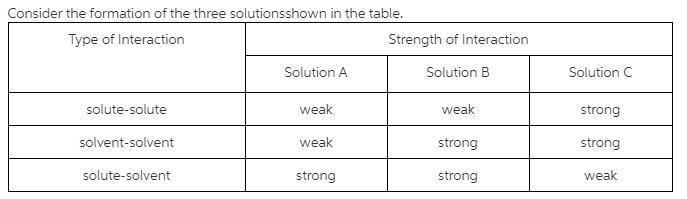
Rank the formation of the solutions A, B, and C from the most exothermic to the most endothermic. Rank the enthalpy of solution
Elodia [21]

This is an incomplete question, the table is attached below.

Answer : The correct ranking of the solution from most exothermic to most endothermic will be: A, B and C.

Explanation :

As we know that the intermolecular force of attraction play an important role in the interaction of solute-solute, solute-solvent and solvent solvent solution.

In the solution A, the solute-solute and solvent-solvent interactions are weak. So, their solute-solvent interaction will be strong. That means, the solution will be more exothermic.

In the solution C, the solute-solute and solvent-solvent interactions are strong. So, their solute-solvent interaction will be weak. That means, the solution will be more endothermic.

Thus, the correct ranking of the solution from most exothermic to most endothermic will be: A, B and C.

4 0
2 years ago
What is most likely the author’s motive for writing this article?
s2008m [1.1K]
You need to attach the article or tell us the title of it
5 0
2 years ago
Read 2 more answers
Summarize the process a scientist goes through to come up with a<br> satisfactory solution.
maria [59]
Guess and check, test, trial and error, completion.
6 0
2 years ago
Other questions:
  • A "shielding gas" mixture of argon and carbon dioxide is sometimes used in welding to improve the strength of the weld. if a gas
    12·2 answers
  • What is the [h3o+] for a solution at 25°c that has poh = 5.640?
    12·1 answer
  • How many carbon atoms are contained in 2.8 g of c2h4 ?
    13·2 answers
  • Calculate the internal energy and enthalpy changes resulting if air changes from an initial |state of 5°C and 10bar, where its m
    11·1 answer
  • You want to determine ΔH o for the reaction Zn(s) + 2HCl(aq) → ZnCl2(aq) + H2(g) To do so, you first determine the heat capacity
    5·1 answer
  • The energy difference between the 5d and 6s sublevels in gold accounts for its color. Assuming this energy difference is about 2
    14·1 answer
  • A 1.80 g sample of barium chloride hydrate, BaCl2 ⋅ xH2O is treated with excess sulfuric acid, forming a BaSO4 precipitate which
    6·2 answers
  • A balloon filled with 1.22 L of gas at 286 K is heated until the
    10·1 answer
  • The equilibrium constant for the reaction is 1.1 x 10⁶ M. HONO(aq) + CN-(aq) ⇋ HCN(aq) + ONO-(aq) This value indicates that
    7·1 answer
  • A 25.0 mL sample of 0.25 M potassium carbonate (K2CO3) solution is added to 30.0 mL of a 0.40 M barium nitrate (Ba(NO3)2) soluti
    8·1 answer
Add answer
Login
Not registered? Fast signup
Signup
Login Signup
Ask question!