answer.
Ask question
Login Signup
Ask question
All categories
  • English
  • Mathematics
  • Social Studies
  • Business
  • History
  • Health
  • Geography
  • Biology
  • Physics
  • Chemistry
  • Computers and Technology
  • Arts
  • World Languages
  • Spanish
  • French
  • German
  • Advanced Placement (AP)
  • SAT
  • Medicine
  • Law
  • Engineering
-Dominant- [34]
2 years ago
10

A boy and a girl are resting on separate rafts 14 m apart in calm water when the girl notices a small beach toy floating midway

between the rafts. The girl and her raft have three times the inertia of the boy and his raft. The rafts are connected by a rope 16 m long, so she decides to pull on the rope, drawing the rafts together until she can reach the toy. How much distance is there between the two rafts when the first one reaches the toy?
Physics
1 answer:
Ilya [14]2 years ago
6 0

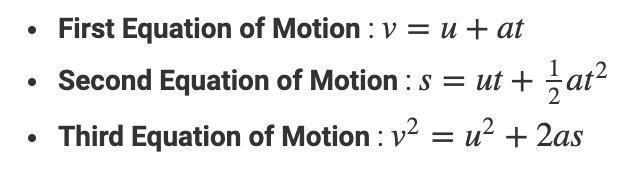
To solve this problem we will apply the concepts related to the kinematic equations of linear motion. Where speed is described as the distance traveled in a given time, and the successive equivalences that can be made under that equation.

The distance traveled by the girl with in the given time is

d_g = v_g t

The distance covered by the boy with in the given time is

d_b = v_b t

Since the boy will travels with twice the speed of the girl

d_b = v_b t

d_b = 2v_g t

d_b = 2d_g

Half way between the two rafts at the beginnings is

\frac{14m}{2} = 7m

7m = 2d_g

d_g = 3.5m

The final distance between the two rafts at the instant the boy reached the central point of the line joining between them is

\Delta d = d_b-d_g

\Delta d = 7m-3.5m

\Delta d = 10.5m

Therefore the distance that there is between the two rafts when the first one reaches the toy is 10.5m

You might be interested in
Newton's law of cooling states that the temperature of an object changes at a rate proportional to the difference between its te
QveST [7]

Answer:

Please see attachment

Explanation:

Please see attachment

8 0
2 years ago
A mover hoists a 50 kg box from the ground to a height of 2 m. What was the change in the box's energy
SSSSS [86.1K]

Answer:

980 J

Explanation:

The change in box's energy is equal to its change in gravitational potential energy:

\Delta U = m g \Delta h

where

m = 50 kg is the mass of the box

g = 9.8 m/s^2 is the acceleration due to gravity

\Delta h= 2m is the change in height of the box

Substituting numbers, we find

\Delta U = (50 kg)(9.8 m/s^2)(2 m)=980 J

3 0
2 years ago
In ideal flow, a liquid of density 850 kg/m3 moves from a horizontal tube of radius 1.00 cm into a second horizontal tube of rad
Crank

Answer:

a)   Q = π r₁ √ 2ΔP / rho [r₁² / r₂² -1] , b) Q = 3.4 10⁻² m³ / s , c)      Q = 4.8 10⁻² m³ / s

Explanation:

We can solve this fluid problem with Bernoulli's equation.

         P₁ + ½ ρ v₁² + ρ g y₁ = P₂ + ½ ρ v₂² + ρ g y₂

With the two tubes they are at the same height y₁ = y₂

        P₁-P₂ = ½ ρ (v₂² - v₁²)

The flow rate is given by

         A₁ v₁ = A₂ v₂

         v₂ = v₁ A₁ / A₂

We replace

         ΔP = ½ ρ [(v₁ A₁ / A₂)² - v₁²]

         ΔP = ½ ρ v₁² [(A₁ / A₂)² -1]

Let's clear the speed

         v₁ = √ 2ΔP /ρ[(A₁ / A₂)² -1]

The expression for the flow is

           Q = A v

           Q = A₁ v₁

           Q = A₁ √ 2ΔP / rho [(A₁ / A₂)² -1]

The areas are

            A₁ = π r₁

            A₂ = π r₂

We replace

        Q = π r₁ √ 2ΔP / rho [r₁² / r₂² -1]

Let's calculate for the different pressures

      r₁ = d₁ / 2 = 1.00 / 2

      r₁ = 0.500 10⁻² m

      r₂ = 0.250 10⁻² m

b) ΔP = 6.00 kPa = 6 10³ Pa

      Q = π 0.5 10⁻² √(2 6.00 10³ / (850 (0.5² / 0.25² -1))

       Q = 1.57 10⁻² √(12 10³/2550)

        Q = 3.4 10⁻² m³ / s

c) ΔP = 12 10³ Pa

        Q = 1.57 10⁻² √(2 12 10³ / (850 3)

         Q = 4.8 10⁻² m³ / s

5 0
2 years ago
A baseball player exerts a force of 100 N on a ball for a distance of 0.5 mas he throws it. If the ball has a mass of 0.15 kg, w
Aloiza [94]

Answer:

25.82 m/s

Explanation:

We are given;

Force exerted by baseball player; F = 100 N

Distance covered by ball; d = 0.5 m

Mass of ball; m = 0.15 kg

Now, to get the velocity at which the ball leaves his hand, we will equate the work done to the kinetic energy.

We should note that work done is a measure of the energy exerted by the baseball player.

Thus;

F × d = ½mv²

100 × 0.5 = ½ × 0.15 × v²

v² = (2 × 100 × 0.5)/0.15

v² = 666.67

v = √666.67

v = 25.82 m/s

4 0
1 year ago
If a galaxy is located 200 million light years from Earth, what can you conclude about the light from that galaxy?
natulia [17]
If a galaxy is located 200 million light years from Earth, you can conclude that t<span>he light will take 200 million years to reach Earth. </span>
8 0
2 years ago
Read 2 more answers
Other questions:
  • A carnot cycle engine operates between a low temperature reservoir at 20°c and a high temperature reservoir at 800°c. if the eng
    15·1 answer
  • Multiplying or dividing vectors by scalars results in a. vectors. b. scalars. c. vectors if multiplied or scalars if divided. d.
    14·2 answers
  • Starting with only the Balmer series light (visible light), how could we ensure that the solar panels generate a current that Ma
    14·2 answers
  • A student uses a spring scale to exert a horizontal force on a block, pulling the block over a smooth floor. the student repeats
    13·1 answer
  • Charlie is playing with his daughter Torrey in the snow. She sits on a sled and asks him to slide her across a flat, horizontal
    10·2 answers
  • A scared elephant has a mass of 7000 kg. The mouse that frightened the elephant is 0.02 kg. The distance between the elephant an
    11·1 answer
  • Which phenomena did Michael Faraday explore to help him invent the motor and the generator? A. motion and magnetism B. motion an
    15·2 answers
  • A slender rod is 80.0 cm long and has mass 0.370 kg . A small 0.0200-kg sphere is welded to one end of the rod, and a small 0.05
    5·1 answer
  • 2. A pebble is dropped down a well and hits the water 1.5 s later. Using the equations for motion with constant acceleration, de
    14·1 answer
  • A person of mass m stands on roller skates facing a wall.After pushing against the wall with a constant force F he moves away, r
    9·1 answer
Add answer
Login
Not registered? Fast signup
Signup
Login Signup
Ask question!