answer.
Ask question
Login Signup
Ask question
All categories
  • English
  • Mathematics
  • Social Studies
  • Business
  • History
  • Health
  • Geography
  • Biology
  • Physics
  • Chemistry
  • Computers and Technology
  • Arts
  • World Languages
  • Spanish
  • French
  • German
  • Advanced Placement (AP)
  • SAT
  • Medicine
  • Law
  • Engineering
Kitty [74]
2 years ago
12

A figure skater rotating at 5.00 rad/s with arms extended has a moment of inertia of 2.25 kg·m2. If the arms are pulled in so t

he moment of inertia decreases to 1.80 kg·m2
What is:
a) The final angular speed?
b) The initial and final kinetic energy?
Physics
1 answer:
Serggg [28]2 years ago
7 0

a) 6.25 rad/s

The law of conservation of angular momentum states that the angular momentum must be conserved.

The angular momentum is given by:

L=I\omega

where

I is the moment of inertia

\omega is the angular speed

Since the angular momentum must be conserved, we can write

L_1 = L_2\\I_1 \omega_1 = I_2 \omega_2

where we have

I_1 = 2.25 kg m^2 is the initial moment of inertia

\omega_1 = 5.00 rad/s is the initial angular speed

I_2 = 2.25 kg m^2 is the final moment of inertia

\omega_2 is the final angular speed

Solving for \omega_2, we find

\omega_2 = \frac{I_1 \omega_1}{I_2}=\frac{(2.25 kg m^2)(5.00 rad/s)}{1.80 kg m^2}=6.25 rad/s

b) 28.1 J and 35.2 J

The rotational kinetic energy is given by

K=\frac{1}{2}I\omega^2

where

I is the moment of inertia

\omega is the angular speed

Applying the formula, we have:

- Initial kinetic energy:

K=\frac{1}{2}(2.25 kg m^2)(5.00 rad/s)^2=28.1 J

- Final kinetic energy:

K=\frac{1}{2}(1.80 kg m^2)(6.25 rad/s)^2=35.2 J

You might be interested in
yami pours powdered cocoa mix into milk and stirs it. then she microwaves the mixture for three minutes. when she takes the cup
MrRa [10]
Convection can best be observed as she blows the warm steam air that rises.

As the warm steam rises,  she forces displaces it with cool air from her mouth. Because the warm steam is less dense it rises and because the cool air is more dense, it displaces the warm air.

This scenario is an example of convection.
 
6 0
2 years ago
Read 2 more answers
With your hand parallel to the floor and your palm upright, you lower a 3-kg book downward. If the force exerted on the book by
Stells [14]
For Newton's second law, the resultant of the forces acting on the book is equal to the product between the mass of the book and its acceleration:
\sum F = ma (1)

There are only two forces acting on the book:
- its weight, directed downward: mg
- the force exerted by the hand on the book, of 20 N, directed upward

so, equation (1) becomes
mg - F = ma
from which we can calculate the book's acceleration, a:
a= g -  \frac{F}{m}= 9.81 m/s^2 - \frac{20 N}{3 kg}=3.14 m/s^2
7 0
2 years ago
Read 2 more answers
A circular coil has a 10.0 cm radius and consists of 30.0 closely wound turns of wire. an externally produced magnetic field of
IrinaVladis [17]
Magnetic flux can be calculated by the product of the magnetic field and the area that is perpendicular to the field that it penetrates. It has units of Weber or Tesla-m^2. For the first question, when there is no current in the coil, the flux would be:

ΦB = BA
          A = πr^2
          A = π(.1 m)^2
          A = π/100 m^2   

 ΦB = 2.60x10^-3 T (π/100 m^2 ) ΦB = 8.17x10^-5 T-m^2 or Wb (This is only for one loop of the coil)

The inductance on the coil given the current flows in a certain direction can be calculated by the product of the total number of turns in the coil and the flux of one loop over the current passing through. We do as follows:

L = N (ΦB ) / I
L = 30 (8.17x10^-5 T-m^2) / 3.80 = 6.44x10^-4 mH

6 0
2 years ago
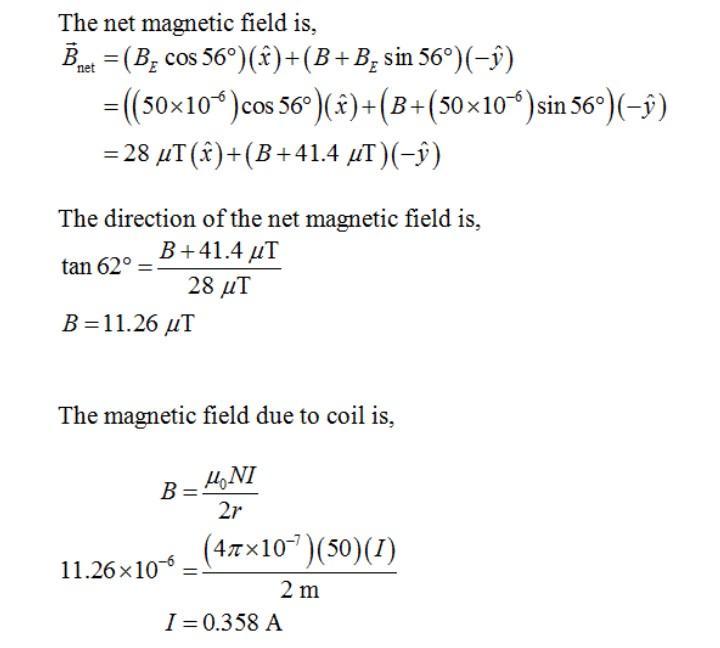
At the equator, the earth’s field is essentially horizontal; near the north pole, it is nearly vertical. In between, the angle v
Yanka [14]

Answer:

A current of 0.358A is required

Explanation:

Pls refer to attached document for more details

7 0
2 years ago
What is the mass of an object that weighs 686N on Earth?
Oxana [17]

Answer:

70 kg is the mass of the object

Explanation:

This question can be solved with this simple formula:

Weight force = mass . gravity

686 N = mass . 9.8 m/s²

686 N /  9.8 m/s² = mass → 70 kg

Note → 1N = 1 kg . m / s²

8 0
2 years ago
Other questions:
  • The drawing shows the top view of a door that is 1.68 m wide. two forces are applied to the door as indicated. what is the magni
    14·1 answer
  • a proton is moving horizontally at 7.9 x 10^5 m/s. It passes through a vertical magnetic field that points downward. In which di
    7·1 answer
  • In the winter sport of bobsledding, athletes push their sled along a horizontal ice surface and then hop on the sled as it start
    10·2 answers
  • Gibbons, small Asian apes, move by brachiation, swinging below a handhold to move forward to the next handhold. A 9.4 kg gibbon
    15·1 answer
  • A child pushes a 75 N toy car across the floor. What is the mass of the car?
    6·1 answer
  • Two blocks, 1 and 2, are connected by a rope R1 of negligible mass. A second rope R2, also of negligible mass, is tied to block
    9·1 answer
  • In the sum of 54.34 and 45.66, the number of significant figure for the<br>answer is​
    5·1 answer
  • A ball is fired at an angle of 45 degrees, the angle that yields the maximum range in the absence of air resistance. What is the
    6·2 answers
  • Consider the specific example of a positive charge qqq moving in the +x direction with the local magnetic field in the +y direct
    12·2 answers
  • At a drag race, a jet car travels 1/4 mile in 5.2 seconds. What is the final speed of the
    15·1 answer
Add answer
Login
Not registered? Fast signup
Signup
Login Signup
Ask question!