answer.
Ask question
Login Signup
Ask question
All categories
  • English
  • Mathematics
  • Social Studies
  • Business
  • History
  • Health
  • Geography
  • Biology
  • Physics
  • Chemistry
  • Computers and Technology
  • Arts
  • World Languages
  • Spanish
  • French
  • German
  • Advanced Placement (AP)
  • SAT
  • Medicine
  • Law
  • Engineering
kenny6666 [7]
2 years ago
14

If the water is initially at temperature 10.2 ∘C, how long will it take for its temperature to rise to 57.9 ∘C?

Chemistry
1 answer:
denpristay [2]2 years ago
7 0

Answer:

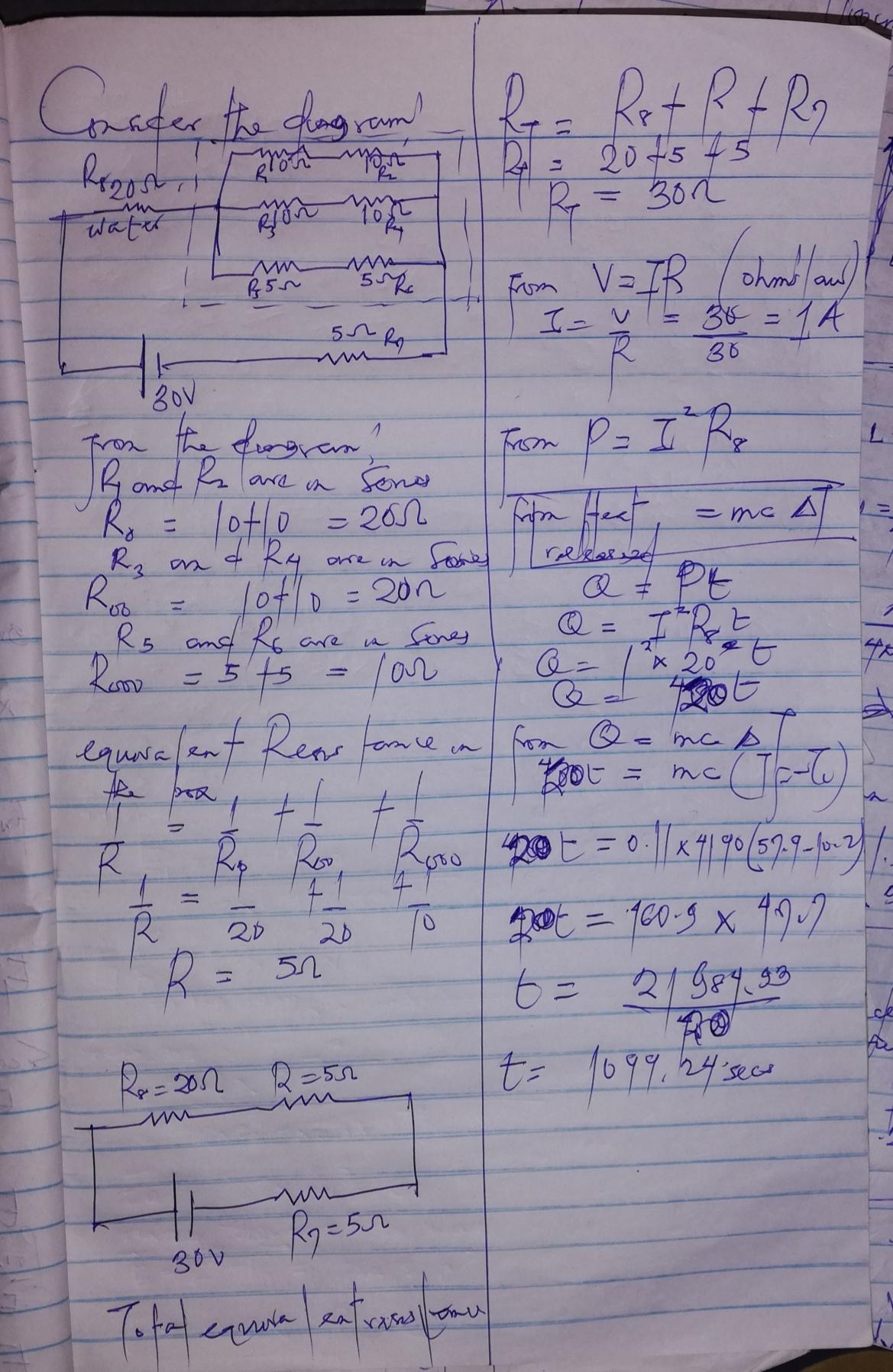
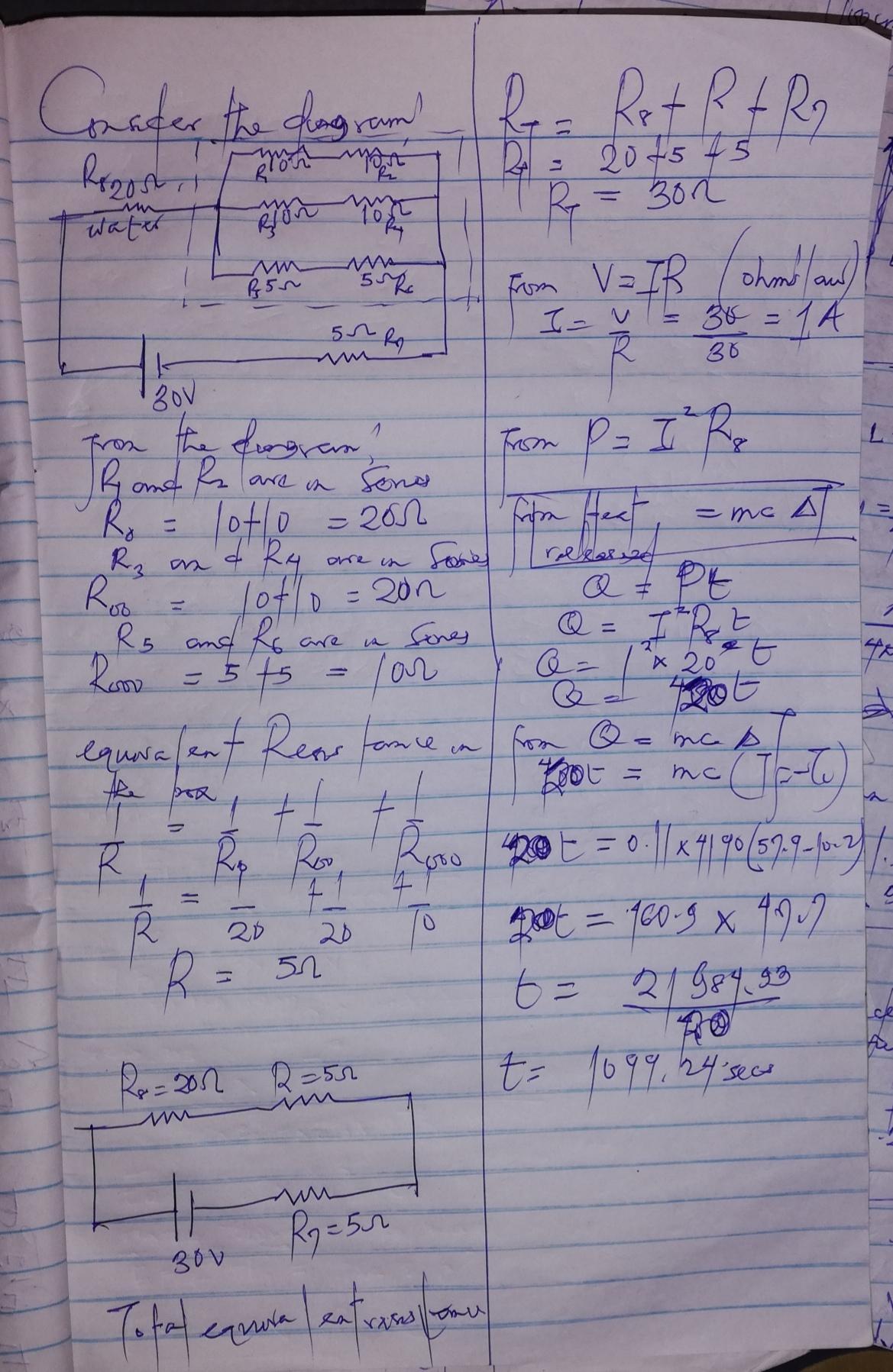
The complete part of the question is ; In the circuit in the figure, (Figure 1)a 20-ohm resistor sits inside 110 g of pure water that is surrounded by insulating Styrofoam. If the water is initially at temperature 10.2 ∘C, how long will it take for its temperature to rise to 57.9 ∘C?

Use 4190J/kg⋅C∘ as the heat capacity of water, and express your answer in seconds using three significant figures.

answer = time taken = 1099.24secs

Explanation:

Tthe detailed calculation is as shown in the attachment.

The principle applied is the resolution of resistance of circuit in series and in parralel and then finding the equivlaent resistance.

Use the ohm's law equation to find the current in the circuit.

Use the Power generated

From the specific heat capacity equation to get the time duration.

You might be interested in
ethylene glycol used in automobile antifreeze and in the production of polyester. The name glycol stems from the sweet taste of
Luden [163]

<u>Answer:</u> The empirical and molecular formula for the given organic compound is CH_3O and C_4H_{12}O_4

<u>Explanation:</u>

The chemical equation for the combustion of hydrocarbon having carbon, hydrogen and oxygen follows:

C_xH_yO_z+O_2\rightarrow CO_2+H_2O

where, 'x', 'y' and 'z' are the subscripts of Carbon, hydrogen and oxygen respectively.

We are given:

Mass of CO_2=9.06g

Mass of H_2O=5.58g

We know that:

Molar mass of carbon dioxide = 44 g/mol

Molar mass of water = 18 g/mol

  • <u>For calculating the mass of carbon:</u>

In 44g of carbon dioxide, 12 g of carbon is contained.

So, in 9.06 g of carbon dioxide, \frac{12}{44}\times 9.06=2.47g of carbon will be contained.

  • <u>For calculating the mass of hydrogen:</u>

In 18g of water, 2 g of hydrogen is contained.

So, in 5.58 g of water, \frac{2}{18}\times 5.58=0.62g of hydrogen will be contained.

  • Mass of oxygen in the compound = (6.38) - (2.47 + 0.62) = 3.29 g

To formulate the empirical formula, we need to follow some steps:

  • <u>Step 1:</u> Converting the given masses into moles.

Moles of Carbon =\frac{\text{Given mass of Carbon}}{\text{Molar mass of Carbon}}=\frac{2.47g}{12g/mole}=0.206moles

Moles of Hydrogen = \frac{\text{Given mass of Hydrogen}}{\text{Molar mass of Hydrogen}}=\frac{0.62g}{1g/mole}=0.62moles

Moles of Oxygen = \frac{\text{Given mass of oxygen}}{\text{Molar mass of oxygen}}=\frac{3.29g}{16g/mole}=0.206moles

  • <u>Step 2:</u> Calculating the mole ratio of the given elements.

For the mole ratio, we divide each value of the moles by the smallest number of moles calculated which is 0.206 moles.

For Carbon = \frac{0.206}{0.206}=1

For Hydrogen  = \frac{0.62}{0.206}=3

For Oxygen  = \frac{0.206}{0.206}=1

  • <u>Step 3:</u> Taking the mole ratio as their subscripts.

The ratio of C : H : O = 1 : 3 : 1

Hence, the empirical formula for the given compound is C_1H_{3}O_1=CH_3O

For determining the molecular formula, we need to determine the valency which is multiplied by each element to get the molecular formula.

The equation used to calculate the valency is:

n=\frac{\text{molecular mass}}{\text{empirical mass}}

We are given:

Mass of molecular formula = 124 amu = 124 g/mol

Mass of empirical formula = 31 g/mol

Putting values in above equation, we get:

n=\frac{124g/mol}{31g/mol}=4

Multiplying this valency by the subscript of every element of empirical formula, we get:

C_{(1\times 4)}H_{(3\times 4)}O_{(1\times 4)}=C_4H_{12}O_4

Thus, the empirical and molecular formula for the given organic compound is CH_3O and C_4H_{12}O_4

3 0
2 years ago
Find the enthalpy of neutralization of HCl and NaOH. 87 cm3 of 1.6 mol dm-3 hydrochloric acid was neutralized by 87 cm3 of 1.6 m
Vesna [10]

Answer : The correct option is, (A) -101.37 KJ

Explanation :

First we have to calculate the moles of HCl and NaOH.

\text{Moles of HCl}=\text{Concentration of HCl}\times \text{Volume of solution}=1.6mole/L\times 0.087L=0.1392mole

\text{Moles of NaOH}=\text{Concentration of NaOH}\times \text{Volume of solution}=1.6mole/L\times 0.087L=0.1392mole

The balanced chemical reaction will be,

HCl+NaOH\rightarrow NaCl+H_2O

From the balanced reaction we conclude that,

As, 1 mole of HCl neutralizes by 1 mole of NaOH

So, 0.1392 mole of HCl neutralizes by 0.1392 mole of NaOH

Thus, the number of neutralized moles = 0.1392 mole

Now we have to calculate the mass of water.

As we know that the density of water is 1 g/ml. So, the mass of water will be:

The volume of water = 87ml+87ml=174ml

\text{Mass of water}=\text{Density of water}\times \text{Volume of water}=1g/ml\times 174ml=174g

Now we have to calculate the heat absorbed during the reaction.

q=m\times c\times (T_{final}-T_{initial})

where,

q = heat absorbed = ?

c = specific heat of water = 4.18J/g^oC

m = mass of water = 174 g

T_{final} = final temperature of water = 317.4 K

T_{initial} = initial temperature of metal = 298 K

Now put all the given values in the above formula, we get:

q=174g\times 4.18J/g^oC\times (317.4-298)K

q=14110.008J=14.11KJ

Thus, the heat released during the neutralization = -14.11 KJ

Now we have to calculate the enthalpy of neutralization.

\Delta H=\frac{q}{n}

where,

\Delta H = enthalpy of neutralization = ?

q = heat released = -14.11 KJ

n = number of moles used in neutralization = 0.1392 mole

\Delta H=\frac{-14.11KJ}{0.1392mole}=-101.37KJ/mole

Therefore, the enthalpy of neutralization is, -101.37 KJ

3 0
2 years ago
On a separate sheet of paper, write the formulas for the missing components of these neutralization reactions.
Fofino [41]
The  formula  of  the  missing  component  are  a   follows

HBr  +  KOH  ------>  KBr  +  H2O

H2SO4  +  2NH4OH--------> (NH4)2SO4  +  2H2O

2HNO3     +  Mg(OH)2  --------->  Mg(NO3)2  +  2  H2O
4 0
2 years ago
Read 2 more answers
Which sentence is a scientific statement? A. There is a substance around us that cannot be detected. B. Kids should go to school
stellarik [79]

Answer:

Experimentation is the best way to obtain knowledge.

Explanation:

This is a statement and it is scientific

6 0
2 years ago
How much silver can be produced from 125g of Ag2S
rosijanka [135]

Answer:

108.9g of Silver can be produced from 125g of Ag2S

Explanation:

The compound Ag2S shows that two atoms of Silver Ag, combined with an atom of Sulphur S to form Ag2S. We can as well say the combination ration of Silver to Sulphur is 2:1

•Now we need to calculate the molecular weight of this compound by summing up the molar masses of each element in the compound.

•Molar mass of Silver Ag= 107.9g/mol

•Molar mass of Sulphur S= 32g/mol

•Molecular weight of Ag2S= (2×107.9g/mol) + 32g/mol

•Molecular weight of Ag2S= 215.8g/mol + 32g/mol= 247.8g/mol

•From our calculations, we know that 215.8g/mol of Ag is present in 247.8g/mol of Ag2S

If 247.8g Ag2S produced 215.8g Ag

125g Ag2S will produce xg Ag

cross multiplying we have

xg= 215.8g × 125g / 247.8g

xg= 26975g/247.8

xg= 108.85g

Therefore, 108.9g of Silver can be produced from 125g of Ag2S

3 0
2 years ago
Read 2 more answers
Other questions:
  • How many grams of o2 are required to produce 358.5 grams of zno??
    10·2 answers
  • In the reaction C + O2 → CO2, 18 g of carbon react with oxygen to produce 72 g of carbon dioxide. What mass of oxygen would be n
    15·1 answer
  • When the reaction mixture is worked-up, it is first washed three times with 5% sodium bicarbonate, and then with a saturated nac
    7·1 answer
  • Rank the compounds below from slowest to Fastest rate of hydration. 1) formaldehyde 2) 3,3-dimethyIbutan-2-one 3) propanal 4)3-m
    7·1 answer
  • A class is given a demonstration of solution chemistry and solubility equilibria.Passage: A 6.57-g sample of NiSO4•6H2O (molar m
    10·1 answer
  • The delocalized π system in benzene is formed by a cyclic overlap of 6 ________ orbitals.
    8·1 answer
  • An atom of helium has a radius = and an average speed in the gas phase at of . . Suppose the speed of a helium atom at has been
    11·1 answer
  • imagine you have four food dyes to test A, B, C and D imagine that you are going to investigate which food dye diffuses more qui
    7·1 answer
  • 1.00 g of a compound is combusted in oxygen and found to give 3.14g of CO2 and 1.29 g of H2O. From these data we can tell thatA.
    6·1 answer
  • A boy lifts a 30N dragon 2 meters above the ground. How much work did the boy do on the dragon?
    13·1 answer
Add answer
Login
Not registered? Fast signup
Signup
Login Signup
Ask question!