answer.
Ask question
Login Signup
Ask question
All categories
  • English
  • Mathematics
  • Social Studies
  • Business
  • History
  • Health
  • Geography
  • Biology
  • Physics
  • Chemistry
  • Computers and Technology
  • Arts
  • World Languages
  • Spanish
  • French
  • German
  • Advanced Placement (AP)
  • SAT
  • Medicine
  • Law
  • Engineering
oksian1 [2.3K]
2 years ago
3

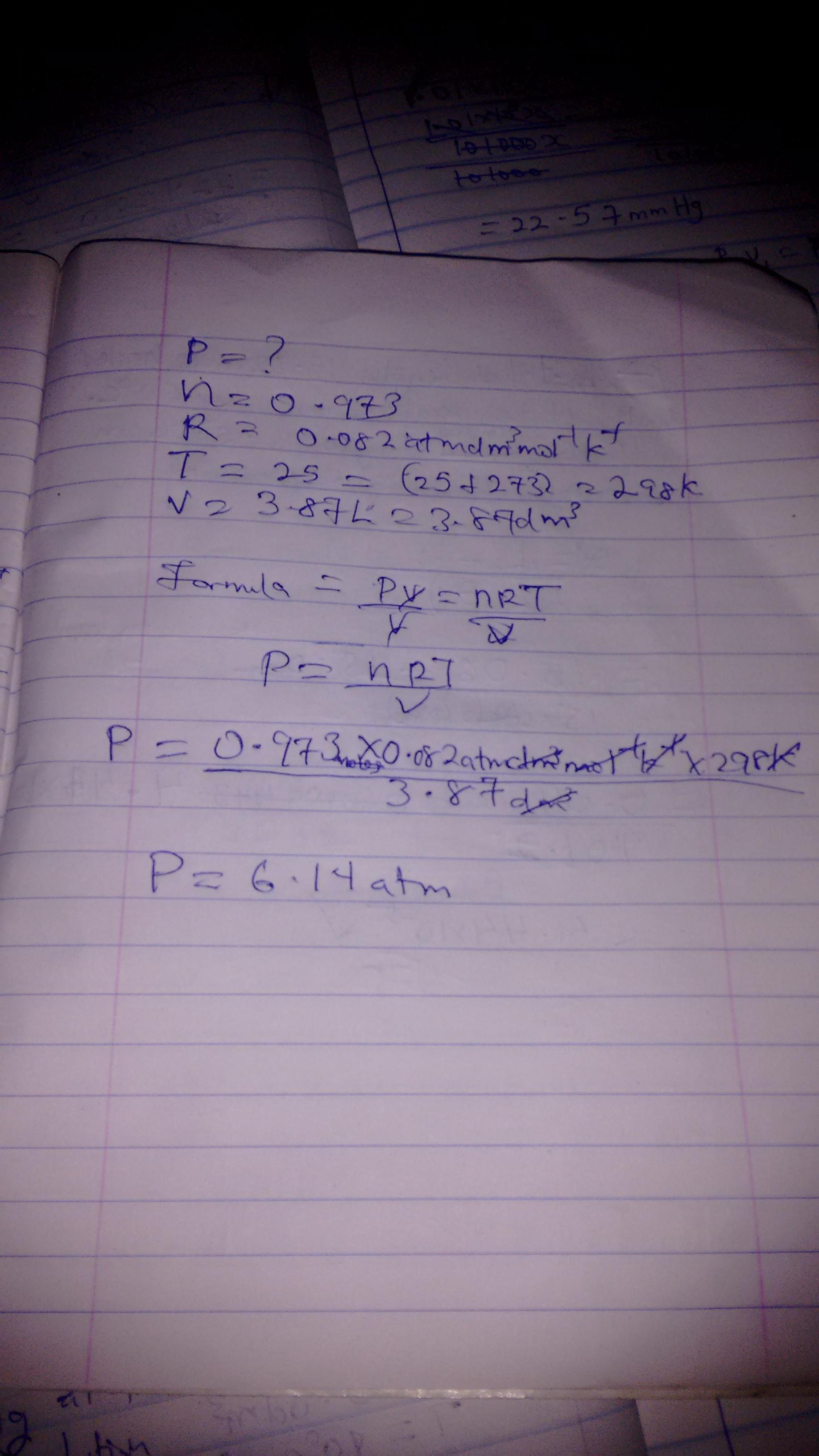
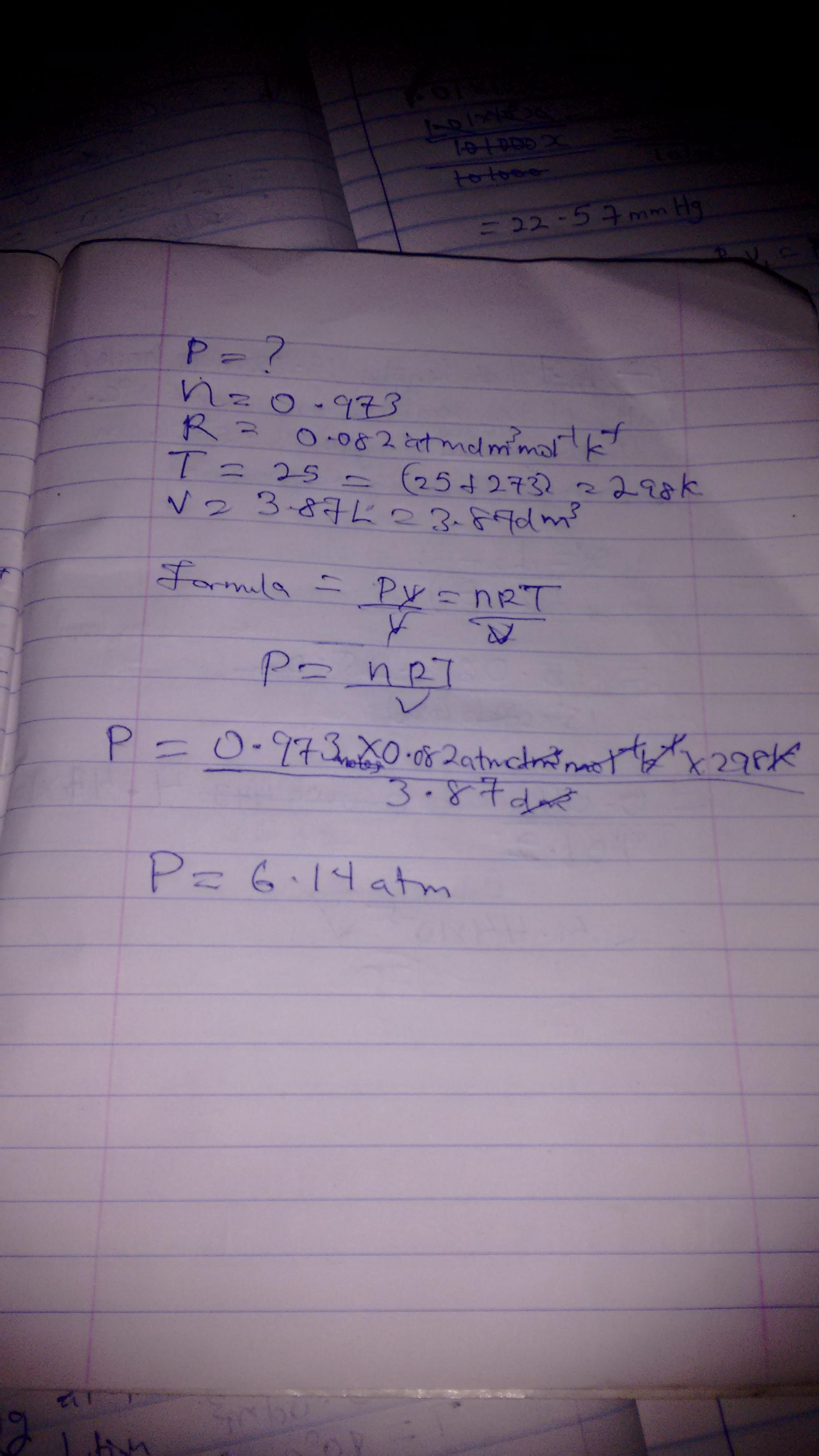
a 0.973 mole sample of helium gas at 25 degrees celsius filled a ballon to a volume of 3.87 L. what is the pressure of the ballo

n?

Chemistry
1 answer:
weeeeeb [17]2 years ago
8 0

Answer:

I have solved it . It is in the picture . I hope it helps please mark me brainliest :)

Explanation:

You might be interested in
Which milligram quantity contains a total of four significant figures
denis23 [38]
D has a total of four significant figures.
7 0
2 years ago
Read 2 more answers
How should students prepare to use chemicals in the lab? Select one or more: Sort the lab chemicals in alphabetical order for qu
maksim [4K]

Answer:

Sort the lab chemicals in alphabetical order for quick access.

Become familiar with the chemicals to be used, including exposure or spill hazards.

Locate the spill kits and understand how they are used.

Explanation:

There are many chemicals in a laboratory hence they should be sorted out and arranged in alphabetical order so that theory can easily be identified and located whenever they are required.

The properties of each chemical should be known especially hazards connected to exposure or spill of the chemicals.

The students should also familiarize themselves with the contents of spill kits and how they are used.

7 0
2 years ago
Calculate the entropy change for a process in which 3.00 moles of liquid water at 08c is mixed with 1.00 mole of water at 100.8c
kupik [55]
The question provides the data in an incorrect way, but what the question is asking is for the entropy change when combining 3 moles of water at 0 °C (273.15 K) with 1 mole of water at 100 °C (373.15 K). We are told the molar heat capacity is 75.3 J/Kmol. We will be using the following formula to calculate the entropy change of each portion of water:

ΔS = nCln(T₂/T₁)

n = number of moles
C = molar heat capacity
T₂ = final temperature
T₁ = initial temperature

We can first find the equilibrium temperature of the mixture which will be the value of T₂ in each case:

[(3 moles)(273.15 K) + (1 mole)(373.15 K)]/(4 moles) = 298.15 K

Now we can find the change in entropy for the 3 moles of water heating up to 298.15 K and the 1 mole of water cooling down to 298.15 K:

ΔS = (3 moles)(75.3 J/Kmol)ln(298.15/273.15)
ΔS = 19.8 J/K

ΔS = (1 mole)(75.3 J/Kmol)ln(298.15/373.15)
ΔS = -16.9 J/K

Now we combine the entropy change of each portion of water to get the total entropy change for the system:

ΔS = 19.8 J/K + (-16.9 J/K)
ΔS = 2.9 J/K

The entropy change for combining the two temperatures of water is 2.9 J/K.
3 0
2 years ago
Read 2 more answers
How many grams of Cr can be produced by the reaction of 44.1 g of Cr2O3 with 35.0 g of Al according to the following chemical eq
allsm [11]

Answer:

30.17 grams of Cr can be produced by the reaction of 44.1 g of Cr₂O₃ with 35.0 g of Al.

19.33 grams of the excess react will remain once the reaction goes to completion.

Explanation:

You know:

2 Al + Cr₂O₃ → Al₂O₃ + 2 Cr

By stoichiometry of the reaction (that is, the relationship between the amount of reagents and products in a chemical reaction), the following amounts of the compounds participating in the reaction react and are produced:

  • Al: 2 moles
  • Cr₂O₃: 1 mole
  • Al₂O₃: 1 mole
  • Cr: 2 moles

Being:

  • Al: 27 g/mole
  • Cr: 52 g/mole
  • O: 16 g/mole

the molar mass of the compounds participating in the reaction is:

  • Al: 27 g/mole
  • Cr₂O₃: 2*52 g/mole + 3 *16 g/mole= 152 g/mole
  • Al₂O₃: 2*27 g/mole + 3 *16 g/mole= 102 g/mole
  • Cr: 52 g/mole

Then, by stoichiometry of the reaction, the amounts of reagents and products that participate in the reaction are:

  • Al: 2 moles* 27 g/mole= 54 g
  • Cr₂O₃: 1 mole* 152 g/mole= 152 g
  • Al₂O₃: 1 mole* 102 g/mole= 102 g
  • Cr: 2moles*52 g/mole= 104 g

First, you must determine the limiting reagent. The limiting reagent is one that is consumed first in its entirety, determining the amount of product in the reaction. When the limiting reagent is finished, the chemical reaction will stop.

Then, for this you must apply the following rule of three: if 54 grams of Al react with 152 grams of Cr₂O₃ by stoichiometry of the reaction, 35 grams of Al with how much mass of Cr₂O₃ will react?

mass of Cr_{2} O_{3} =\frac{35 grams of Al*152 gramsof Cr_{2} O_{3}}{54 grams of Al}

mass of Cr₂O₃= 98.52 grams

But 98.52 grams of Cr₂O₃ are not available, 44.1 grams are available. Since you have less moles than you need to react with 35 grams of Al, the compound Cr₂O₃ will be the limiting reagent.

To determine the amount of Cr that can be produced, you use the amount of limiting reagent available and apply the following rule of three: if by stoichiometry 152 grams of Cr₂O₃ produce 104 grams of Cr, 44.1 grams of Cr₂O₃ how much mass of Cr does it produce?

mass of Cr =\frac{104 grams of Cr*44.1 grams of Cr_{2} O_{3}}{152 grams of Cr_{2} O_{3}}

mass of Cr= 30.17 grams

<u><em>30.17 grams of Cr can be produced by the reaction of 44.1 g of Cr₂O₃ with 35.0 g of Al.</em></u>

As Al is the excess reagent, you must first calculate the amount of mass that reacts with 44.1 grams of Cr₂O₃ using the following rule of three: if 152 grams of Cr₂O₃ react with 54 grams of Al, 44.1 grams of Cr₂O₃ with how much mass of Al reaction to?

mass of Al =\frac{54 grams of Al*44.1 gramsnof Cr_{2} O_{3}}{152 gramsnof Cr_{2} O_{3}l}

mass of Al=15.67 grams

With 35 grams being the amount of Al available, the amount of Al that will remain in the reaction after all the limiting reagent reacts and the reaction is complete is calculated by:

mass of excess= 35 grams - 15.67 grams= 19.33 grams

<em><u>19.33 grams of the excess react will remain once the reaction goes to completion.</u></em>

6 0
2 years ago
which factors are needed to determine the amount of heat absorbed by an aluminum cube after it is warmed? check all that apply
Deffense [45]

Answer:

Explanation:

final temperature of the cube

initial temperature of the cube

mass of the cube

specific heat of aluminum

4 0
2 years ago
Other questions:
  • When a polar molecule causes a charge redistribution in a nonpolar molecule, what are the molecules of the mixture most likely e
    7·1 answer
  • When one atom loses an electron and another atom accepts that electron a(n) bond between the two atoms results?
    14·1 answer
  • To neutralize 1.65g LiOH, how much .150 M HCl would be needed?
    6·1 answer
  • You decide to place a bottle of water into the freezer so it will stay cold all day at school. Which of the following accurately
    12·1 answer
  • Oxyacetylene torches produce such high temperature that they are often used to weld and cut metal. When 1.53 g of acetylene (C2H
    7·1 answer
  • When heating a flammable or volatile solvent for a recrystallization, which of these statements are correct? More than one answe
    6·1 answer
  • What is the main purpose of using NaOH in the saponification reaction . NaOH works as the catalyst b. NaOH solution is the solve
    14·1 answer
  • Determine whether the statement is true or false, and why? “Climate change could cause many habitats to be destroyed, leading to
    7·1 answer
  • Will is learning about a new kind of plastic used to make models. He learns that infrared light is absorbed by the plastic, X-ra
    7·2 answers
  • Consider the energy diagram below.
    12·2 answers
Add answer
Login
Not registered? Fast signup
Signup
Login Signup
Ask question!