answer.
Ask question
Login Signup
Ask question
All categories
  • English
  • Mathematics
  • Social Studies
  • Business
  • History
  • Health
  • Geography
  • Biology
  • Physics
  • Chemistry
  • Computers and Technology
  • Arts
  • World Languages
  • Spanish
  • French
  • German
  • Advanced Placement (AP)
  • SAT
  • Medicine
  • Law
  • Engineering
anyanavicka [17]
2 years ago
13

The structures of TeF4 and TeCl4 in the gas phase have been studied by electron diffraction.

Chemistry
1 answer:
elena-14-01-66 [18.8K]2 years ago
5 0

Answer:

a)

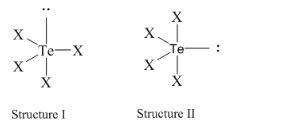
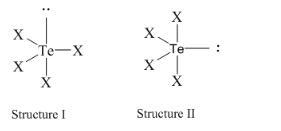
From VSPER theory, the compound TeF₄ and TeCl₄ AX₄E type of models. Hence, the molecular geometry of this molecule is trigonal bipyramidal. The plausible structure of this molecule are shown on the first uploaded image

Looking at the image we see that  structure 1 has three lone pairs repulsion with 90° angle. From  VSPER theory, the repulsive force between the electron  pair is given as

lone pair - lone pair > lone pair - bond pair > bond pair - bond pair

The above shows that bond pair -bond pair has less repulsion than lone pair- bond pair, and next is lone pair - lone pair

This means that structure 2 is more stable structure for TeF₄ or TeCl₄ .,because the lone pair is present at equatorial position.

This stable structure is shown on the second uploaded image

A lone pair of electron occupy more space around the central atom than a bond pair electron that are present at axial positions, the two atoms that are present at axial position are tilt away from the lone pair

       We can see the structure on the third uploaded image

Due to the repulsive interaction , the bond distance between Te - X(axial) increases, which means that the Te - X(axial) distance is longer than  Te - X(equitorial)  distance.

b)

It is a general concept that TeX₄ ha a bond angle of 90° for axial position and  120° in between equitorial position. This is shown on the fourth uploaded image

Considering TeF₄ and TeCl₄ , F is more electro-negative element  Than Cl.This mean that the fluorine would pull strongly the  shared electron away from the Te which reduces the electron density near the central Te atom.This would result in decrease bond angle be TeCl₄

So , F(axial) - Te - F(axial) has smaller bond angle than Cl(axial) - Te - Cl(axial)

Considering the equitorial position we see that because of the highly electro - negative fluorine atom, the bond angle decrease much in  TeF₄ than in  TeCl₄

      This means that  F(equitorial) - Te - F(equitorial)  has smaller bond angle than Cl(equitorial) - Te - Cl(equitorial)
You might be interested in
The specific heat of water is 4.18 J/g•°C. How much heat does 225.0 g of water release when it cools from 85.5°C to 50.0°C? Ente
Sergio [31]
The answer is 33400J
4 0
2 years ago
Read 2 more answers
Calculate the freezing point of a 0.08500 m aqueous solution of nano3. the molal freezing-point-depression constant of water is
Citrus2011 [14]
Depression in freezing point (ΔT_{f}) = K_{f}×m×i,
where, K_{f} = cryoscopic constant = 1.86^{0} C/m,
m= molality of solution = 0.0085 m
i = van't Hoff factor = 2 (For NaNO_{3})

Thus, (ΔT_{f}) = 1.86 X 0.0085 X 2 = 0.03162^{0}C

Now, (ΔT_{f}) = T^{0} - T
Here, T = freezing point of solution
T^{0} = freezing point of solvent = 0^{0}C
Thus, T = T^{0} - (ΔT_{f}) = -0.03162^{0}C
8 0
2 years ago
Read 2 more answers
How does the arrangement of atoms in a mineral relate to its properties?
MakcuM [25]
The arrangement of atoms in a mineral can change its physical and chemical properties. 
Diamonds and coal are both made of carbon, however, their chemical and physical properties are very different. 

6 0
2 years ago
Read 2 more answers
A 20.0 -\,L volume of an ideal gas in a cylinder with a piston is at a pressure of 3.2 atm. Enough weight is suddenly removed fr
zzz [600]

Answer:

1. ΔE = 0 J

2. ΔH = 0 J

3. q = 3.2 × 10³ J

4. w = -3.2 × 10³ J

Explanation:

The change in the internal energy (ΔE) and the change in the enthalpy (ΔH) are functions of the temperature. If the temperature is constant, ΔE = 0 and ΔH = 0.

The gas initially occupies a volume V₁ = 20.0 L at P₁ = 3.2 atm. When the pressure changes to P₂ = 1.6 atm, we can find the volume V₂ using Boyle's law.

P₁ × V₁ = P₂ × V₂

3.2 atm × 20.0 L = 1.6 atm × V₂

V₂ = 40 L

The work (w) can be calculated using the following expression.

w = - P . ΔV

where,

P is the external pressure for which the process happened

ΔV is the change in the volume

w = -1.6 atm × (40L - 20.0L) = -32 atm.L × (101.325 J/1atm.L) = -3.2 × 10³ J

The change in the internal energy is:

ΔE = q + w

0 = q + w

q = - w = 3.2 × 10³ J

6 0
2 years ago
a compound contain 8.57g of carbon and 1.43g of hydrogen. The relative formula mass is 70 calculate the empirical formula of the
yanalaym [24]

Answer:

Empirical formula: CH2

Molecular formula: C5H10

5 0
1 year ago
Other questions:
  • How does the written lewis structure for potassium chloride differ from that of hydrogen chloride?
    9·1 answer
  • Caculate the mass of oxygen needed to burn 175.0grams of octane
    5·1 answer
  • Write a balanced half-reaction describing the reduction of aqueous chromium(IV) cations to solid chromium.
    13·1 answer
  • What is the mass of nickel(ii) nitrate (182.71 g/mol) dissolved in 25.0 ml of 0.100 m ni(no3)2 solution?
    13·2 answers
  • In the example above, imagine that the sunlight, solar cell, and fan form a closed system and no heat is generated. In this situ
    15·2 answers
  • A 37.2-g sample of lead (Pb) pellets at 20°C is mixed with a 62.7-g sample of lead pellets at the same temperature. What are th
    10·1 answer
  • A gas of potassium chlorate molecules KClO3 all decompose into potassium chloride, KCl, and diatomic oxygen, O2. The products an
    9·1 answer
  • Choose the substance with the lowest surface tension. Choose the substance with the lowest surface tension. a) H2O b) (CH3)2CO c
    14·1 answer
  • If Co(NH3)63+ has a λmax at 440 nm, calculate ΔE for the complex. A) 2.72 x 10⁻⁴ kJ/mol B) 4.52 x 10⁻² kJ/mol C) 2.72 x 10 2 kJ/
    5·1 answer
  • The molar mass of an imaginary molecule is is 93.89 g/mol. Determine its density at STP.
    14·1 answer
Add answer
Login
Not registered? Fast signup
Signup
Login Signup
Ask question!