a) The average acceleration is 
b) Instantaneous acceleration: 0 at t = 0,  at t = 5.00 s
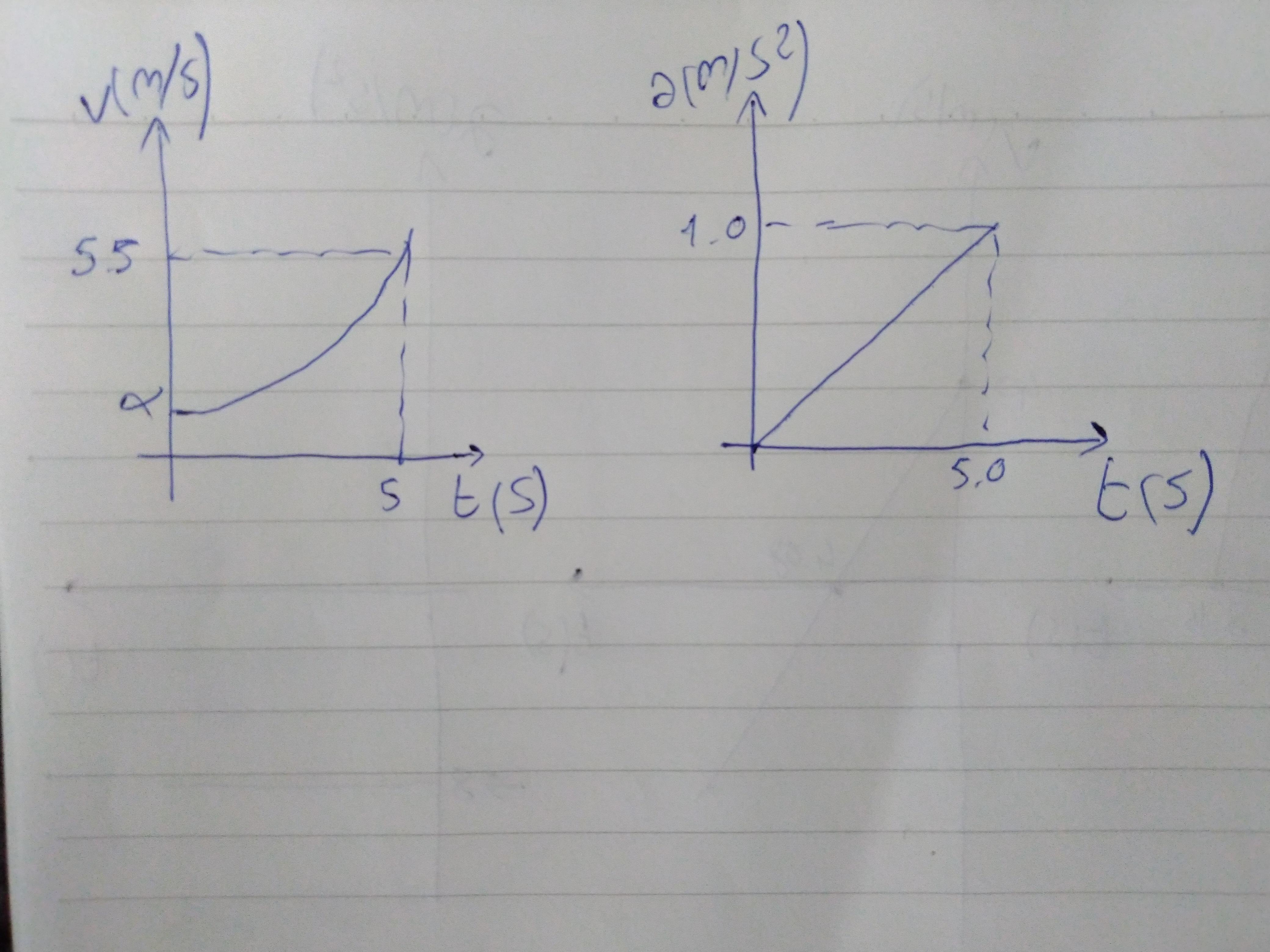
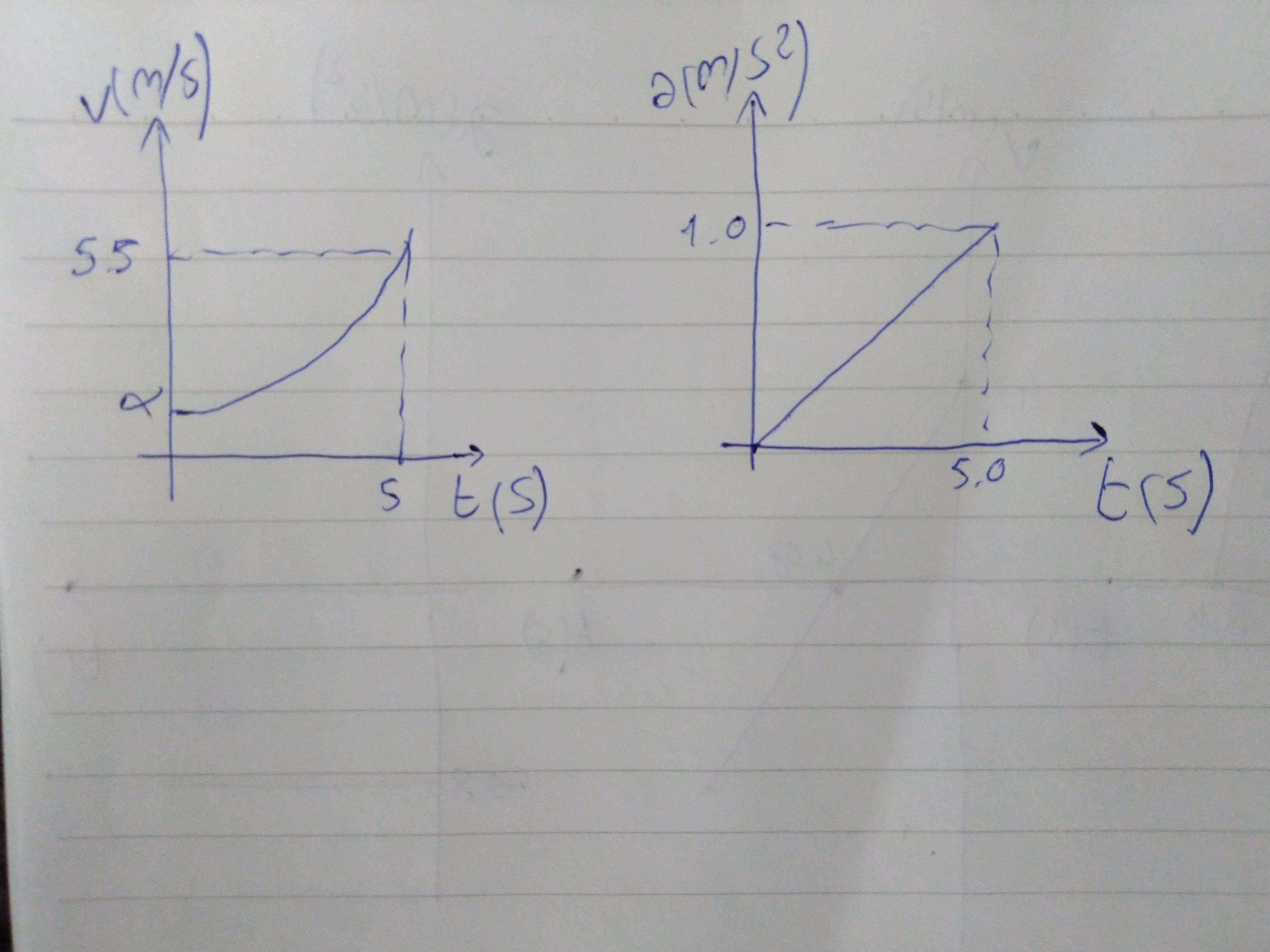
c) Find the two graphs in attachment
Explanation:
a)
The car velocity as a function of time is given by

where

In order to calculate the average acceleration, we have to calculate the velocity at t = 0 and at t = 5.00 s, then calculate the change in velocity, and then divide by the time interval.
The velocity at t = 0 is:

The velocity at t = 5.00 s is:

So the change in velocity is

And since the time interval is 5.00 s, the average acceleration is

b)
In order to find the instantaneous acceleration, we have to calculate the derivative of the velocity function.
Differentiating the velocity, we get:

Therefore, the instantaneous acceleration at t = 0 is

While the instantaneous acceleration at t = 5.00 s is

c)
Find in attachment the velocity-time and acceleration-time graph. We observe that:
- For the velocity-time graph, the curve is a parabola, since the velocity is proportional to  . The initial velocity at t = 0 is
  , then it increases up to v = 5.50 m/s when t = 5.00 s
- For the acceleration-time graph, we observe that the curve is a straight line passing through the origin, because  , so the acceleration is directly proportional to t. It starts from zero when t = 0 and it becomes equal to
  when t = 5.00 s.
Learn more about accelerated motion:
brainly.com/question/9527152
brainly.com/question/11181826
brainly.com/question/2506873
brainly.com/question/2562700
#LearnwithBrainly