answer.
Ask question
Login Signup
Ask question
All categories
  • English
  • Mathematics
  • Social Studies
  • Business
  • History
  • Health
  • Geography
  • Biology
  • Physics
  • Chemistry
  • Computers and Technology
  • Arts
  • World Languages
  • Spanish
  • French
  • German
  • Advanced Placement (AP)
  • SAT
  • Medicine
  • Law
  • Engineering
vitfil [10]
2 years ago
3

Question 7 of an unknown protein are dissolved in enough solvent to make of solution. The osmotic pressure of this solution is m

easured to be at . Calculate the molar mass of the protein. Round your answer to significant digits.
Chemistry
1 answer:
Angelina_Jolie [31]2 years ago
7 0

The question is incomplete, here is the complete question:

371. mg of an unknown protein are dissolved in enough solvent to make 5.00 mL of solution. The osmotic pressure of this solution is measured to be 0.118 atm at 25°C. Calculate the molar mass of the protein. Round your answer to 3 significant digits.

<u>Answer:</u> The molar mass of the unknown protein is 1.54\times 10^3g/mol

<u>Explanation:</u>

To calculate the concentration of solute, we use the equation for osmotic pressure, which is:

\pi=iMRT

or,

\pi=i\times \frac{\text{Mass of solute}\times 1000}{\text{Molar mass of solute}\times \text{Volume of solution (in mL)}}\times RT

where,

\pi = osmotic pressure of the solution = 0.118 atm

i = Van't hoff factor = 1 (for non-electrolytes)

Mass of protein = 371. mg = 0.371 g   (Conversion factor:  1 g = 1000 mg)

Molar mass of protein = ?

Volume of solution = 5.00 mL

R = Gas constant = 0.0821\text{ L atm }mol^{-1}K^{-1}

T = temperature of the solution = 25^oC=[25+273]K=298K

Putting values in above equation, we get:

0.118atm=1\times \frac{0.371\times 1000}{\text{Molar mass of protein}\times 5}\times 0.0821\text{ L. atm }mol^{-1}K^{-1}\times 298K\\\\\pi=\frac{1\times 0.371\times 1000\times 0.0821\times 298}{0.118\times 5}=1538.4g/mol=1.54\times 10^3g/mol

Hence, the molar mass of the unknown protein is 1.54\times 10^3g/mol

You might be interested in
what is the new pressure acting on a 2.5 l balloon if its original volume was 5.8 l at 3.7 ATM of pressure
Ivan

Answer : The new pressure acting on a 2.5 L balloon is, 8.6 atm.

Explanation :

Boyle's Law : It is defined as the pressure of the gas is inversely proportional to the volume of the gas at constant temperature and number of moles.

P\propto \frac{1}{V}

or,

P_1V_1=P_2V_2

where,

P_1 = initial pressure = 3.7 atm

P_2 = final pressure = ?

V_1 = initial volume = 5.8 L

V_2 = final volume = 2.5 L

Now put all the given values in the above equation, we get:

3.7atm\times 5.8L=P_2\times 2.5L

P_2=8.6atm

Thus, the new pressure acting on a 2.5 L balloon is, 8.6 atm.

8 0
2 years ago
What kind of decoration did artists use on Tutankhamen's throne?
Temka [501]

If there are options, they are b, c, and d. I've done this question in class before :)

5 0
2 years ago
Read 2 more answers
Are The Reactions Of Ordinary Molecular Hydrogen Slow Or Rapid ? Why ?
olchik [2.2K]
In nature reactions of ordinary molecular hydrogen are slow since it's  a diatomic molecule whose atoms are held together by very strong covalent bonds.The reaction rate of hydrogen varies depending on temperature and the properties of the reactants, for instance under high temperatures above 500°C hydrogen reacts vigorously and with fluorine it reacts explosively even under low temperatures
4 0
2 years ago
A solution is made by dissolving 58.125 g of sample of an unknown, nonelectrolyte compound in water. The mass of the solution is
e-lub [12.9K]

Answer:

molecular weight (Mb) = 0.42 g/mol

Explanation:

mass sample (solute) (wb) = 58.125 g

mass sln = 750.0 g = mass solute + mass solvent

∴ solute (b) unknown nonelectrolyte compound

∴ solvent (a): water

⇒ mb = mol solute/Kg solvent (nb/wa)

boiling point:

  • ΔT = K*mb = 100.220°C ≅ 373.22 K

∴ K water = 1.86 K.Kg/mol

⇒ Mb = ? (molecular weight) (wb/nb)

⇒ mb = ΔT / K

⇒ mb = (373.22 K) / (1.86 K.Kg/mol)

⇒ mb = 200.656 mol/Kg

∴ mass solvent = 750.0 g - 58.125 g = 691.875 g = 0.692 Kg

moles solute:

⇒ nb = (200.656 mol/Kg)*(0.692 Kg) = 138.83 mol solute

molecular weight:

⇒ Mb = (58.125 g)/(138.83 mol) = 0.42 g/mol

8 0
2 years ago
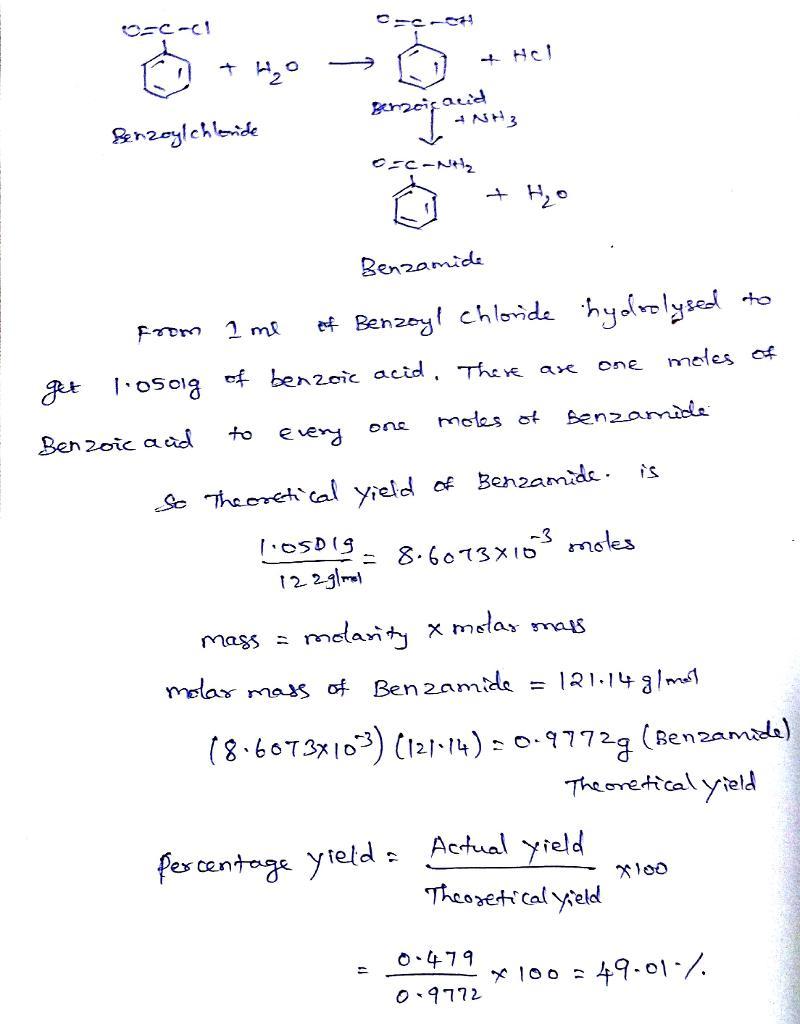
Consider the ammonolysis of benzoyl chloride by adding concentrated ammonium hydroxide to form the final product, benzamide. Rea
gizmo_the_mogwai [7]

Answer:

Explanation: see attachment below

4 0
2 years ago
Other questions:
  • if the solubility of a gas is 7.5 g/L at 404 pressure, what is the solubility of the gas when the pressure is 202 kPa?
    9·2 answers
  • Tanks of compressed gas must be kept away from heat sources. If a compressed–gas tank is heated too much, it may explode and cau
    7·2 answers
  • An air bubble with a volume of 5.0 mL is released at the bottom of a lake where the pressure is 3.0 atm. When it reaches the sur
    15·2 answers
  • The [H3O+] in a solution is increased to twice the original concentration. Which change could occur in the pH? 2.0 to 4.0 1.7 to
    14·2 answers
  • Does it take more, less, or the same amount of heat to melt 1.0 kg of ice at 0°C, or to bring 1.0 kg of liquid water at 0°C to t
    13·1 answer
  • Ethylene (C2H4) is the starting material for the preparation of polyethylene. Although typically made during the processing of p
    11·1 answer
  • A sample of an ideal gas occupies 2.78 x 10^3 mL at 25°C and 760 mm Hg.
    14·2 answers
  • Help me pls someone plss???help me pls someone plss???
    11·1 answer
  • 9 The Haber process is a reversible reaction. N2(g) + 3H2(g) 2NH3(g) The reaction has a 30% yield of ammonia. Which volume of am
    12·1 answer
  • A sample of baking soda contains 34.48 g of sodium, 1.51 g of hydrogen, 18.02 g of carbon, and 72.00 g of oxygen.
    6·1 answer
Add answer
Login
Not registered? Fast signup
Signup
Login Signup
Ask question!