answer.
Ask question
Login Signup
Ask question
All categories
  • English
  • Mathematics
  • Social Studies
  • Business
  • History
  • Health
  • Geography
  • Biology
  • Physics
  • Chemistry
  • Computers and Technology
  • Arts
  • World Languages
  • Spanish
  • French
  • German
  • Advanced Placement (AP)
  • SAT
  • Medicine
  • Law
  • Engineering
Effectus [21]
2 years ago
4

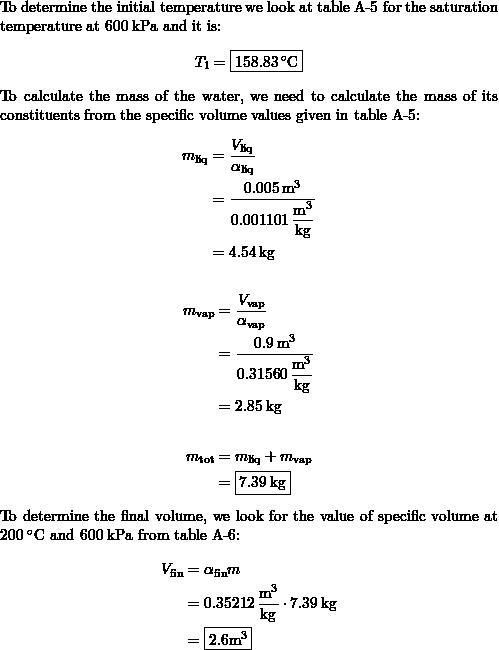
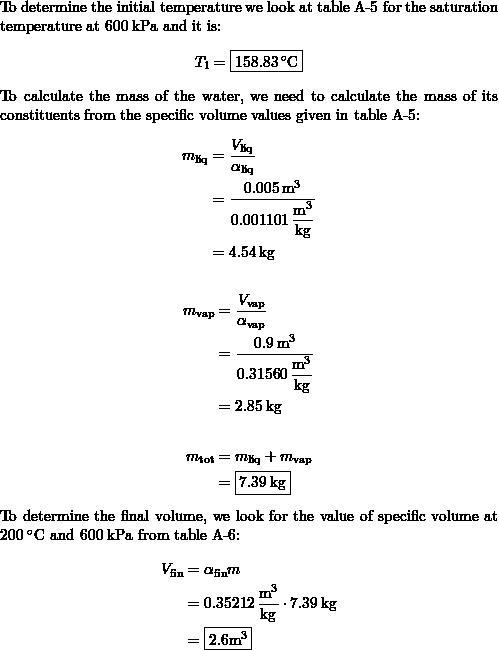
A piston-cylinder device contains 0.005 m3 of liquid water and 0.9 m3 of water vapor in equilibrium at 600 kPa. Heat is transfer

red at constant pressure until the temperature reaches 200°C. Determine (a) the initial temperature of the water; (b) the total mass of the water; (c) the final volume; and (d) show the process on a P-? diagram with respect to saturation lines.

Physics
1 answer:
olga55 [171]2 years ago
5 0

Answer:

a) 158.83 Degree Celcius

b) 7.39 Kg

c) 2.6 cubic metre

Explanation:

You might be interested in
you want to compare brands of paper towels to see which holds the most liquid. the independent variable in your experiment would
Kazeer [188]

Answer: the brand of paper towel

Explanation: the independent variable is the one you control in an experiment. the dependent variable would be the amount of water in the paper towel

5 0
2 years ago
A diver shines light up to the surface of a flat glass-bottomed boat at an angle of 30° relative to the normal. If the index of
son4ous [18]

Answer:

<h2>35</h2>

Explanation:

According to snell's law which states that the ratio of the sin of incidence (i) to the angle of refraction(n) is a constant for a given pair of media.

sini/sinr = n

n is the constant = refractive index

Since the diver shines light up to the surface of a flat glass-bottomed boat, the refractive index n = nw/ng

nw is the refractive index of water and ng is that of glass

sini/sinr = nw/ng

given i = 30°, nw = 1.33, ng = 1.5, r = angle the light leave the glass

On substitution;

sin 30/sinr = 1.33/1.5

1.5sin30 = 1.33sinr

sinr = 1.5sin30/1.33

sinr = 0.75/1.33

sinr = 0.5639

r = arcsin0.5639

r ≈35°

angle the light leave the glass is 35°

7 0
2 years ago
A 0.900 kg ornament is hanging by a 1.50 m wire when the ornament is suddenly hit by a 0.400 kg missile traveling horizontally a
just olya [345]

Explanation:

The given data is as follows.

  Mass of the ornament (m_{1}) = 0.9 kg

  Length of the wire (l) = 1.5 m

 Mass of missile (m_{2}) = 0.4 kg

 Initial speed of missile (u_{2}) = 12 m/s

         r = 1.5 m

According to the law of conservation of momentum,

                   p_{i} = p_{f}  

     m_{1}u_{1} + m_{2}u_{2} = (m_{1} + m_{2})v

Putting the given values into the above formula as follows.

          m_{1}u_{1} + m_{2}u_{2} = (m_{1} + m_{2})v

         0.9 \times 0 + 0.4 \times 12 = (0.9 + 0.4)v

              0 + 4.8 = 1.3v

                  v = 3.69 m/s

Now, the centrifugal force produced is calculated as follows.

            F_{c} = (m_{1} + m_{2}) \times \frac{v^{2}}{r}

                       = (0.9 + 0.4) \times \frac{(3.69)^{2}}{1.5}

                       = 11.80 N

Hence, tension in the wire is calculated as follows.

              T = F_{c} + (m_{1} + m_{2})g

                 = 11.80 N + (0.9 + 0.4) \times 9.8

                 = 24.54 N

Thus, we can conclude that tension in the wire immediately after the collision is 24.54 N.

4 0
2 years ago
What mass of ice (in g) can be melted if 27.2 kJ of thermal energy are added at the freezing point? Use molar mass = 18.02 g/mol
san4es73 [151]

Answer : The mass of ice melted can be, 3.98 grams.

Explanation :

First we have to calculate the moles of ice.

Q=\frac{\Delta H}{n}

where,

Q = energy absorbed = 27.2 kJ

\Delta H = enthalpy of fusion of ice = 6.01 kJ/mol

n = moles = ?

Now put all the given values in the above expression, we get:

27.2kJ=\frac{6.01kJ/mol}{n}

n=0.221mol

Now we have to calculate the mass of ice.

\text{Mass of ice}=\text{Moles of ice}\times \text{Molar mass of ice}

Molar mass of ice = 18.02 g/mol

\text{Mass of ice}=0.221mol\times 18.02g/mol=3.98g

Thus, the mass of ice melted can be, 3.98 grams.

3 0
2 years ago
A 5.0-kilogram box is sliding across a level floor. The box is acted upon by a force of 27 newtons east and a frictional force o
marshall27 [118]

Answer:

The magnitude of the acceleration of the box is 2 m/s².

Explanation:

Given:

Mass of the box, m=5.0 kg

Force acting towards east, F=27 N

Frictional force acting towards west, f=17 N

Let the acceleration be a m/s².

Now, net force acting on the box towards east is given as:

F_{net}=F-f=27-17=10\textrm{ N}

From Newton's second law of motion,

F_{net}=ma\\10=5.0\times a\\a=\frac{10}{5.0}=2\textrm{ }m/s^2

Therefore, the magnitude of the acceleration of the box is 2 m/s².
6 0
2 years ago
Read 2 more answers
Other questions:
  • Two movers use a rope system to lift a box to a third-story apartment. they do 1,200 j of work on the rope system, and the rope
    8·2 answers
  • A 3kW oven supplied with 9mJ of energy.How many minutes can it run for?
    12·2 answers
  • A 25cm×25cm horizontal metal electrode is uniformly charged to +50 nC . What is the electric field strength 2.0 mm above the cen
    6·1 answer
  • A proposed space elevator would consist of a cable stretching from the earth's surface to a satellite, orbiting far in space, th
    6·1 answer
  • Derive an expression for the total mechanical energy of the system as the monkey reaches the top of the motion, Etop, in terms o
    9·1 answer
  • A metal, M, forms an oxide having the formula M2O3 containing 52.92% metal by mass. Determine the atomic weight in g/mole of the
    8·1 answer
  • An amusement park ride consists of a car moving in a vertical circle on the end of a rigid boom of negligible mass. The combined
    8·1 answer
  • You live on a planet far from ours. "Based on extensive communication with a physicist on earth", you have determined that all l
    6·1 answer
  • In a circus act, an acrobat rebounds upward from the surface of a trampoline at the exact moment that another acrobat, perched 9
    12·1 answer
  • Evaporation of sweat requires energy and thus take excess heat away from the body. Some of the water that you drink may eventual
    8·1 answer
Add answer
Login
Not registered? Fast signup
Signup
Login Signup
Ask question!