answer.
Ask question
Login Signup
Ask question
All categories
  • English
  • Mathematics
  • Social Studies
  • Business
  • History
  • Health
  • Geography
  • Biology
  • Physics
  • Chemistry
  • Computers and Technology
  • Arts
  • World Languages
  • Spanish
  • French
  • German
  • Advanced Placement (AP)
  • SAT
  • Medicine
  • Law
  • Engineering
FromTheMoon [43]
2 years ago
8

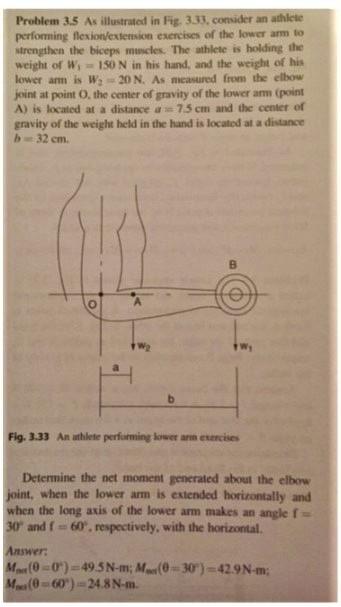
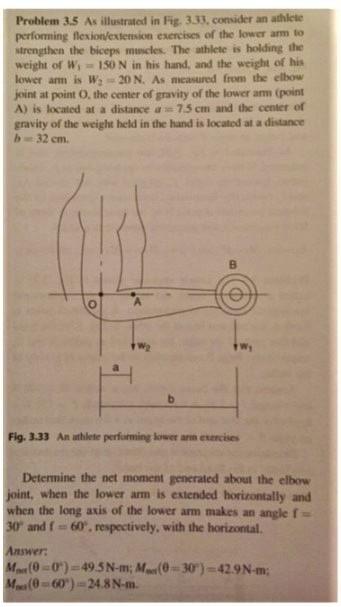
As illustrated in Fig. 3.33, consider an athlete performing flexion/extension exercises of the lower arm to strengthen the bicep

s muscles. The athlete is holding the weight of W1 ¼ 150 N in his hand, and the weight of his lower arm is W2 ¼ 20 N. As measured from the elbow joint at point O, the center of gravity of the lower arm (point A) is located at a distance a ¼ 7:5 cm and the center of gravity of the weight held in the hand is located at a distance b ¼ 32

Physics
1 answer:
yarga [219]2 years ago
6 0
<h3>Missing Question Data:</h3>

Some part of the question along with a related diagram was missing. I have attached it here for convenience.

<h3></h3><h3>Data:</h3><h3></h3>

W_{1}\;=\;150\;N\\\\W_{2}\;=\;20\;N\\\\a\;=\;7.5\;cm\;=\;0.075\;m\\\\b\;=\;32\;cm\;=\;0.32\;m\\\\\theta_{1}\;=\;0^{o}\\\\\theta_{2}\;=\;30^{o}\\\\\theta_{3}\;=\;60^{o}\\\\

<h3></h3><h3>Answer with Explanation:</h3>

To find the net Momentum, we can use the following formula,

M_{NET}\;=\;\sum M\;\;\;\;\;\;\;\;\;\;\;\;\;\;\;\;\;\;\;\; (Taking\;clock-wise\;direction\;as\;positive)

M_{NET}\;(\theta_{1}\;=\;0^{o})\;=\;W_{1}\;*\;b\;+\;W_{2}\;*a\\\\M_{NET}\;(\theta_{1}\;=\;0^{o})\;\;=\;150\;*\;0.32\;+\;20\;*0.075\\\\M_{NET}\;(\theta_{1}\;=\;0^{o})\;\;=\;49.5\;N-m

The value of net Momentum at any angle \theta can be obtain by the formula,

M_{NET}\;(\theta)\;=M_{NET}\;(0^{o})\;cos(\theta)\\\\\therefore\;M_{NET}\;(\theta_{2}\;=\;30^{o})\;=M_{NET}\;(0^{o})\;cos(\theta_{2})\\\\M_{NET}\;(\theta_{2}\;=\;30^{o})\;=\;49.5\;*\;cos(30^{o})\\\\\M_{NET}\;(\theta_{2}\;=\;30^{o})\;=\;42.9\;N-m

Similarly,

M_{NET}\;(\theta)\;=M_{NET}\;(0^{o})\;cos(\theta)\\\\\therefore\;M_{NET}\;(\theta_{3}\;=\;60^{o})\;=M_{NET}\;(0^{o})\;cos(\theta_{3})\\\\M_{NET}\;(\theta_{3}\;=\;60^{o})\;=\;49.5\;*\;cos(60^{o})\\\\\M_{NET}\;(\theta_{3}\;=\;60^{o})\;=\;24.8\;N-m

You might be interested in
A 0.2-kg steel ball is dropped straight down onto a hard, horizontal floor and bounces straight up. The ball's speed just before
nadya68 [22]

Answer:

Explanation:

Given

mass of steel ball m=0.2\ kg

initial speed of ball u=10\ m/s

Final speed of ball v=-10\ m/s (in upward direction)

Impulse imparted is given by change in the momentum of object

therefore impulse J is given by

J=\Delta P

\Delta P=m(v-u)

\Delta P=0.2(-10-10)

\Delta =-4\ N-s

so magnitude of Impulse =4 N-s

7 0
2 years ago
Read 2 more answers
A displacement vector points in a direction of θ = 23° left of the positive y-axis. The magnitude of this vector is D = 155 m. R
Lady bird [3.3K]

Answer:

Dₓ = -155 sin 23° i + 0 j

Explanation:

The diagram showing the vector has been attached to this response.

As shown in the diagram,

The vector D has an x-component (also called horizontal component) of -D sinθ i. i.e

Dₓ = -D sin θ i   [The negative sign shows that D lies in the negative x direction]

Where;

D = magnitude of D = 155m

θ = direction of D = 23°

Therefore;

Dₓ = -155 sin 23° i

Since Dₓ represents the x component, its unit vector, j component has a value of 0.

Therefore, Dₓ can be written in terms of D, θ and the unit vectors i and j as follows;

Dₓ = -155 sin 23° i + 0 j

3 0
2 years ago
Suppose you were hanging in empty space at rest, far from the Earth, but at the same distance from the Sun as the Earth. What mi
schepotkina [342]

Answer:

V = 42187 m/s = 42.18 km/s

Explanation:

given data:

mass of sun is  = 2\times 10^{30} kg

radius of earth orbit is 1.5\times 10^{11} m

minimum speed can be determined by using following formula

V = (\frac{2gM}{r}))^{1/2}

where G is \times 10^{-11}

Plugging all value to get desired value

V  =(\frac{2\times 6.674 \times 10^{-11}2\times 10^{30}}{1.5\times 10^{11}})^{1/2}

V = 42187 m/s = 42.18 km/s

4 0
2 years ago
Read 2 more answers
An astronaut hits a golf ball of mass m on the Moon, where there is no atmosphere and the acceleration due to gravity is g 6 , w
sasho [114]

Answer:

The magnitude of the average force exerted by the club on the ball during contact = mv/t

Explanation:

Impulse exerted on the ball = Momentum of the ball = mass * velocity = m*v

As we know,  

m*v = Integration of F.dt with limits 0 to T

Ft = mv

F = mv/t

The magnitude of the average force exerted by the club on the ball during contact = mv/t

5 0
2 years ago
Susie walks 3 blocks north to the local CVS store, then 4 blocks east to her grandmother’s house. She then walks 2 blocks west a
Slav-nsk [51]

Answer:

Suzie is 3 blocks north of where she started

Explanation:

Displacement is the minimum distance between the initial and final point of motion.

Here, Suzie first walks 3 blocks north. From there she walks 4 blocks east. Then 2 blocks to the east then 2 blocks north and then 2 blocks east. She covered 4 blocks east toward west. This is the same distance she covered traveling east. But she is 2 blocks north. From there she traveled a block south to the pizzeria and another block to her friends house. She covered the two block she had traveled north.

Hence, Suzie is 3 blocks north of where she started.
7 0
2 years ago
Other questions:
  • Will two separate 50db sounds together constitute a 100db sound explain mathematical
    13·1 answer
  • To absorb kinetic energy and dissipate the force of a crash, newer cars __________
    10·1 answer
  • How did Newton use creativity and logic in his approach to investigating light?
    15·2 answers
  • A student throws a softball horizontally from a dorm window 15.0 m above the ground. Another student standing 10.0 m away catche
    11·1 answer
  • An airplane flying parallel to the ground undergoes two consecutive dis- placements. The first is 75 km 30.0° west of north, and
    9·1 answer
  • What mass needs to be attached to a spring with a force constant of 7N/m in order to make a simple harmonic oscillator oscillate
    9·1 answer
  • A uniform piece of wire, 20 cm long, is bent in a right angle in the center to give it an L-shape. How far from the bend is the
    15·2 answers
  • An 80.0-kg man jumps from a height of 2.50 m onto a platform mounted on springs. As the springs compress, he pushes the platform
    10·1 answer
  • An object of mass m moves horizontally, increasing in speed from 0 to v in a time t. The power necessary to accelerate the objec
    9·1 answer
  • A cyclist traveling at 5m/s uniformly accelerates up to 10 m/s in 2 seconds. Each tire of the bike has a 35 cm radius, and a sma
    6·1 answer
Add answer
Login
Not registered? Fast signup
Signup
Login Signup
Ask question!