answer.
Ask question
Login Signup
Ask question
All categories
  • English
  • Mathematics
  • Social Studies
  • Business
  • History
  • Health
  • Geography
  • Biology
  • Physics
  • Chemistry
  • Computers and Technology
  • Arts
  • World Languages
  • Spanish
  • French
  • German
  • Advanced Placement (AP)
  • SAT
  • Medicine
  • Law
  • Engineering
hram777 [196]
2 years ago
8

The empirical formula of a compound is CH2O and its molecular weight is 90.09 g/mol. Determine the molecular formula.

Chemistry
1 answer:
Pachacha [2.7K]2 years ago
7 0

Answer : The molecular formula of the compound will be, C_{3}H_{6}O_3

Explanation :

Empirical formula : It is the simplest form of the chemical formula which depicts the whole number of atoms of each element present in the compound.  

Molecular formula : it is the chemical formula which depicts the actual number of atoms of each element present in the compound.  

For determining the molecular formula, we need to determine the valency which is multiplied by each element to get the molecular formula.

The equation used to calculate the valency is :

n=\frac{\text{molecular mass}}{\text{empirical mass}}

As we are given that the empirical formula of a compound is CH_2O and the molar mass of compound is, 90.09 gram/mol.

The empirical mass of CH_2O = 1(12) + 2(1) + 1(16) = 30 g/eq

n=\frac{\text{molecular mass}}{\text{empirical mass}}

n=\frac{90.09}{30}=3

Molecular formula = (CH_2O)_n=(CH_2O)_3=C_{3}H_{6}O_3

Thus, the molecular formula of the compound will be, C_{3}H_{6}O_3

You might be interested in
1. After clamping a buret to a ring stand, you notice that the set-up is tippy and unstable. What should you do to stabilize the
vampirchik [111]

Answer:

A. Move the buret clamp to a ring stand with a larger base.

Explanation:

The ring stands are used to hold burettes, light in weight to avoid loss of stability, that is why it is necessary to change the size of the ring stand so that it can support the buret that we are going to use.  It is not recommended to balance it with the hand since it would give us an inaccurate result in the titration.

7 0
2 years ago
In a study of the decomposition of the compound XX via the reaction
Leya [2.2K]

Answer:

( About ) 0.03232 M

Explanation:

Based on the units for this reaction it should be a second order reaction, and hence you would apply the integrated rate law equation "1 / [X] = kt + 1 / [X_o]"

This formula would be true for the following information -

{ X_o = the initial concentration of X, k = rate constant, [ X ] = the concentration after a certain time ( which is what you need to determine ), and t = time in minutes }

________

Therefore, all we have left to do is plug in the known values. The initial concentration of X is 0.467 at a time of 0 minutes, as you can tell from the given data. This is not relevant to the time needed in the formula, as we need to calculate the concentration of X after 18 minutes ( time = 18 minutes ). And of course k, the rate constant = 1.6

1 / [X] = ( 1.6 )( 18 minutes ) + 1 / ( 0.467 ) - Now let's solve for X

1 / [X] = 28.8 + 1 / ( 0.467 ),

1 / [X] = 28.8 + 2.1413...,

1 / [X] = 31,

[X] = 1 / 31 = ( About ) 0.03232 M

Now for this last bit here you probably are wondering why 1 / 31 is not 0.03232, rather 0.032258... Well, I did approximate one of the numbers along the way ( 2.1413... ) and took the precise value into account on my own and solved a bit more accurately. So that is your solution! The concentration of X after 18 minutes is about 0.03232 M

3 0
2 years ago
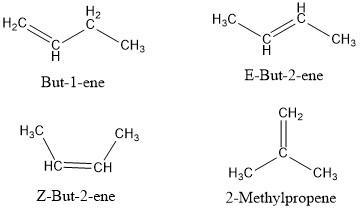
Identify structure(s) for all constitutional isomers with the molecular formula C4H8 that have one double bond. Select all that
Alchen [17]

Answer:

a) But-1-ene

b) E-But-2-ene

c) Z-But-2-ene

d) 2-Methylpropene

Explanation:

In this case, if we want to draw the <u>isomers</u>, we have to check the<u> formula </u>C_4_H8 in this formula we can start with a linear structure with 4 carbons. We also know that we have a double bond, so we can put this double bond between carbons 1 and 2 and we will obtain <u>But-1-ene.</u>

<u />

For the next isomer, we can move the double bond to carbons 2 and 3. When we do this can have two structures. When the methyl groups are placed on the same side we will obtain <u>Z-But-2-ene</u>. When the methyls groups are placed on opposite sides we will obtain <u>E-But-2-ene.</u>

<u />

Finally, we can use a linear structure of three carbons with a methyl group in the middle with a double bond, and we will obtain <u>2-Methylpropene.</u>

<u />

See figure 1 to further explanations.

I hope it helps!

<u />

<u />

8 0
2 years ago
doctor has ordered that a patient be given 20 g of glucose, which is available in a concentration of 70.00 g glucose/1000.0 mL o
butalik [34]
The patient should be given 285.71 ml. 
1000 ml contains 70 gr glucose.
    x        contains 20 gr glucose.

x=1000*20/70
8 0
2 years ago
At saturation, the further addition of water vapor or a decrease in temperature results in __________
Dafna1 [17]

The answer in the space provided is active condensation. Active condensation will likely occur if in saturation, further addition of water vapor has occurred or there is a presence of decrease in temperature. Condensation is a process that occurs when physical state is being changes such example of this when gas is formed into a liquid.

7 0
2 years ago
Other questions:
  • PLEASE HELP!!! Which of John Dalton's contributions are present in the modern atomic model and which were eventually disproven a
    12·1 answer
  • Which of the following distinguishes the isotope mercury-196 from the isotope mercury-199?
    14·1 answer
  • The identity of a carbonyl-containing compound has been narrowed down to three possibilities: acetamide (ethanamide), acetone (p
    9·1 answer
  • At what temperature would the volume of a gas be 0.550 L if it had a volume of 0.432 L at –20.0 o C?
    8·2 answers
  • Determine the volume of hexane that contains 5.33 × 10²² molecules of hexane. The density of hexane is 0.6548 g/ml and its molar
    10·1 answer
  • You are asked to identify compound X (a white, crystalline solid), which was extracted from a plant seized by customs inspectors
    15·1 answer
  • Classify each of these soluble solutes as a strong electrolyte, a weak electrolyte, or a nonelectrolyte. Solutes Formula Hydroch
    5·2 answers
  • A student placed 11.5 g of glucose (C6H12O6) in a volumetric flask, added enough water to dissolve the glucose by swirling, then
    12·2 answers
  • One hour of bicycle riding can require 500-900 kcal of energy, depending on the speed, the terrain, and the weight of the racer.
    14·1 answer
  • On the basis of electronegativity differences between atoms, which of the following scientific claims is the most accurate regar
    9·1 answer
Add answer
Login
Not registered? Fast signup
Signup
Login Signup
Ask question!