answer.
Ask question
Login Signup
Ask question
All categories
  • English
  • Mathematics
  • Social Studies
  • Business
  • History
  • Health
  • Geography
  • Biology
  • Physics
  • Chemistry
  • Computers and Technology
  • Arts
  • World Languages
  • Spanish
  • French
  • German
  • Advanced Placement (AP)
  • SAT
  • Medicine
  • Law
  • Engineering
Bezzdna [24]
2 years ago
3

A polymer bar’s dimensions are 1 in. 3 2 in. 3 15 in. The polymer has a modulus of elasticity of 600,000 psi. What force is requ

ired to stretch the bar elastically from 15 in. to 15.25 in.?

Physics
1 answer:
Jobisdone [24]2 years ago
8 0

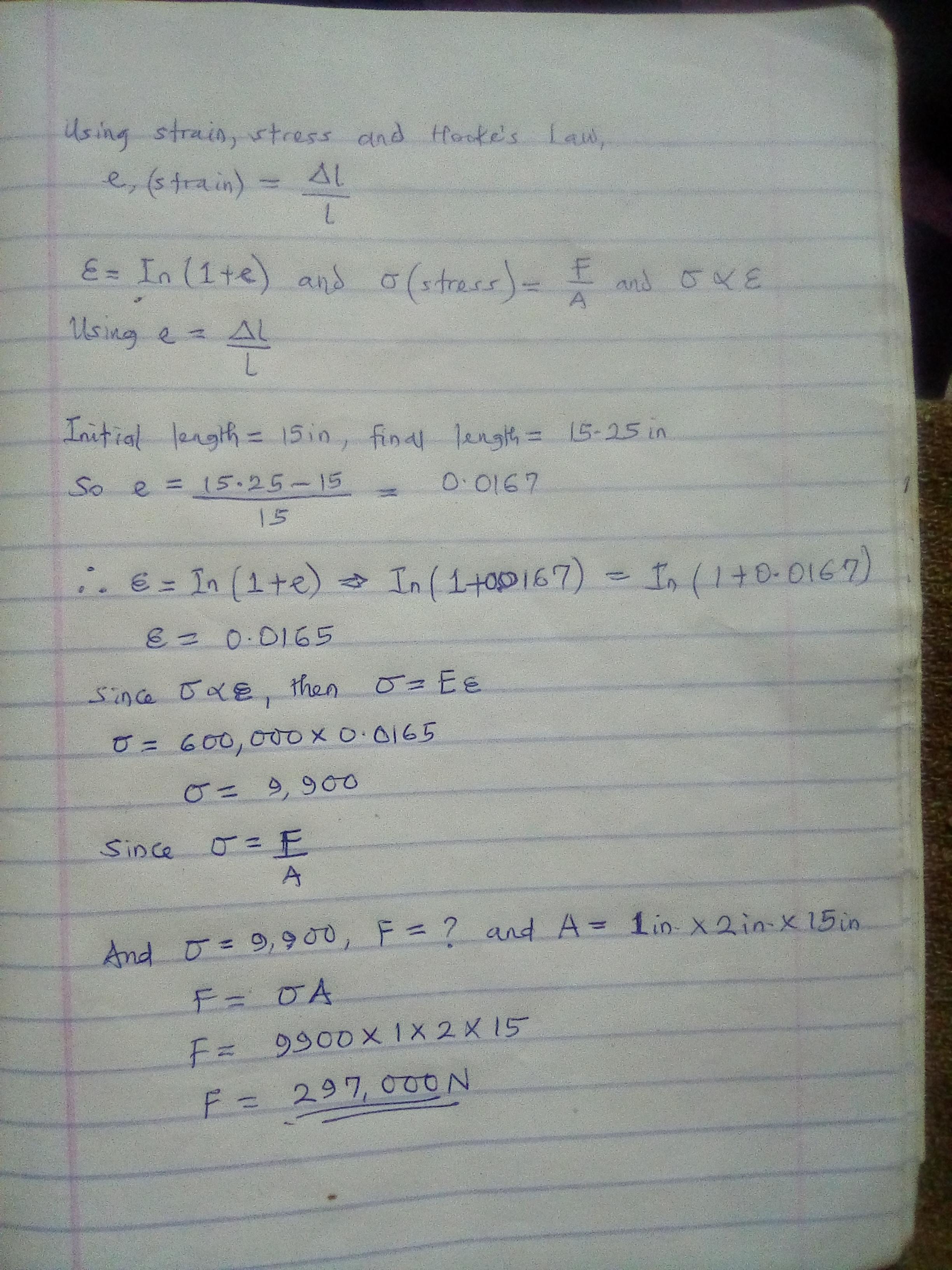
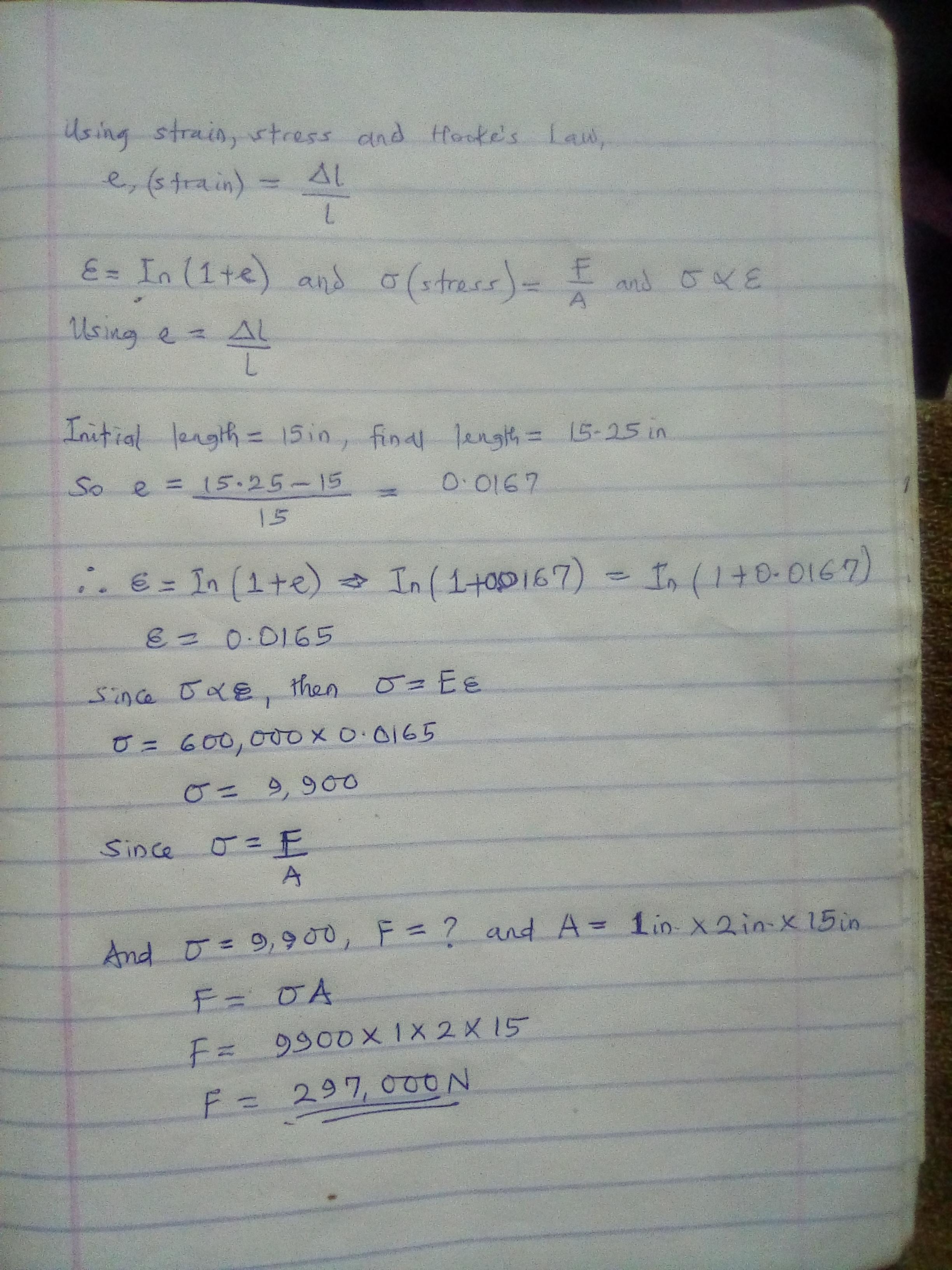
Answer: Force= 297,000 N

Explanation:

Strain, stress and Hooke's Law will be used to solve this problem.

(The attachment below shows the calculations)

You might be interested in
According to a rule-of-thumb. every five seconds between a lightning flash and the following thunder gives the distance to the f
Bond [772]

Answer:

S_{s}=300 m/s

The rule for kilometers is that every three seconds between a lightning flash and the following thunder gives the distance to the flash in kilometers.

Explanation:

In order to use the rule of thumb to find the speed of sound in meters per second, we need to use some conversion ratios. We know there is 1 mile per every 5 seconds after the lightning is seen. We also know that there are 5280ft in 1 mile and we also know that there are 0.3048m in 1ft. This is enough information to solve this problem. We set our conversion ratios like this:

\frac{1mi}{5s}*\frac{5280ft}{1mi}*\frac{0.3048m}{1ft}=321.87m/s

notice how the ratios were written in such a way that the units got cancelled when calculating them. Notice that in one ratio the miles were on the numerator of the fraction while on the other they were on the denominator, which allows us to cancel them. The same happened with the feet.

The problem asks us to express the answer to one significant figure so the speed of sound rounds to 300m/s.

For the second part of the problem we need to use conversions again. This time we will write our ratios backwards and take into account that there are 1000m to 1 km, so we get:

\frac{5s}{1mi}*\frac{1mi}{5280ft}*\frac{1ft}{0.3048m}*\frac{1000m}{1km}=3.11s/km

This means that for every 3.11s there will be a distance of 1km from the place where the lightning stroke. Since this is a rule of thumb, we round to the nearest integer for the calculations to be made easily, so the rule goes like this:

The rule for kilometers is that every three seconds between a lightning flash and the following thunder gives the distance to the flash in kilometers.

3 0
2 years ago
A 5.00-g bullet is shot through a 1.00-kg wood block suspended on a string 2.00 m long. The center of mass of the block rises a
o-na [289]

Answer:395.6 m/s

Explanation:

Given

mass of bullet m=5 gm

mass of wood block M=1 kg

Length of string L=2 m

Center of mass rises to an height of 0.38 cm

initial velocity of bullet u=450 m/s

let v_1 and v_2 be the velocity of bullet and block after collision

Conserving momentum

mu=mv_1+Mv_2 -------------1

Now after the collision block rises to an height of 0.38 cm

Conserving Energy for block

kinetic energy of block at bottom=Gain in Potential Energy

\frac{Mv_2^2}{2}=Mgh_{cm}

v_2=\sqrt{2gh_{cm}}

v_2=\sqrt{2\times 9.8\times 0.38}

v_2=0.272 m/s

substitute the value of v_2 in equation 1

5\times 450=5\times v_1+1000\times 0.272

v_1=395.6 m/s

4 0
2 years ago
A woman fires a rifle with barrel length of 0.5400 m. Let (0, 0) be where the 125 g bullet begins to move, and the bullet travel
dybincka [34]

Answer:

Explanation:

Given that,

Length of barrel =0.54m

Mass of bullet=125g=0.125kg

Force extend

F=16,000+10,000x-26,000x²

a. Work done is given as

W= ∫Fdx

W= ∫(16,000+10,000x-26,000x² dx from x=0 to x=0.54m

W=16,000x+10,000x²/2 -26,000x³/3 from x=0 to x=0.54m

W=16,000x+5,000x²- 8666.667x³ from x=0 to x=0.54m

W= 16,000(0.54) + 5000(0.54²) - 8666.667(0.54³) +0+0-0

W=8640+1458-1364.69

W=8733.31J

The workdone by the gas on the bullet is 8733.31J

b. Work done is given as

Work done when the length=1.05m

W= ∫Fdx

W= ∫(16,000+10,000x-26,000x² dx from x=0 to x=1.05m

W=16,000x+10,000x²/2 -26,000x³/3 from x=0 to x=1.05m

W=16,000x+5,000x²- 8666.667x³ from x=0 to x=1.05mm

W= 16,000(1.05) + 5000(1.05²) - 8666.667(1.05³) +0+0-0

W=16800+5512.5-10032.75

W=12,279.75J

The workdone by the gas on the bullet is 12,279.75J
3 0
2 years ago
A planet of mass M and radius R has no atmosphere. The escape velocity at its surface is ve. An object of mass m is at rest a di
zubka84 [21]

Answer:

Explanation:

Expression for escape velocity

ve = \sqrt{\frac{2GM}{R} }

ve² R / 2 = GM

M is mass of the planet , R is radius of the planet .

At distance r >> R , potential energy of object

= \frac{-GMm}{r}

Since the object is at rest at that point , kinetic energy  will be zero .

Total mechanical energy  = \frac{-GMm}{r} + 0 = \frac{-GMm}{r}

Putting the value of GM = ve² R / 2

Total mechanical energy  = ve² Rm / 2 r

This mechanical energy will be conserved while falling down on the earth due to law of conservation of mechanical energy  . So at surface of the earth , total mechanical energy

=  ve² Rm / 2 r

8 0
2 years ago
Select the correct answer from each drop-down menu.
bagirrra123 [75]

Answer:

(1) An object that’s negatively charged has more electrons than protons.

(2) An object that’s positively charged has fewer electrons than protons.

(3) An object that’s not charged has the same number of electrons than protons.

Explanation :

Objects have three subatomic particles that are Electrons, protons, and neutrons.

Protons and neutrons are found in the nucleus and electrons rotate or move outside the nucleus. Naturally, protons are positively charged, neutrons have no charge, and electrons are negatively charged.

Therefore, an object that is negatively charged has more electrons than protons.  An object that is not charged has the same number of electrons than protons. An object that is positively charged has fewer electrons than protons.

8 0
2 years ago
Other questions:
  • Which pair of sentences is describing the same velocity? A car is parked. A car is moving in circles. A bus drives 40 miles per
    9·2 answers
  • Joel uses a claw hammer to remove a nail from a wall. He applies a force of 40 newtons on the hammer. The hammer applies a force
    14·2 answers
  • A large ant is standing on the middle of a circus tightrope that is stretched with tension Ts. The rope has mass per unit length
    15·1 answer
  • Hanging by a thread. Two metal spheres hang from nylon threads and attract each other when brought close together. (i) What can
    13·1 answer
  • A ball thrown straight up climbs for 3.0 sec before falling. Neglecting air resistance, with what velocity was the ball thrown?
    8·1 answer
  • A 5⁢kg object is released from rest near the surface of a planet such that its gravitational field is considered to be constant.
    11·1 answer
  • How does the sun transfer energy to Earth?
    12·2 answers
  • A +4.0- μC charge is placed on the x axis at x = +3.0 m, and a −2.0- μC charge is located on the y axis at y = −1.0 m. Point A i
    9·1 answer
  • What is NOT one of the three primary resources that families have to reach financial goals?
    15·1 answer
  • Ram has power of 550 watt. What does it mean?
    10·1 answer
Add answer
Login
Not registered? Fast signup
Signup
Login Signup
Ask question!