answer.
Ask question
Login Signup
Ask question
All categories
  • English
  • Mathematics
  • Social Studies
  • Business
  • History
  • Health
  • Geography
  • Biology
  • Physics
  • Chemistry
  • Computers and Technology
  • Arts
  • World Languages
  • Spanish
  • French
  • German
  • Advanced Placement (AP)
  • SAT
  • Medicine
  • Law
  • Engineering
Nesterboy [21]
2 years ago
4

A mixture of 3-chlorobenzoic acid, 2-heptylamine and anthracene are dissolved in 25 mL of dichloromethane. Place the steps neede

d in order to move the basic compound into the water layer and then isolate it from the water layer.

Chemistry
1 answer:
Vinvika [58]2 years ago
8 0

Answer:

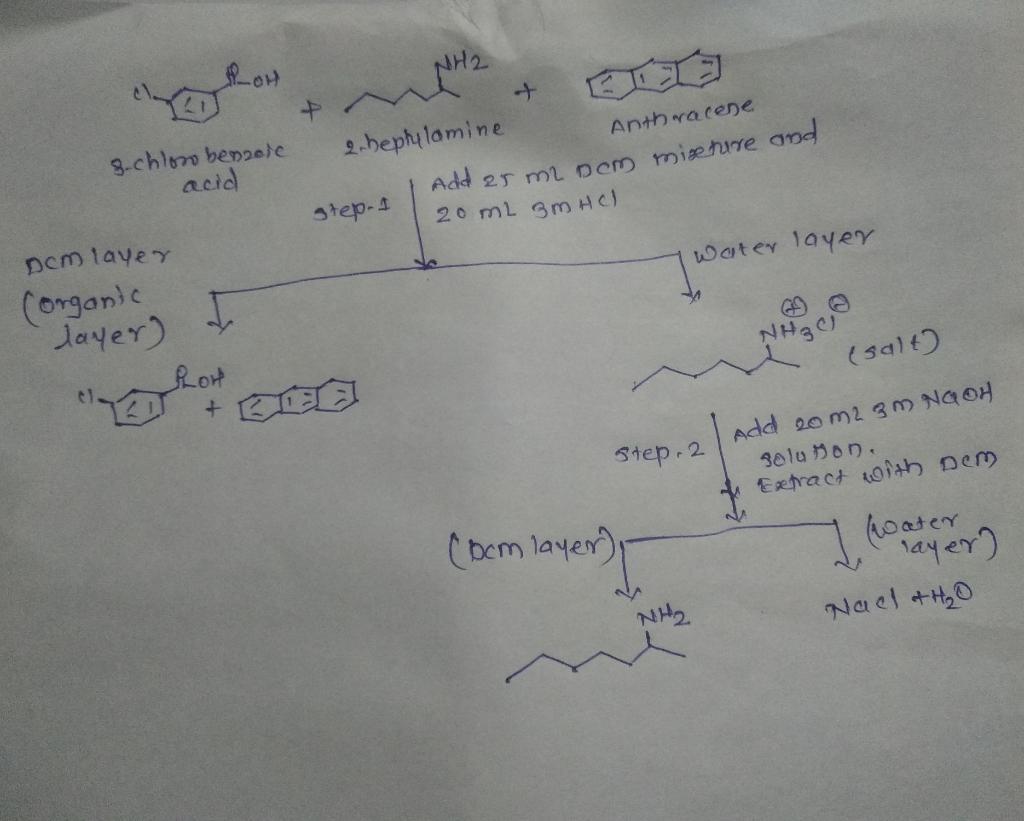
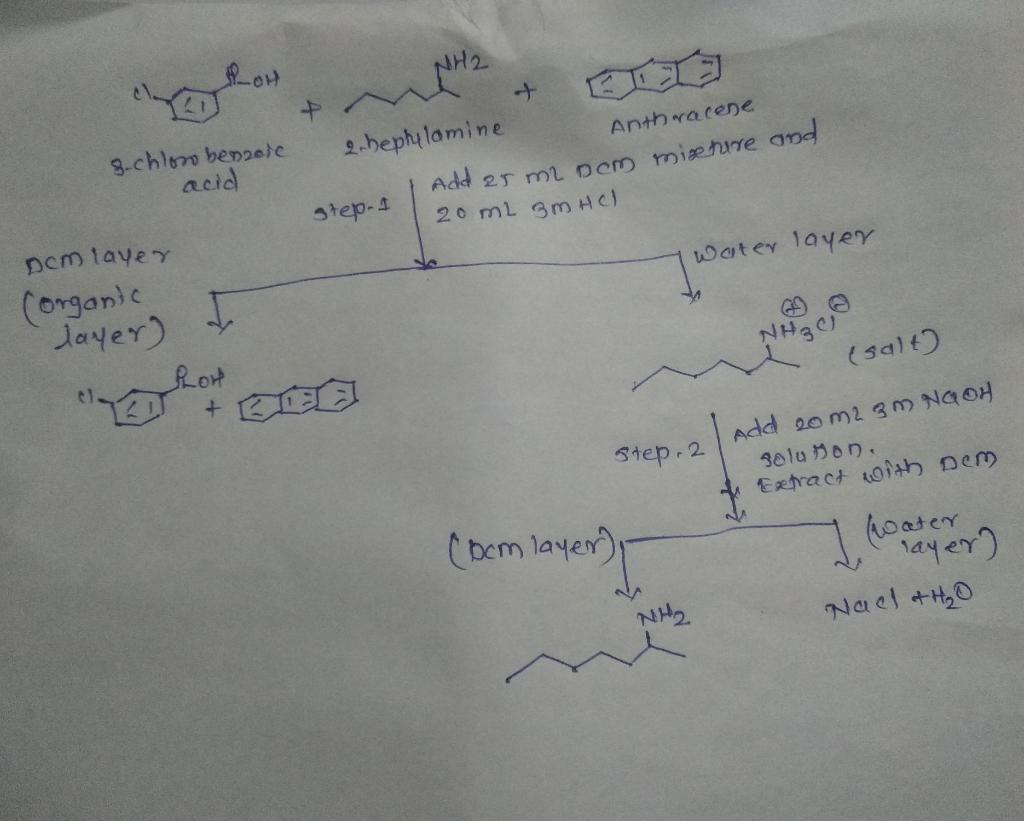
1. 2-heptylamine is basic compound in this mixture.

2. Step 1- Dissolve this mixture in DCM and add 3M HCl solution solution amino group will get converted into quaternary salt and will go in aqueous layer whereas 3-chlorobenzoicacid and anthracene will go in DCM layer.

3. Aqueous layer of step 1 on treatment with 3M NaOH we will get again free base and which will come in DCM layer by concentrating organic layer we will get our basic compound that is 2-heptylamine.

You might be interested in
Given the following reactions Fe2O3 (s) + 3CO (s) → 2Fe (s) + 3CO2 (g) ΔH = -28.0 kJ 3Fe (s) + 4CO2(s) → 4CO (g) + Fe3O4(s) ΔH =
Taya2010 [7]

Answer: The enthalpy of the reaction is -109 kJ

Explanation:

According to Hess’s law of constant heat summation, the heat absorbed or evolved in a given chemical equation is the same whether the process occurs in one step or several steps.

According to this law, the chemical equation can be treated as ordinary algebraic expression and can be added or subtracted to yield the required equation. That means the enthalpy change of the overall reaction is the sum of the enthalpy changes of the intermediate reactions.

Fe_2O_3(s)+3CO(s)\rightarrow 2Fe(s)+3CO_2(g)   \Delta H=-28.0kJ  \times 3    

3Fe_2O_3(s)+9CO(s)\rightarrow 6Fe(s)+9CO_2(g)   \Delta H=-84.0kJ     (1)

3Fe(s)+4CO_2(s)\rightarrow 4CO(g)+Fe_3O_4(s) \Delta H=+12.5kJ  \times 2  

6Fe(s)+8CO_2(s)\rightarrow 8CO(g)+2Fe_3O_4(s) \Delta H=+25.0kJ     (2)

The final reaction is:

Subtracting (2) from (1):

3Fe_2O_3(s)+CO(g)\rightarrow CO_2(g)+2Fe_3O_4(s) \Delta H=-84.0-(+25.0)=-109kJ

Thus the enthalpy of the reaction is -109 kJ

7 0
2 years ago
It takes 330 j of energy to raise the temperature of 14.6 g of benzene from 21.0 °c to 28.7 °c at constant pressure. What is the
Akimi4 [234]

The mathematical expression for heat capacity at constant pressure is given as:

Q=n\times C_{p}\times \Delta T   (1)

where, Q = heat capacity

C_{p} =  molar heat capacity at constant pressure

\Delta T = change in temperature

n = number of moles

Therefore, \Delta T = 28.7^{o}C-21^{o}C

= 7.7 ^{o}C

Number of moles  =\frac{given mass in g}{molar mass}

= \frac{14.6 g }{78.11 g/mol}

= 0.186 mole

Put the values in formula (1)

330 J=0.186 mole\times C_{p}\times (7.7 ^{o}C+ 273) (conversion of degree Celsius into kelvin)

C_{p} = \frac{330 J}{0.186 mole\times 280.7 K}

= \frac{330 J}{52.2102 mole K}

= 6.32 J /mol K

Hence, molar heat capacity of benzene at constant pressure  = 6.32 Jmol^{-1} K^{-1}

6 0
2 years ago
How many grams of Boron can be obtained from 234 grams of B2O3?
Xelga [282]

Answer:

72.67g of B

Explanation:

The reaction of B₂O₃ to produce boron (B), is:

B₂O₃ → 3/2O₂ + 2B

<em>That means B₂O₃ produce 2 moles of boron</em>

Molar mass of B₂O₃ is 69.62g/mol. 234g of B₂O₃ contains:

234g B₂O₃ ₓ (1mol / 69.62g) = 3.361 moles of B₂O₃.

As 1 mole of B₂O₃ produce 2 moles of B, Moles of B that can be produced from B₂O₃ is:

3.361mol B₂O₃ ₓ 2 = <em>6.722 moles of B</em>.

As molar mass of B is 10.811g/mol. Thus mass of B that can be produced is:

6.722mol B ₓ (10.811g / mol) = <em>72.67g of B</em>

4 0
2 years ago
How are exothermic and endothermic reactions linked in the process of refining metal ore?
Alex777 [14]
The intended sense is that of a reaction that depends on absorbing heat if it is to proceed. The opposite of an endothermic process is an exothermic process, one that releases "gives out" energy in the form of heat
6 0
2 years ago
An ion with 5 protons, 6 neutrons and a charge of 3+ has an atomic number of ____.
Umnica [9.8K]

Answer:An ion with 5 protons, 6 neutrons and a charge of 3+ has an atomic number of 5

Explanation:
3 0
2 years ago
Read 2 more answers
Other questions:
  • Air pressure is lower at high altitudes. An airplane cabin can adjust, but as the plane rises, passengers can experience tempora
    14·2 answers
  • A 1.800-g sample of solid phenol (C6H5OH(s)) was burned in a bomb calorimeter, which has a total heat capacity of 11.66 kJ/∘C. T
    10·1 answer
  • Mendeleev placed thallium (Tl) in the same group as lithium (Li), sodium (Na), potassium (K), rubidium (Rb), and cesium (Cs). Ho
    11·1 answer
  • The infrared spectrum above represents the absorption of certain wavelengths of radiation by molecules of CO2. Which of the foll
    9·1 answer
  • Select the correct answer from each drop-down menu.
    11·2 answers
  • Carlos stomps a soda con flat and throw it away. Which of the following statements BEST describes the change made in the soda ca
    8·1 answer
  • The change in entropy, ΔS∘rxn , is related to the the change in the number of moles of gas molecules, Δngas . Determine the chan
    8·1 answer
  • sekiranya kutu tinggal di badan arnab dan menghisap darah arnab , apakah jenis interaksi antara kutu dengan arnab ?​
    5·1 answer
  • Perform the following conversion: 6.1 × 10³ K (the surface temperature of the Sun) to °F and °C. Pay attention to the number of
    10·1 answer
  • Which are examples of science rather than pseudoscience? Check all that apply. People can get rid of hiccups by holding their br
    13·2 answers
Add answer
Login
Not registered? Fast signup
Signup
Login Signup
Ask question!