answer.
Ask question
Login Signup
Ask question
All categories
  • English
  • Mathematics
  • Social Studies
  • Business
  • History
  • Health
  • Geography
  • Biology
  • Physics
  • Chemistry
  • Computers and Technology
  • Arts
  • World Languages
  • Spanish
  • French
  • German
  • Advanced Placement (AP)
  • SAT
  • Medicine
  • Law
  • Engineering
otez555 [7]
2 years ago
3

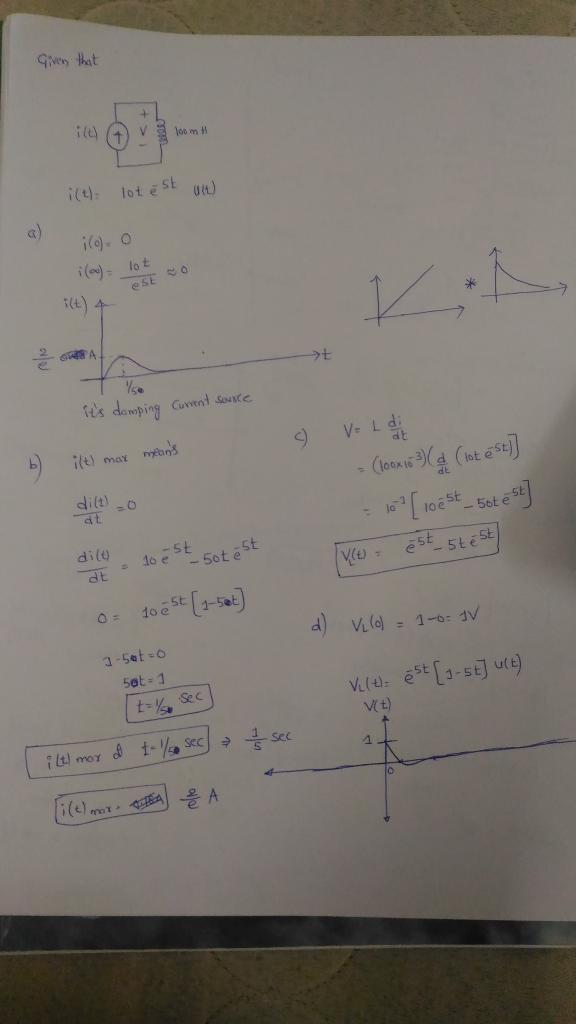
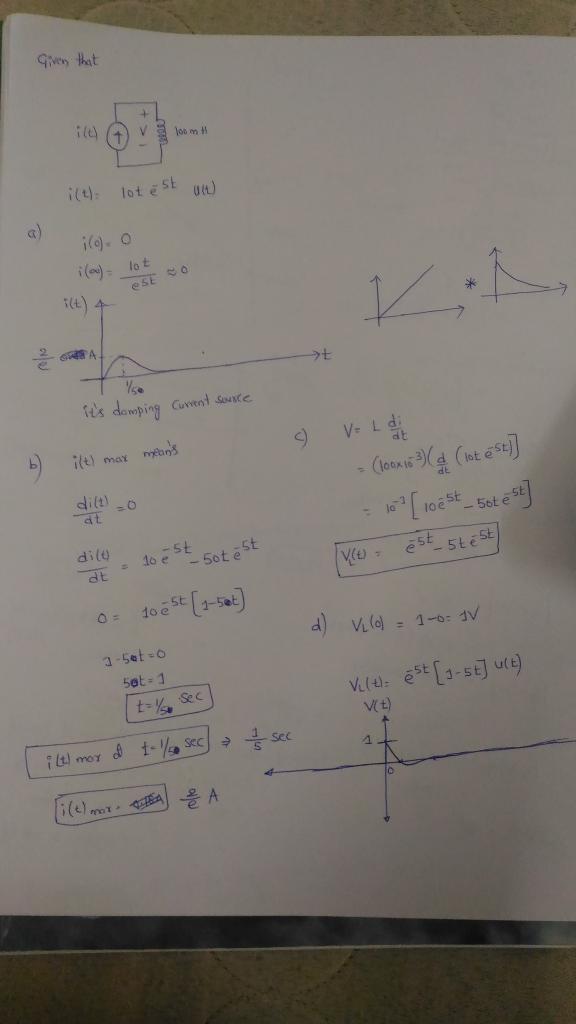
The independent current source generates 0 current for t < 0 and a pulse 10te-5t for t > 0. a. Sketch the current waveform

. b. At what instant of time is the current maximum? c. Express the voltage across the terminals of the 100 mH inductor, v, as a function of time. d. Sketch the voltage waveform. e. Is the voltage maximum when the current is maximum? f. At what instant of time does the voltage change polarity? g. Is there ever an ins

Physics
1 answer:
Maksim231197 [3]2 years ago
3 0

g- There is no sudden change across the inductor because inductor doesn't allow any sudden change in quantity.

You might be interested in
A straight wire lies along the y-axis initially carrying a current of 10 A in the positive y-direction. The current decreases an
Elan Coil [88]

Answer:

Explanation:

The magnetic field due to straight wire is into the square coil.

As the current in straight wire decreases the magnetic flux in the coil decreases . The induced magnetic field is into the coil.The induced current is along +y direction

8 0
2 years ago
An archer draws her bow and stores 34.8 J of elastic potential energy in the bow. She releases the 63 g arrow, giving it an init
elena-14-01-66 [18.8K]

Answer:

Approximately 71\%.

Explanation:

The formula for the kinetic energy \rm KE of an object is:

\displaystyle \mathrm{KE} = \frac{1}{2}\, m \cdot v^2,

where

  • m is the mass of that object, and
  • v is the speed of that object.

Important: Joule (\rm J) is the standard unit for energy. The formula for \rm KE requires two inputs: mass and speed. The standard unit of mass is \rm kg while the standard unit for speed is \rm m \cdot s^{-1}. If both inputs are in standard units, then the output (kinetic energy) will also be in the standard unit (that is: joules,

Convert the unit of the arrow's mass to standard unit:

m = 63\; \rm g = 0.063\; \rm kg.

Initial \rm KE of this arrow:

\begin{aligned}\mathrm{KE} &= \frac{1}{2} \, m \cdot v^2 \\ &= \frac{1}{2}\times 0.063\; \rm kg \times \left(\rm 28 \; m \cdot s^{-1}\right)^2 \\ &\approx 24.696\; \rm J\end{aligned}.

That's the same as the energy output of this bow. Hence, the efficiency of energy transfer will be:

\displaystyle \frac{24.696\; \rm J}{34.8\; \rm J} \times 100\% \approx 71\%.

8 0
2 years ago
At some airports there are speed ramps to help passengers get from one place to another. A speed ramp is a moving conveyor belt
Volgvan

Answer:

It takes you 32.27 seconds to travel 121 m using the speed ramp

Explanation:

<em>Lets explain how to solve the problem</em>

- The speed ramp has a length of 121 m and is moving at a speed of

 2.2 m/s relative to the ground

- That means the speed of the ramp is 2.2 m/s

- You can cover the same distance in 78 seconds when walking on

  the ground

<em>Lets find your speed on the ground</em>

Speed = Distance ÷ Time

The distance is 121 meters

The time is 78 seconds

Your speed on the ground = 121 ÷ 78 = 1.55 m/s

If you walk at the same rate with respect to the speed ramp that

you walk on the ground

That means you walk with speed 1.55 m/s and the ramp moves by

speed 2.2 m/s

So your speed using the ramp = 2.2 + 1.55 = 3.75 m/s

Now we want to find the time you will take to travel 121 meters using

the speed ramp

Time = Distance ÷ speed

Distance = 121 meters

Speed 3.75 m/s

Time = 121 ÷ 3.75 = 32.27 seconds

It takes you 32.27 seconds to travel 121 m using the speed ramp

8 0
2 years ago
A single crystal of aluminum is oriented for a tensile test such that its slip plane normal makes angle of 28.1 with the tensil
NISA [10]

Answer:

we have to find out the critical resolved shear stress. As it it given in the question

Ф = 28.1°and the possible values for λ are 62.4°, 72.0° and 81.1°.

a) Slip will occur in the direction where cosФ cosλ are maximum. Cosine for all possible λ values are given as follows.

cos(62.4°) = 0.46

cos(72.0°) = 0.31

cos(81.1°) = 0.15

Thus, the slip direction is at the angle of 62.4° along the tensile axis.

b) now the critical resolved shear stress can be find out by the following equation.

τ_{crss} = σ_{Y} ( cosФ cosλ)_{max}

now by putting values,

     = (1.95MPa)[ cos(28.1) cos(62.4)] = 0.80 MPa (114 Psi) 7.23

3 0
2 years ago
You need to design a clock that will oscillate at 10 MHz and will spend 75% of each cycle in the high state. You will be using a
Svetllana [295]

Answer:

Hello your question has some missing parts and the required diagram attached below is the missing part and the diagram

Digital circuits require actions to take place at precise times, so they are controlled by a clock that generates a steady sequence of rectangular voltage pulses. One of the most widely

used integrated circuits for creating clock pulses is called a 555 timer.  shows how the timer’s output pulses, oscillating between 0 V and 5 V, are controlled with two resistors and a capacitor. The circuit manufacturer tells users that TH, the time the clock output spends in the high (5V) state, is TH =(R1 + R2)*C*ln(2). Similarly, the time spent in the low (0 V) state is TL = R2*C*ln(2). Design a clock that will oscillate at 10 MHz and will spend 75% of each cycle in the high state. You will be using a 500 pF capacitor. What values do you need to specify for R1 and R2?

ANSWER : R1 = 144.3Ω,   R2 =  72.2 Ω

Explanation:

Frequency = 10 MHz

Time period = 1 / F =  0.1 <em>u </em>s

Duty cycle = 75% = 0.75

Duty cycle can be represented as :   Ton / T

Also: Ton = Th = 0.75 * 0.1 <em>u </em>s  = 75 <em>n</em> s

TL = T - Th = 100 <em>n</em>s - 75 <em>n</em> s = 25 <em>n</em> s

To find the value of R2 we use the equation for  time spent in the low (0 V) state

TL = R2*C*ln(2)

hence R2 = TL / ( C * In 2 )

c = 500 pF

Hence R2 = 25 / ( 500 pF * 0.693 )  = 72.2 Ω

To find the value of R1 we use the equation for the time the clock output spends in the high (5V) state,

Th = (R1 + R2)*C*ln(2)

  from the equation make R1 the subject of the formula

R1 =  (Th - ( R2 * C * In2 )) / (C * In 2)

R1 = ( 75 ns - ( 72.2 * 500 pF * 0.693)) / ( 500 pF * 0.693 )

R1 = ( 75 ns  - ( 25 ns ) / 500 pf * 0.693

     = 144.3Ω
8 0
2 years ago
Other questions:
  • After watching a video about submarines, Jamil wants to learn more about the ocean. which question could be answered through sci
    9·1 answer
  • What force must be exerted on the master cylinder of a hydraulic lift to support the weight of a 2000-kg car (a large car) resti
    8·1 answer
  • A 100 cm3 block of lead weighs 11N is carefully submerged in water. One cm3 of water weighs 0.0098 N.
    12·1 answer
  • Which statements describe the characteristics of asteroids? Check all that apply. formed 4.6 billion years ago orbit the Sun bey
    7·2 answers
  • 1) A fan is to accelerate quiescent air to a velocity of 8 m/s at a rate of 9 m3/s. Determine the minimum power that must be sup
    13·1 answer
  • Janelle stands on a balcony, two stories above Michael. She throws one ball straight up and one ball straight down, but both wit
    15·1 answer
  • Temperature and kinetic energy are ___________ proportional. adirectly directly indirectly 2. Heat is a measure of _____________
    15·2 answers
  • A weatherman carried an aneroid barometer from the ground floor to his office atop the Sears Tower in Chicago. On the level grou
    10·1 answer
  • A charge Q is uniformly spread over one surface of a very large nonconducting square elastic sheet having sides of length d. At
    13·1 answer
  • Two moles of an ideal gas at 3.0 atm and 10 °C are heated up to
    8·1 answer
Add answer
Login
Not registered? Fast signup
Signup
Login Signup
Ask question!