answer.
Ask question
Login Signup
Ask question
All categories
  • English
  • Mathematics
  • Social Studies
  • Business
  • History
  • Health
  • Geography
  • Biology
  • Physics
  • Chemistry
  • Computers and Technology
  • Arts
  • World Languages
  • Spanish
  • French
  • German
  • Advanced Placement (AP)
  • SAT
  • Medicine
  • Law
  • Engineering
Over [174]
2 years ago
6

How many electrons are transferred between the cation and anion to form the ionic bond in one formula unit of each compound? (1

electrons, 2 electrons, 3 electrons, 4 electrons) ?
NaCI
CaS
BaO
KBr
LiF
Chemistry
1 answer:
rosijanka [135]2 years ago
3 0
Here are the solutions:
For NaCl, there would be one electron transferred from the sodium atom, now producing a cation to the chlorine atom resulting in a chlorine anion. Forming ionic bond.
For CaS, there would be 2 electrons transferred from an atom of Ca to S, this can be obtained by simply looking at the ionic charges and or combining capacities of Ca.
For BaO, likewise, 2 electrons that are valence electrons are transferred from Ba to Oxygen.
In the ionic compound of KBr, the atom of K, potassium donated its one valence electron to Br, in need of it to achieve a stable octet, and produce the chemical bond.
Finally, LiF, a single valence electron is transferred from a metal atom of Li to F, for both of the atoms that would form the ionic bond to achieve a stable octet, and or full electron shell.
You might be interested in
Old photographic flashbulbs burn magnesium metal in a reaction that causes a flash of brilliant white light. A photographer woul
OLga [1]

Answer is: A. Chemical energy to electromagnetic energy and thermal energy.  

Balanced chemical reaction: 2Mg(s) + O₂(g) → 2MgO(s) + energy.

This is chemical change (chemical reaction), because new substance (magnesium oxide MgO) is formed, the atoms are rearranged and the reaction is followed by an energy change (exothermic reaction because energy is released).

Chemical changes (chemical synthesis) is when a substance combines with another (in this example magnesium and oxygen) to form a new substance.


5 0
2 years ago
Read 2 more answers
Describe how you would prepare approximately 2 l of 0.050 0 m boric acid, b(oh)3.
Elenna [48]

The given concentration of boric acid = 0.0500 M

Required volume of the solution = 2 L

Molarity is the moles of solute present per liter solution. So 0.0500 M boric acid has 0.0500 mol boric acid present in 1 L solution.

Calculating the moles of 0.0500 M boric acid present in 2 L solution:

2 L * \frac{0.0500 mol B(OH)_{3} }{1 L} = 0.100 mol B(OH)_{3}

Converting moles of boric acid to mass:

0.100 mol B(OH)_{3} * \frac{61.83 g}{mol B(OH)_{3}}   = 6.183 g

Therefore, 6.183 g boric acid when dissolved and made up to 2 L with distilled water gives 0.0500 M solution.


5 0
2 years ago
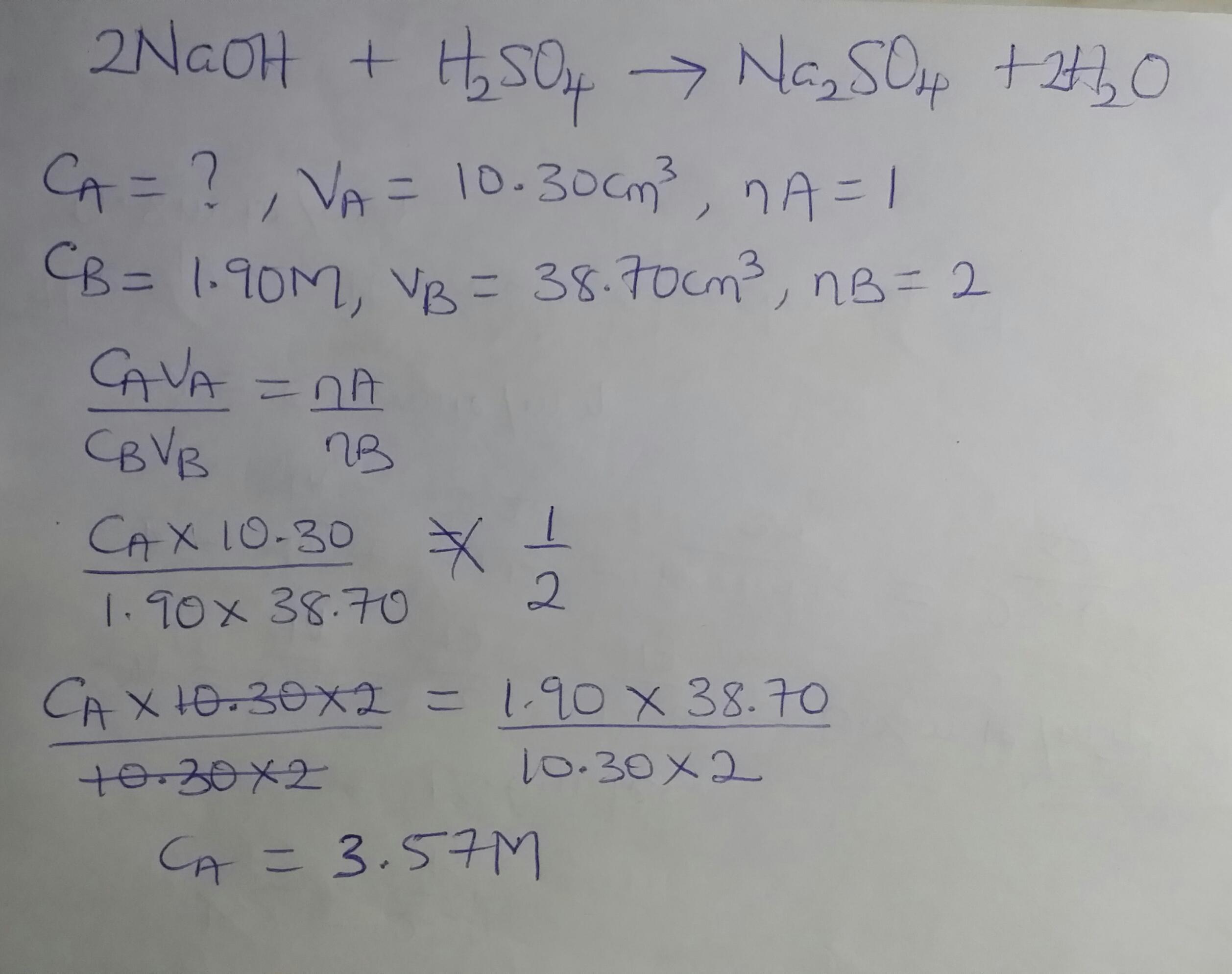
If it takes 38.70cm³ of 1.90 M NaOH to neutralize 10.30cm³ of H2SO4 in a battery, What's the Molarity of the H2SO4 ?​
arlik [135]

Answer: 3.57M

Explanation:Please see attachment for explanation

3 0
2 years ago
Read 2 more answers
Which of the following descriptions best describes a weak base?
Westkost [7]

Answer:

umm.. B. a base that generates a lot of hydroxide ions in water.

5 0
2 years ago
The process of joining many small molecules into larger molecules is called(1) neutralization (3) saponification(2) polymerizati
yulyashka [42]
(2) polymerization. polymerization<span> is a process of reacting monomer molecules together in a chemical reaction to form polymer chains or three-dimensional networks.</span>
8 0
2 years ago
Read 2 more answers
Other questions:
  • A beam of light passes though a liquid in a test tube without scattering. Which type of mixture is most likely in the test tube?
    13·2 answers
  • Matt did an experiment to study the solubility of two substances. He poured 100 mL of water at 20 °C into each of two beakers la
    14·2 answers
  • What mass of calcium carbonate (in grams) can be dissolved by 4.0 g of hcl? (hint: begin by writing a balanced equation for the
    14·2 answers
  • When you apply heat energy to a substance, where does the energy go? Think about the law of conservation of energy.
    8·1 answer
  • Which one of the following is not a valid expression for the rate of the reaction below? 4NH3 + 7O2 → 4NO2 + 6H2O Which one of t
    12·1 answer
  • Iron-59 is used in medicine to diagnose blood circulation disorders. The half life of iron-59 is 44.5 days. How much of a 2.000
    5·1 answer
  • The pyruvate dehydrogenase complex catalyzes the oxidative decarboxylation of pyruvate to form acetyl‑CoA. E1 , E2 , and E3 are
    13·1 answer
  • Identify and calculate the number of representative particles in 2.15 moles of gold.<br>​
    13·1 answer
  • What is the herbivore in the following food chain: algae → fish → herons?
    8·1 answer
  • The pH of an acidic solution is 2.11. What is [H⁺]
    5·2 answers
Add answer
Login
Not registered? Fast signup
Signup
Login Signup
Ask question!