answer.
Ask question
Login Signup
Ask question
All categories
  • English
  • Mathematics
  • Social Studies
  • Business
  • History
  • Health
  • Geography
  • Biology
  • Physics
  • Chemistry
  • Computers and Technology
  • Arts
  • World Languages
  • Spanish
  • French
  • German
  • Advanced Placement (AP)
  • SAT
  • Medicine
  • Law
  • Engineering
Yuri [45]
2 years ago
15

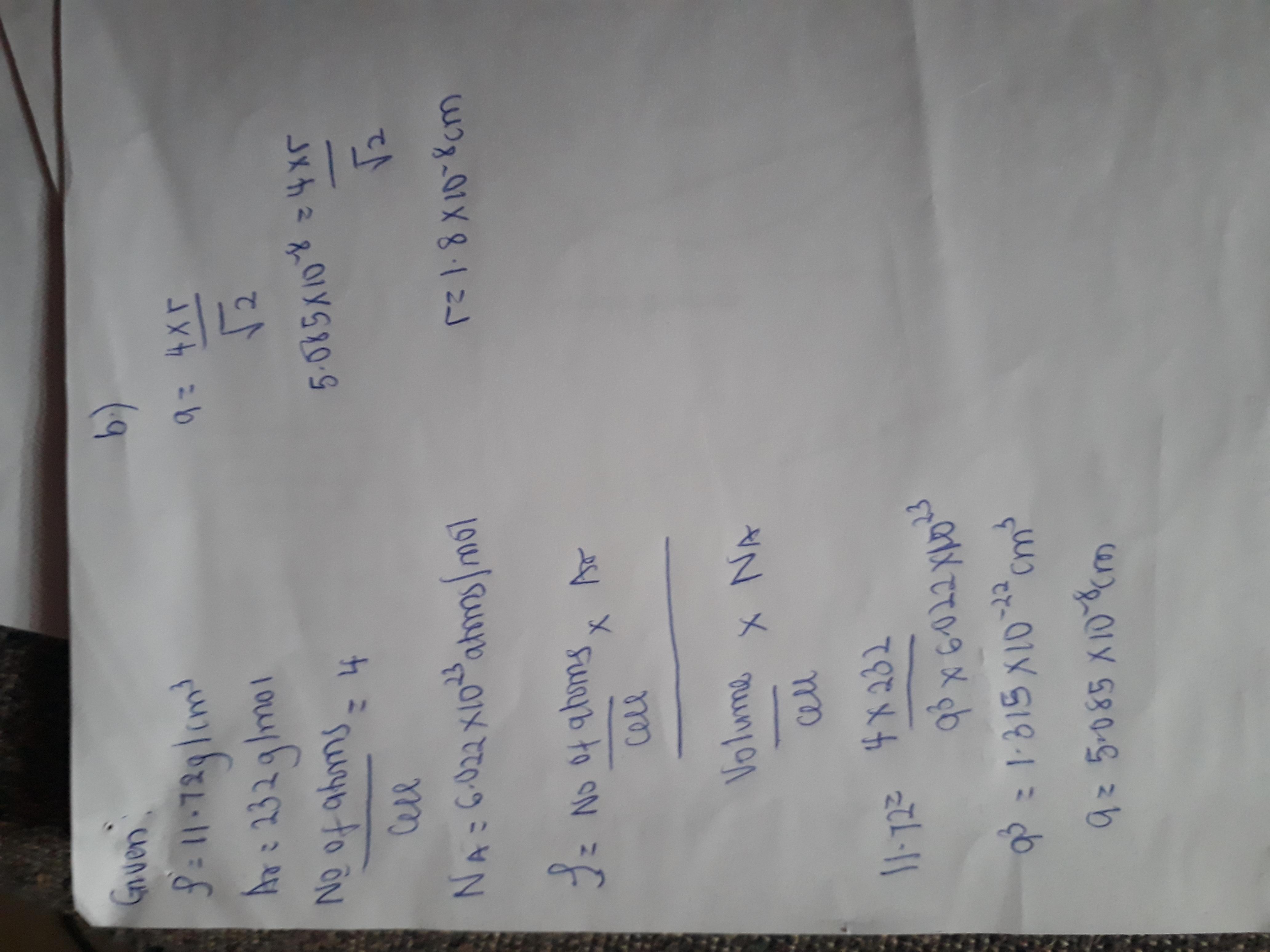
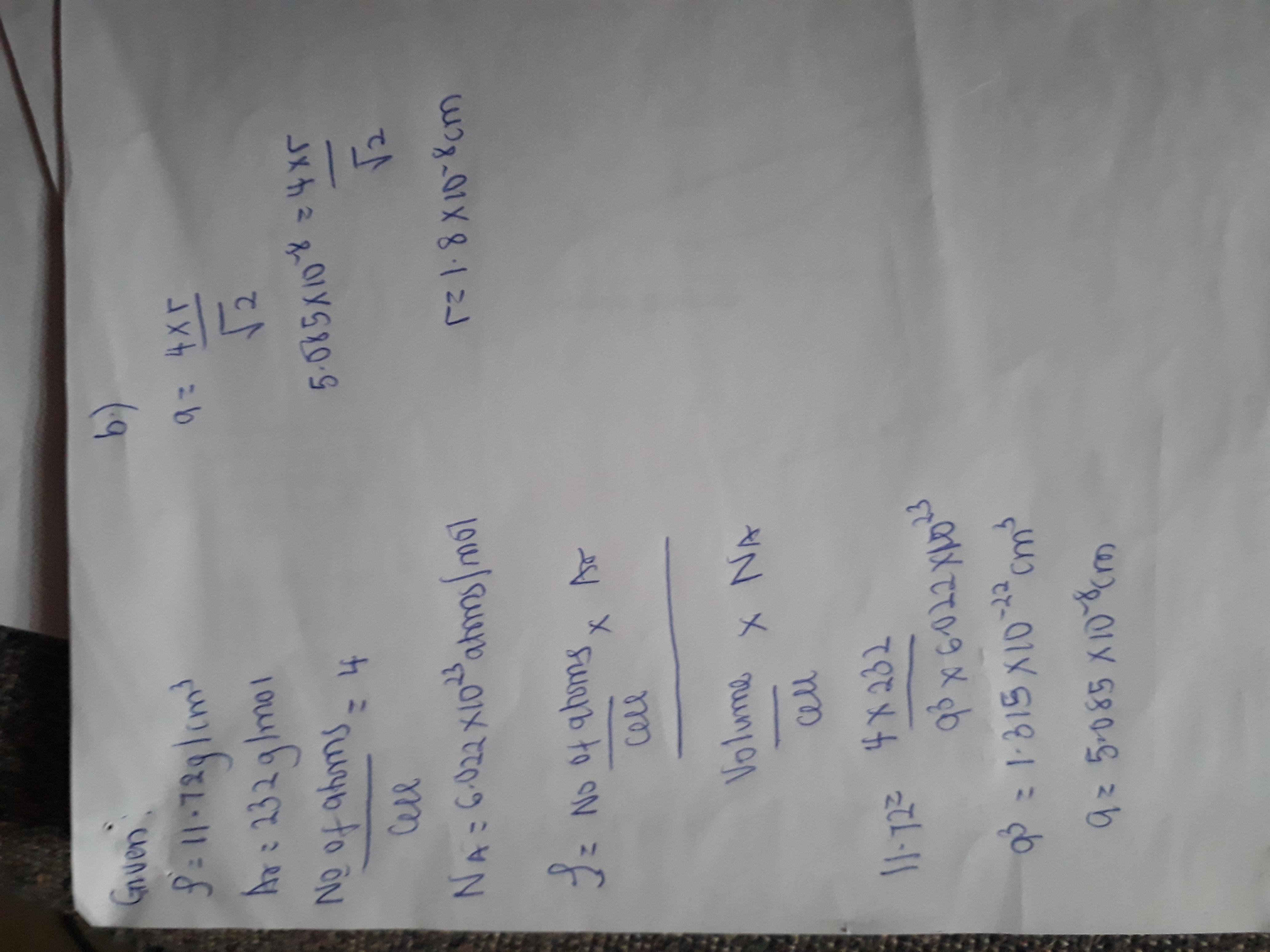
The density of thorium, which has the FCC structure, is 11.72 g/cm3. The atomic weight of thorium is 232 g/mol. Calculate (a) th

e lattice parameter; and (b) the atomic radius of thorium.

Chemistry
2 answers:
seropon [69]2 years ago
4 0

Answer:

(a) a = 5.08x10⁻⁸ cm

(b) r = 179.6 pm  

Explanation:

(a) The lattice parameter "a" can be calculated using the following equation:

\rho = \frac{(N atoms/cell)*m}{V_{c}*N_{A}}      

<em>where ρ: is the density of Th = 11.72 g/cm³, N° atoms/cell = 4, m: is the atomic weight of Th = 232 g/mol, Vc: is the unit cell volume = a³, and </em>N_{A}<em>: is the Avogadro constant = 6.023x10²³ atoms/mol. </em>

Hence the lattice parameter is:  

a^{3} = \frac{(N atoms/cell)*m}{\rho *N_{A}} = \frac{4 atoms*232 g/mol}{11.72 g/cm^{3} *6.023 \cdot 10^{23} atoms/mol} = 1.32 \cdot 10^{-22} cm^{3}

a = \sqrt[3]{1.32 \cdot 10^{-22} cm^{3}} = 5.08 \cdot 10^{-8} cm

(b) We know that the lattice parameter of a FCC structure is:

a = \frac{4r}{\sqrt{2}}

<em>where r: is the atomic radius of Th</em>

Hence, the atomic radius of Th is:

r = \frac{a*\sqrt{2}}{4} = \frac{5.08 \cdot 10^{-8} cm*\sqrt{2}}{4} = 1.796 \cdot 10^{-8} cm = 179.6 pm    

I hope it helps you!    

mario62 [17]2 years ago
3 0

Explanation:

Below is an attachment containing the solution

You might be interested in
In the chemical reaction NaHCO3 + CH3COOH → CH3COONa + H2O +CO2, 83 g of sodium bicarbonate reacts with 70 g of acetic acid. Whi
krok68 [10]
MNaHCO₃: 23+1+12+(48×3) = 84g
mCH₃COOH: 12+(1×3)+12+(16×2)+1 = 60g
.................
84g NaHCO₃ react with 60g CH₃COOH
83g NaHCO₃ react with...........

84g ----- 60g
83g ----- X
X = 59,29g CH₃COOH

We used 70g CH₃COOH, it' too much.
So, acetic acid is excess reagent, and sodium bicarbonate is limiting reagent.
_______________________________
B) Amount of CH3COOH is in excess.

:•)
3 0
2 years ago
Relate text and visuals using the cartoon, explain why the potassium atom becomes positively charged and the fluorine atom becom
tangare [24]
Elements are ionized because they aspire to be stable. The most stable form are the ones with full octet of electrons, the noble gases which consist of the last column in the periodic table. The rest of the elements either accept or readily donate electrons to conform to the electronic configuration that is the same with the nearest noble gas.

1. Potassium's nearest noble gas is Ar which is one electron fewer. So, when ionized, it donates 1 electron. Hence, K⁺.
2. The nearest noble gas for fluorine is Neon which is 1 electron more. Hence, it has to accept one more electron. Hence, F⁻.
5 0
2 years ago
Which statement is true? Nuclear power plants require more fuel than conventional power plants. There is a short supply of high
Bas_tet [7]
I believe the correct answer would be option 4. The only statement that is true would be that it is difficult to responsibly dispose of nuclear waste products. This is because nuclear waste products are radioactive and are very harmful to the society and to the environment. It could cause serious damage to every being in contact to it.
3 0
2 years ago
Read 2 more answers
A white powder is known to be a mixture of magnesium oxide and aluminum oxide. 100cm3 of 2moldm-3 NaOH(aq) is just sufficient to
Effectus [21]

Answer: D.Aluminium Oxide 0.10, Magnesium Oxide 0.50

Explanation:

Number of moles of NaOH= number of moles × volume

Number of moles= 100/1000 × 2 = 0.2 moles

Since;

2 moles of NaOH yield 1 mole of Al2O3

0.2 moles of NaOH will yield 0.2 × 1/2 = 0.1 moles of Al2O3.

Number of moles of HCl= 800/1000 × 2 = 1.6 moles

If 1 mole of Al2O3 requires 6 moles of HCl

0.1 moles of Al2O3 requires 0.1 × 6 = 0.6 moles of HCl.

Number of moles of HCl left after reaction with Al2O3 = 1.6- 0.6 = 1 mole

This leftover reacts with MgO

But;

1 mole of MgO reacts with 2 moles of HCl

x moles of MgO reacts with 1 mole of HCl

Thus; x= 0.5 moles of MgO
8 0
2 years ago
Trichloromethane consists of 10.05% carbon. 0.83% hydrogen and 89.12% chlorine. if uts relative molecular mass is 119.5g . find
Delicious77 [7]

Answer:

C24H2CL213

Explanation:

C

(10.05/100)x119.5

=12x2=24

H

(0.083/100)x119.5

=1x2=2

Cl

(89.12/100)x119.5

=106.5x2=213

4 0
2 years ago
Other questions:
  • Do you think that solids can undergo convection? explain
    8·1 answer
  • If a runner completes a 10 kilometer race in 32.50 minutes, what is the 10.0 km pace in miles per hour? (1.609 km = 1 mile appro
    8·1 answer
  • An isotope undergoes radioactive decay by emitting radiation that has a –1 charge. What other characteristic does the radiation
    14·2 answers
  • How many moles of hydrogen gas are produced when 0.066 mole of sodium is completely reacted?
    14·2 answers
  • Which statement is correct? Salts are formed by the reaction of bases with water. Most salts are ionic and are soluble in water.
    11·2 answers
  • You have two containers of equal volume. one is full of helium gas. the other holds an equal mass of nitrogen gas both gases hav
    7·1 answer
  • Each molecule of nitric acid has the formula hno3. if there are 6000 oxygen atoms present and 6000 nitrogen atoms present, how m
    15·1 answer
  • The graph above shows the changes in temperature recorded for the 2.00 l of h2o surrounding a constant-volume container in which
    9·1 answer
  • What two-step process separated the cans into aluminum, steel, and tin?
    7·1 answer
  • A bottle has a capacity of 1.2 liters. If the density of ether is 0.74 g/mL, what mass of ether can the bottle hold?
    6·1 answer
Add answer
Login
Not registered? Fast signup
Signup
Login Signup
Ask question!