answer.
Ask question
Login Signup
Ask question
All categories
  • English
  • Mathematics
  • Social Studies
  • Business
  • History
  • Health
  • Geography
  • Biology
  • Physics
  • Chemistry
  • Computers and Technology
  • Arts
  • World Languages
  • Spanish
  • French
  • German
  • Advanced Placement (AP)
  • SAT
  • Medicine
  • Law
  • Engineering
alekssr [168]
2 years ago
9

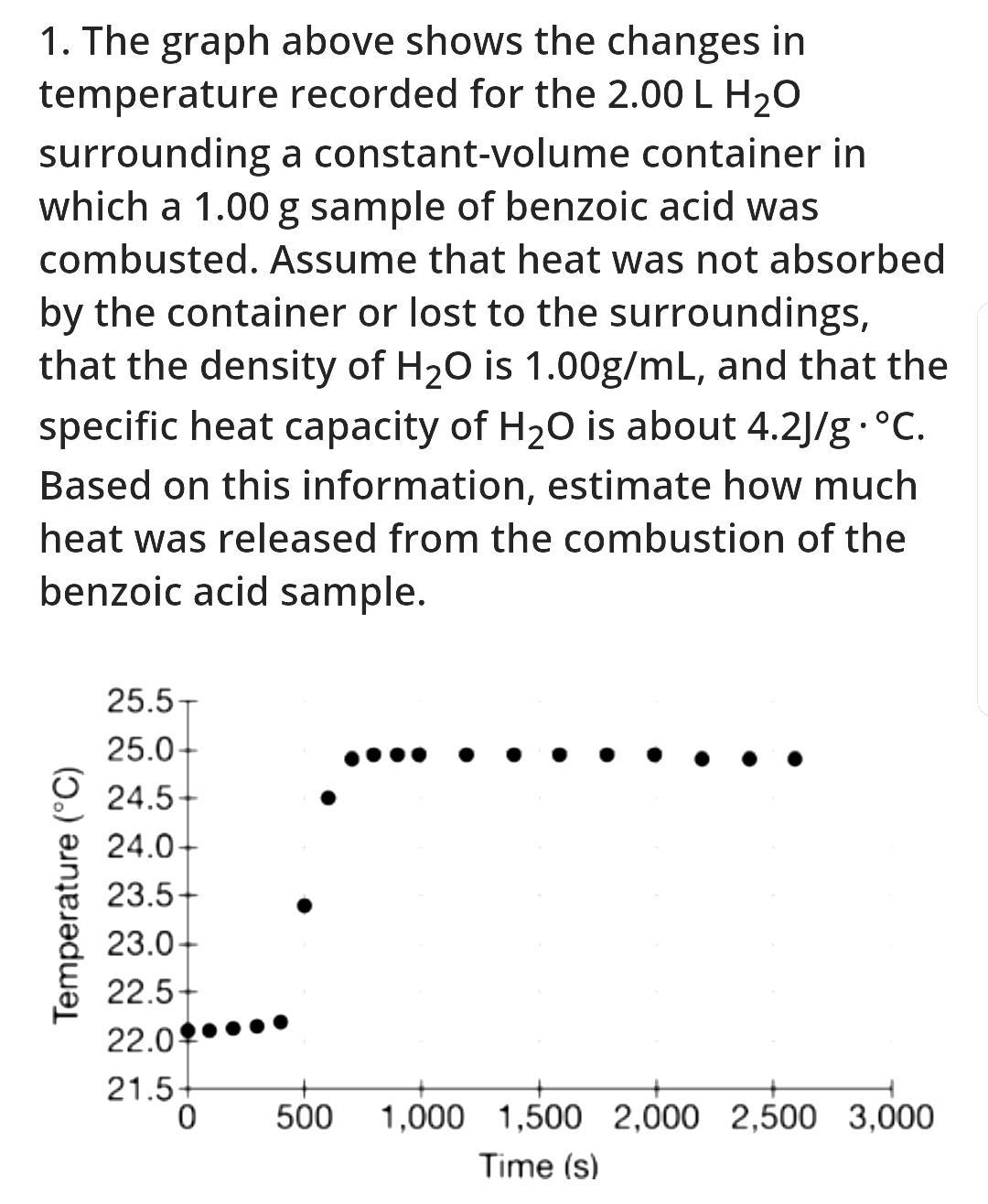
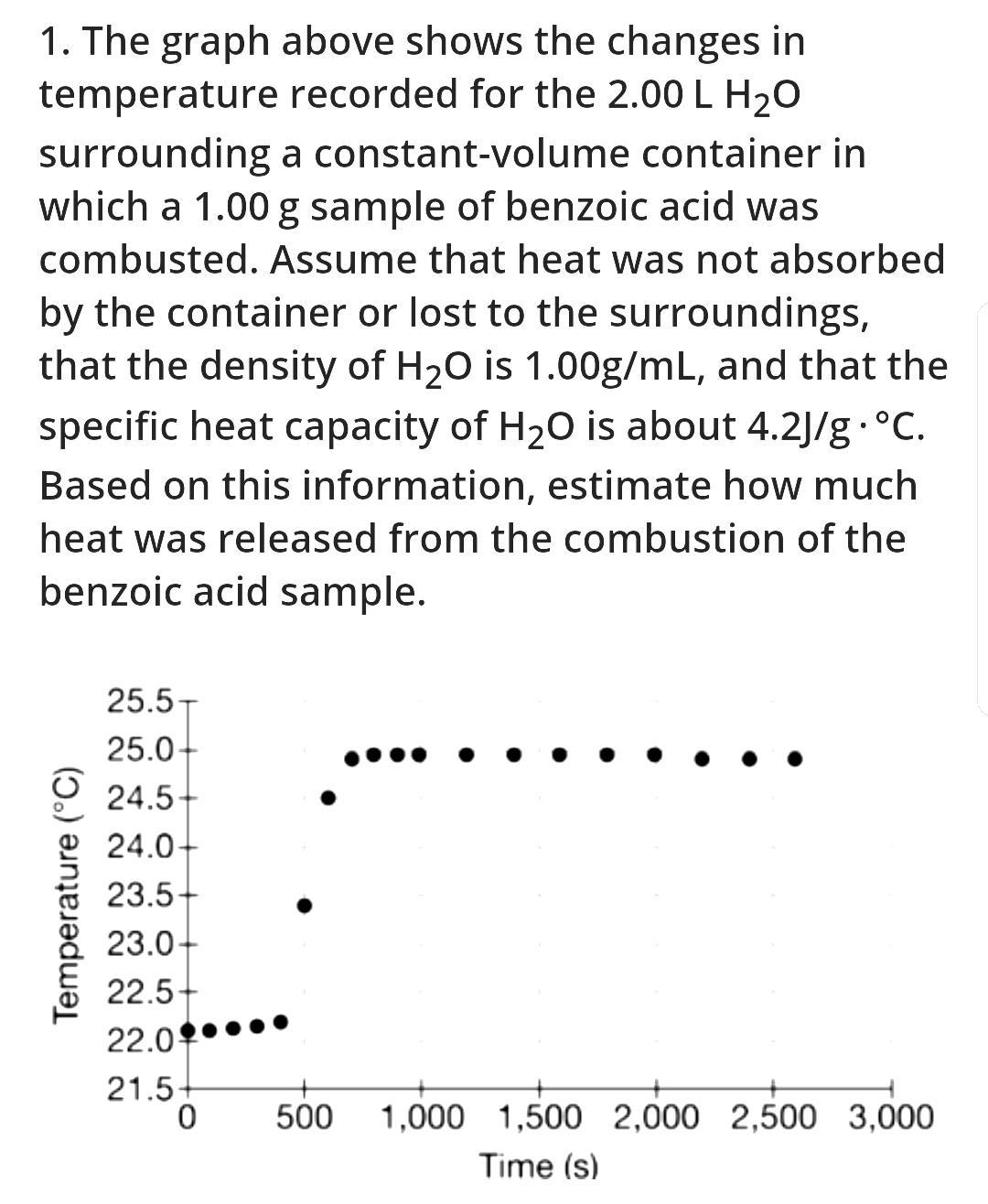
The graph above shows the changes in temperature recorded for the 2.00 l of h2o surrounding a constant-volume container in which

a 1.00 g sample of benzoic acid was combusted. Assume that heat was not absorbed by the container or lost to the surroundings

Chemistry
1 answer:
Otrada [13]2 years ago
6 0

Answer:

25.2 kJ

Explanation:

The complete question is presented in the attached image to this answer.

Note that, the heat gained by the 2.00 L of water to raise its temperature from the initial value to its final value comes entirely from the combustion of the benzoic acid since there are no heat losses to the containing vessel or to the environment.

So, to obtained the heat released from the combustion of benzoic acid, we just calculate the heat required to raise the temperature of the water.

Q = mCΔT

To calculate the mass of water,

Density = (mass)/(volume)

Mass = Density × volume

Density = 1 g/mL

Volume = 2.00 L = 2000 mL

Mass = 1 × 2000 = 2000 g

C = specific heat capacity of water = 4.2 J/g.°C

ΔT = (final temperature) - (Initial temperature)

From the graph,

Final temperature of water = 25°C

Initial temperature of water = 22°C

ΔT = 25 - 22 = 3°C

Q = (2000×4.2×3) = 25,200 J = 25.2 kJ

Hope this Helps!!!
You might be interested in
Using the mass of the proton 1.0073 amu and assuming its diameter is 1.0×10⁻¹⁵m, calculate the density of a proton in g/cm3.
icang [17]

Answer : 3.2 X 10^{15} g/cm^{3}

Explanation :  To convert amu i.e. atomic mass unit in grams we have the conversion factor as 1 amu = 1.66054 X 10^{-24} g

we know the mass of the proton is 1.0073 amu

So converting it into grams we have to multiply;

1.0073 amu X  1.66054 X 10^{-24} g/amu = 1.673 X 10^{-24} g

Now, Volume = 1/6πd³ as diameter is given as 1.0 X 10^{-15} m converting it to cm will require to multiply with 100

∴ Volume  = 1/6π (1.0 X 10^{-15}mX 100 cm / 1 m)^{3}

Hence, volume =  5.236 X 10^{-40} cm^{3}

Therefore, Density = mass / volume

∴ Density =  1.673 X 10^{-24} g / 5.236 X 10^{-40} cm^{3}

Therefore, Density will be 3.2 X 10^{15} g/cm^{3}.

6 0
2 years ago
Read 2 more answers
A group of students are wandering around a room. when their teacher claps, the students sit down wherever they are. this situati
Oksi-84 [34.3K]

an amorphous solid because the particles do not have a regular structure is the answer

8 0
2 years ago
Read 2 more answers
Write a half-reaction for the oxidation of the manganese in MnCO3(s) to MnO2(s) in neutral groundwater where the carbonate-conta
Leokris [45]

Answer:MnCO3+2H2O----->MnO2+ HCO3-+2e-+3H+

Explanation:The equation to be balanced is

MnCO3 ------> MnO2+HCO3-

The oxidation number of Mn changes from +2 in MnCO3 to +4 in MnO2

Therefore two electrons must be added to the right as shown below:

MnCO3 -------> MnO2+ HCO3-+ 2e-Now,there is one negative charge HCO3- and 1 negative charge on the two electrons making a total of -3 charges on the right. There is zero charge on the left.

To balance the equation,add3H+on the right,to cancel out the charges.

MnCO3 --------> MnO2+HCO3-+2e-+3H+

Adding H2O to balance Hydrogen and Oxygen atoms:

MnCO3+2H2O ------->MnO2+HCO3-+2e-+3H+

3 0
2 years ago
If PbI2(s) is dissolved in 1.0MNaI(aq) , is the maximum possible concentration of Pb2+(aq) in the solution greater than, less th
fredd [130]

Answer:

\mathbf{s =\sqrt [3]{\dfrac{K_{sp}}{4}}}

Less than the concentration of Pb2+(aq) in the solution in part ( a )

Explanation:

From the question:

A)

We assume that s to be  the solubility of PbI₂.

The equation of the reaction is given as :

PbI₂(s) ⇌ Pb²⁺(aq) + 2I⁻(aq); Ksp = 7 × 10⁻⁹

 [Pb²⁺] =   s

Then [I⁻] = 2s

K_{sp} =\text{[Pb$^{2+}$][I$^{-}$]}^{2} = s\times (2s)^{2} =  4s^{3}\\s^{3} = \dfrac{K_{sp}}{4}\\\\s =\mathbf{ \sqrt [3]{\dfrac{K_{sp}}{4}}}\\\\\text{The mathematical expressionthat can be used to determine the value of  }\mathbf{s =\sqrt [3]{\dfrac{K_{sp}}{4}}}

B)

The Concentration of Pb²⁺  in water is calculated as :

\mathbf{s =\sqrt [3]{\dfrac{K_{sp}}{4}}}

\mathbf{s =\sqrt [3]{\dfrac{7*10^{-9}}{4}}}

\mathbf{s} =\sqrt[3]{1.75*10^{-9}}

\mathbf{s} =\mathbf{1.21*10^{-3}  \ mol/L }

The Concentration of Pb²⁺  in 1.0 mol·L⁻¹ NaI

\mathbf{PbCl{_2}}  \leftrightharpoons    \ \ \ \ \ \ \  \mathbf{Pb^{2+}}   \ \ \ \  \ +   \ \  \ \ \ \ \ \mathbf{2 I^-}

                             \ \ \ \ \ \ \  \ \   \ \  \ \ \ \ \ \ \  \mathbf0}   \ \ \ \  \ \ \ \ \ \   \ \ \ \ \ \mathbf{1.0}

                            \ \ \ \ \ \ \ \ \ \ \ \ \ \    \ \ \ \ \  \mathbf{+x}   \ \ \ \  \    \ \  \ \ \ \ \ \mathbf{+2x}

                            \ \ \ \ \ \ \ \ \ \ \ \ \ \    \ \ \ \ \  \mathbf{+x}   \ \ \ \  \    \ \  \ \ \ \ \ \mathbf{1.0+2x}

The equilibrium constant:

K_{sp} =[Pb^{2+}}][I^-]^2 \\ \\ K_{sp} = s*(1.0*2s)^2 =7*1.0^{-9} \\ \\ s = 7*10^{-9} \ \  m/L

It is now clear that maximum possible concentration of Pb²⁺ in the solution is less than that in the solution in part (A). This happens due to the  common ion effect. The added iodide ion forces the position of equilibrium to shift to the left, reducing the concentration of Pb²⁺.

3 0
2 years ago
A sample of gasoline contains various hydrocarbons, which comprise atoms of carbon, hydrogen, and oxygen. The hydrocarbons mix t
Naddika [18.5K]

Answer:

  • mixture
  • homogenous mixture  (of hydrocarbons)
  • compound

Explanation:

Mixture can be easily separated by physical methods. Homogeneity and heterogeneity of a mixture is determined by whether the components there in are in a single phase and evenly distributed or not.

A solution has a solute evenly dissolved in  solvent to form a liquid substance.

An element is the basic form of  substance which cannot be broke down into any other simpler unit.  

I hope this was helpful.

4 0
2 years ago
Other questions:
  • How can you tell if a sample contains baking soda and cornstarch or baking powder?
    6·2 answers
  • Carbon dioxide dissolves in water to form carbonic acid. this acid lowers the ph of the water and makes the water corrosive. wha
    12·1 answer
  • Which property to put in which
    14·1 answer
  • You are performing an experiment in your lab. To compare with other experiments you need your results to be in moles. During you
    12·2 answers
  • A solid mixture weighs 0.6813 g. It contains gallium bromide (GaBr3) and other inert impurities. When the solid mixture was diss
    9·2 answers
  • Consider the following reaction: A(g)⇌2B(g). Find the equilibrium partial pressures of A and B for each of the following differe
    11·1 answer
  • 1. Complete the following Data Table as you conduct the lab
    13·2 answers
  • Using the data, which of the following is the rate constant for the rearrangement of methyl isonitrile at 320 ∘C? (HINT: the act
    13·1 answer
  • Read the information on Hydrochloric Acid. List four ways you can avoid injury while using HCl and three steps you would take in
    13·1 answer
  • What it the oxidation number for bromine in the molecule H2Br2O6?
    5·1 answer
Add answer
Login
Not registered? Fast signup
Signup
Login Signup
Ask question!