answer.
Ask question
Login Signup
Ask question
All categories
  • English
  • Mathematics
  • Social Studies
  • Business
  • History
  • Health
  • Geography
  • Biology
  • Physics
  • Chemistry
  • Computers and Technology
  • Arts
  • World Languages
  • Spanish
  • French
  • German
  • Advanced Placement (AP)
  • SAT
  • Medicine
  • Law
  • Engineering
cluponka [151]
2 years ago
3

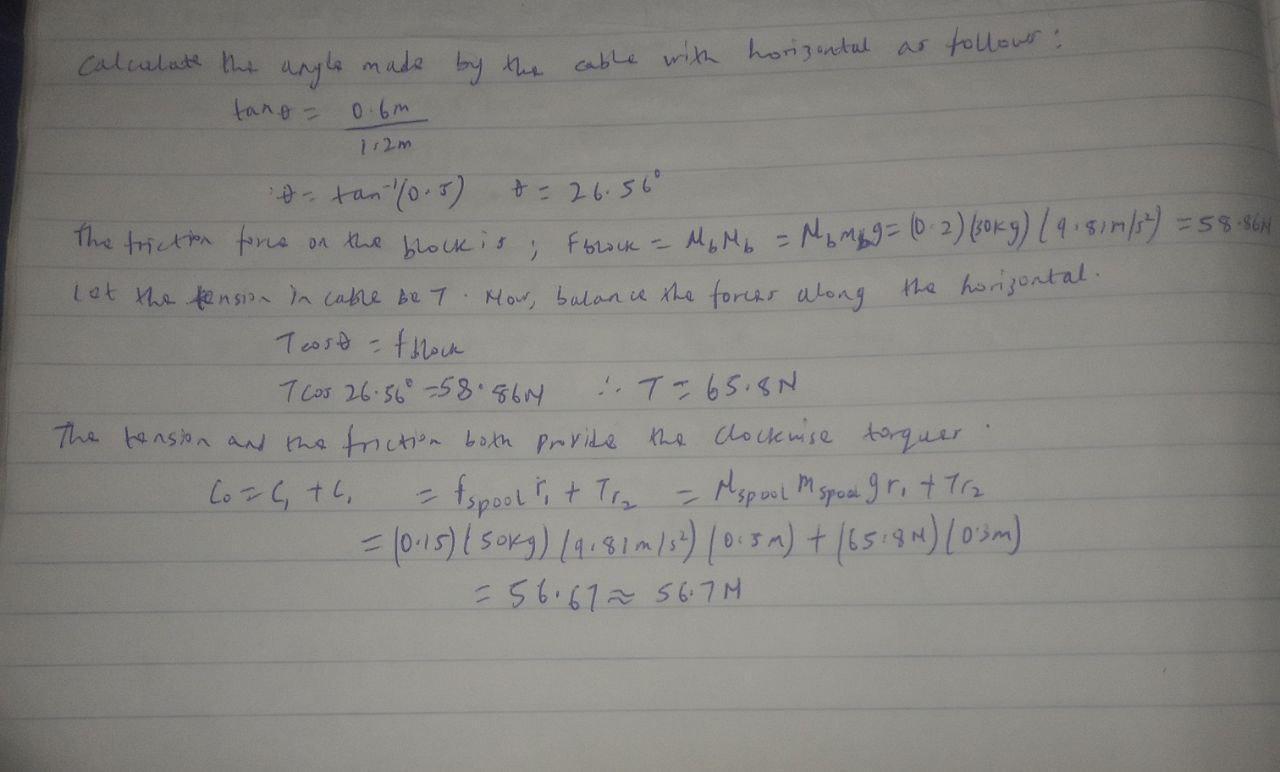
A cable is wound around the hub of a spool that has a mass of 50 kg and center of gravity at G, and is connected to a block with

a mass of 30 kg. It is known that the coefficients of static friction are 0.15 under the spool and 0.2 under the block. Compute the maximum counterclockwise moment of a couple Co that can be applied without disturbing the equilibrium of the system

Physics
1 answer:
Evgen [1.6K]2 years ago
8 0

Answer:

56.7 N

Explanation:

the picture attached within shows the explanation

You might be interested in
An experiment to measure the speed of light uses an apparatus similar to Fizeau's. The distance between the light source and the
Marina86 [1]

Answer:

2.88*10^{8} m/s

Explanation:

The speed of light is given by

c=\frac {2d}{t} and t=\frac {\theta}{\omega} hence

c=\omega\frac {2d}{\theta}

Speed of light is given by

c=900\times 2\pi(\frac {2\times 10}{\frac {2\pi}{2*800}}})=2.88*10^{8} m/s

4 0
2 years ago
Why is the transverse spatial extent of a photon proportional to its wavelength which is a longitudinal quantity?
otez555 [7]
In quantum mechanics, particularly the wave-particle theory, it states that light behaves like a wave or a particle. For the wave behavior, its movement is measured in wavelengths while the time for each wavelength is the frequency. For the particle behavior, according to Planck, the energy of the photon (light particle) is determined as

E = hc/wavelength, where h is the Planck's constant (<span>6.626 x 10⁻³⁴ J-s per particle) and c is the speed of light ( 3 x 10^8m/s)

As you can see, the energy of the photon is INVERSELY PROPORTIONAL to the wavelength with the Planck's constant as the constant of proportionality.</span>
7 0
2 years ago
The mass of Mars is 6.42 × 10²³ kg. Its moon Phobos is 9378 kilometers away from Mars and has a mass of 1.06 × 10¹⁶ kg. What is
dangina [55]

Answer:

5.16 × 10²¹ N

Hope this helps!

4 0
2 years ago
Read 2 more answers
KFC has engineered chickens that do not have beaks and double breast
True [87]
I don't think so.

Before I can accept that rumor, I'll need to see the signed testimony of
two reputable adult witnesses, who have no connection to any business
that profits in any way from the production, sale, or consumption of food,
and who will swear in a public meeting, presided over by three respected
members of their community, that they personally saw more than one of
the alleged beakless double-breasted chickens in the same place at the
same time.

A photo is not acceptable ... not for me, and not for the two witnesses.
6 0
2 years ago
A stone is dropped from rest from the top of a cliff into a pond below. If its initial height is 10 m, what is its speed when it
Jobisdone [24]

Answer:

14 m/s

Explanation:

The problem can be solved by using the law of conservation of energy. In fact:

- The mechanical energy of the stone at the top of the cliff is just gravitational potential energy (because the stone is at rest, so its kinetic energy is zero), and it is given by

E=U=mgh (1)

where m is the mass of the stone, g=9.8 m/s^2 is the acceleration due to gravity, and h=10 m is the height of the cliff.

- The mechanical energy of the stone when it hits the water is just kinetic energy (because the height of the stone has become zero, so the gravitational potential energy is zero), so it is

E=K=\frac{1}{2}mv^2 (2)

where v is the speed of the stone when it hits the water.

Since the mechanical energy is conserved, we can equalize (1) and (2), and solving for v we find:

mgh=\frac{1}{2}mv^2\\v=\sqrt{2gh}=\sqrt{2(9.8 m/s^2)(10 m)}=14 m/s

4 0
2 years ago
Other questions:
  • A 1.0 kg brick falls off a ledge of height 44m and lands on the ground at 3.0 s later.
    6·1 answer
  • Which of the following substances will show the smallest change in temperature when equal amounts of energy are absorbed?
    7·2 answers
  • A car moving 12 m/s stops in 3 seconds vf=
    15·2 answers
  • A box of mass 8 kg slides across a frictionless surface at an initial speed 1.5 m/s into a relaxed spring of spring constant 69
    12·1 answer
  • If you calculate the thermal power radiated by typical objects at room temperature, you will find surprisingly large values, sev
    8·1 answer
  • A bowling ball of mass m=1.7kg is launched from a spring compressed by a distance d=0.31m at an angle of theta=37 measured from
    12·1 answer
  • A 20~\mu F20 μF capacitor has previously charged up to contain a total charge of Q = 100~\mu CQ=100 μC on it. The capacitor is t
    10·1 answer
  • During a game the same batter swings at a ball thrown by the pitcher and hits a line drive. Just before the ball is hit it is tr
    7·1 answer
  • A student placed an ice cube on a table and observed it for five minutes. He noticed that the ice cube seemed to get smaller and
    14·1 answer
  • Intensity: Radiation of a single frequency reaches the upper atmosphere of the earth with an intensity of 1350 W/m2. What is the
    8·1 answer
Add answer
Login
Not registered? Fast signup
Signup
Login Signup
Ask question!