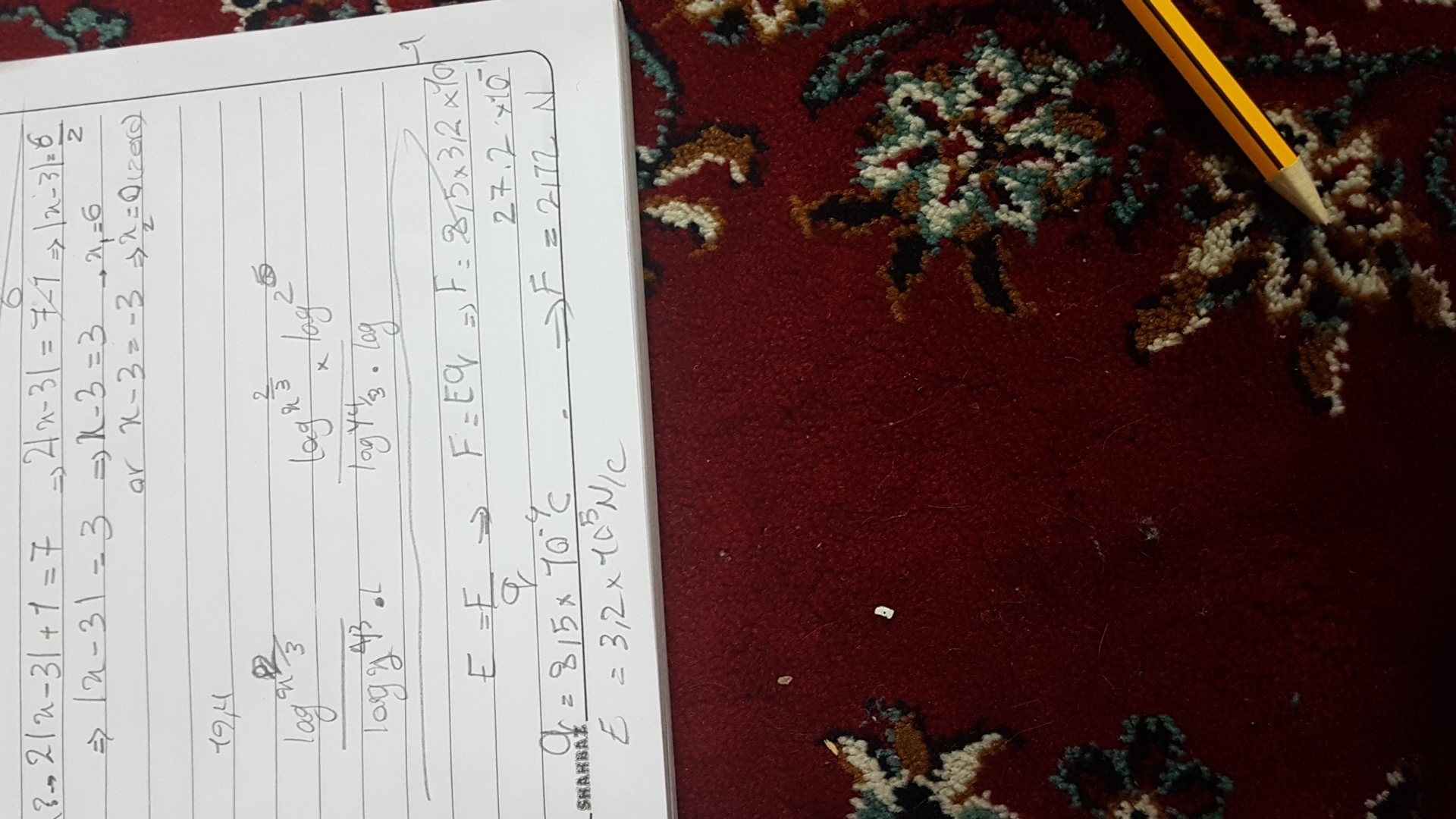
answer.
Ask question
Login Signup
Ask question
All categories
  • English
  • Mathematics
  • Social Studies
  • Business
  • History
  • Health
  • Geography
  • Biology
  • Physics
  • Chemistry
  • Computers and Technology
  • Arts
  • World Languages
  • Spanish
  • French
  • German
  • Advanced Placement (AP)
  • SAT
  • Medicine
  • Law
  • Engineering
laiz [17]
2 years ago
5

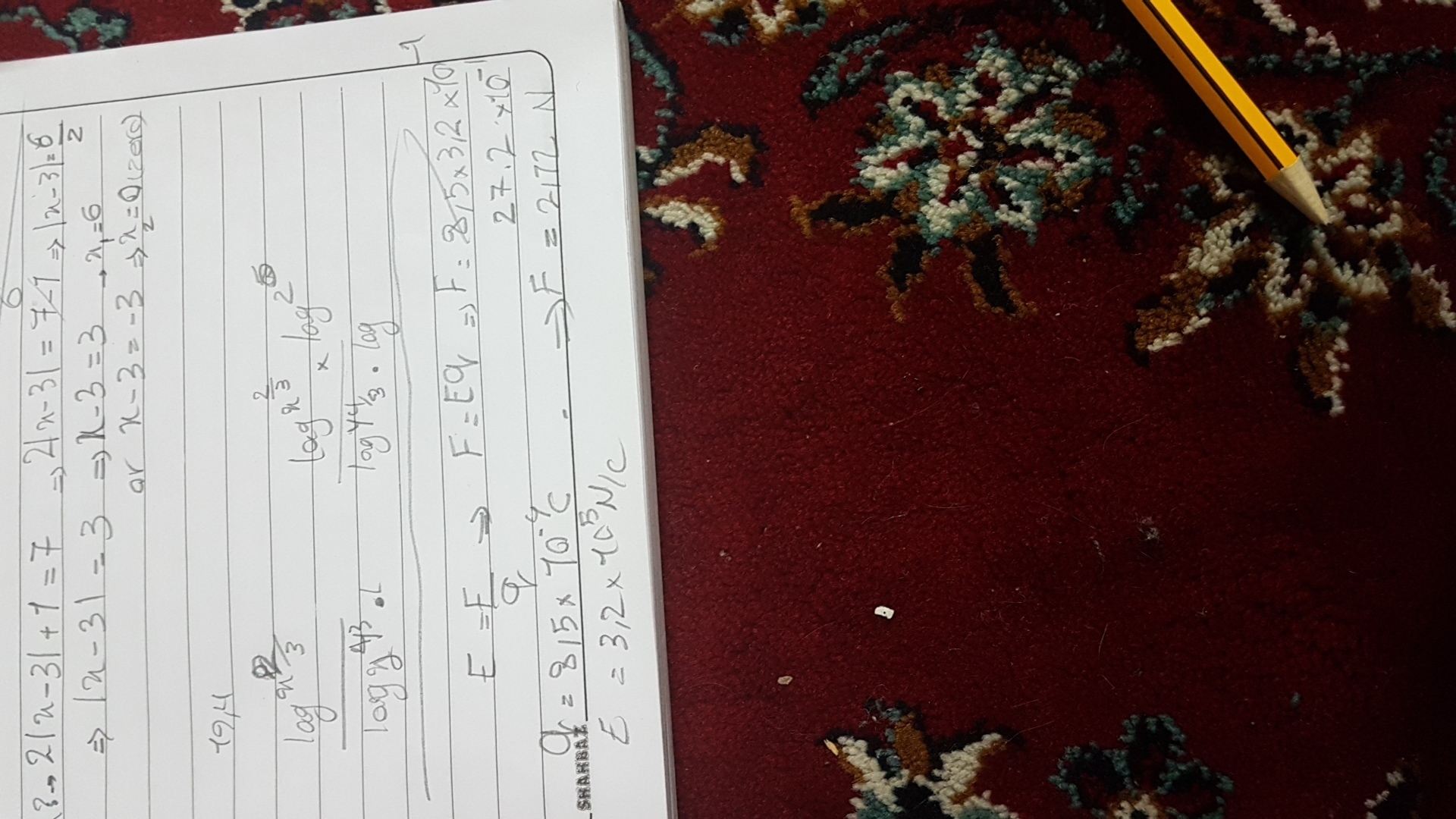
A charge of 8.5 × 10⁻⁶ C is in an electric field that has a strength of 3.2 × 10⁵ N/C. What is the electric force acting on the

charge?

Physics
1 answer:
love history [14]2 years ago
6 0
Ok
here is your anwer
O hope it is useful for you

You might be interested in
Which equation is most likely used to determine the acceleration from a velocity vs:time graph?
tresset_1 [31]
Acceleration, a =  (v - u)/t

where v is the final velocity, u is the initial velocity, and t is the time.

This formula on a velocity time graph represents the slope of the graph.
 
7 0
2 years ago
Read 2 more answers
You start with spring that's already been stretched an unknown amount from equilibrium. After stretching it an additional 2.0 cm
maxonik [38]

Answer: 35*10^3 N/m

Explanation: In order to explain this problem we know that the potential energy for spring is given by:

Up=1/2*k*x^2 where k is the spring constant and x is the streching or compresion position from the equilibrium point for the spring.

We  also know that with additional streching of 2 cm of teh spring,  the potential energy is 18J. Then it applied another additional streching of 2 cm and the energy is 25J.

Then the difference of energy for both cases is 7 J so:

ΔUp= 1/2*k* (0.02)^2 then

k=2*7/(0.02)^2=35000 N/m

7 0
2 years ago
Which of the following strategies can help Earth's coal supply last longer?
ivanzaharov [21]
D. Teach the public energy conservation
7 0
2 years ago
Read 2 more answers
Derive an expression for the total mechanical energy of the system as the monkey reaches the top of the motion, Etop, in terms o
ipn [44]

Answer:

U =  0.5 * k *(x + d - h_max)^2 + m*g*h_max

Explanation:

Given:

- The extension in spring @ equilibrium = x m

- The spring constant = k

- The amount of distance pulled down = d

- mass of the toy = m

Find:

- The total mechanical energy E_top at the top position h_max in terms of the available variables.

Solution:

- First we need to determine the types of Energy that are in play:

- The Elastic potential Energy E_p in a spring is given:

                              E_p: 0.5 * k * (ext)

- In our case when the toy at the top most position h_max will have a net extension ext, by summing displacement of spring:

             ext = Equilibrium + distance pulled - h_max = (x + d - h_max)

Hence, the elastic potential energy will be:

                              E_p = 0.5 * k *(x + d - h_max)^2

- The gravitational potential energy E_g is given by:

                              E_g = m*g*h_max

Where, bottom most position is taken as reference (datum).

- The kinetic Energy E_k is given by:

                              E_k = 0.5*m*v_top^2

- Since we know that the maximum height is reached when velocity is zero

Hence,                   E_k = 0.5*m*0^2 = 0.

The total Energy of the system U is sum of all energies and play:

                               U = E_p + E_k + E_g

                               U =  0.5 * k *(x + d - h_max)^2 + m*g*h_max
8 0
2 years ago
If a rock is thrown upward on the planet mars with a velocity of 14 m/s, its height (in meters) after t seconds is given by h =
crimeas [40]

<u>Answer:</u>

 Velocity of rock after 2 seconds = 6.56 m/s

<u>Explanation:</u>

 We have equation of motion , s= ut+\frac{1}{2} at^2, s is the displacement, u is the initial velocity, a is the acceleration and t is the time.

Here height of rock in meters, h = 14t-1.86t^2

Comparing both the equations

    We will get initial velocity = 14 m/s(already given) and \frac{1}{2} a = -1.86

     So,  Acceleration, a = -3.72 m/s^2

 Now we have equation of motion, v = u + at, where v is the final velocity, u is the initial velocity, a is the acceleration and t is the time taken.

 When time is 2 seconds we need to find final velocity.

     v = 14 - 3.72 * 2 = 6.56 m/s.

  So, Velocity of rock after 2 seconds = 6.56 m/s  

6 0
2 years ago
Other questions:
  • a field hockey ball is launched from the ground at an angle to the horizontal. what are the ball's horizontal and vertical accel
    11·1 answer
  • Every action force has an opposite and equal reaction force. Determine which of these are action/reaction pairs. Check all that
    15·2 answers
  • A 0.500-kg ball traveling horizontally on a frictionless surface approaches a very massive stone at 20.0 m/s perpendicular to wa
    9·1 answer
  • Consider the static equilibrium diagram here. What is the angle F1 must make with the horizontal?
    13·2 answers
  • Which one of the following statements concerning kinetic energy is true? a The kinetic energy of an object always has a positive
    10·1 answer
  • The index of refraction for silicate flint glass is 1.66 for violet light that has a wavelength in air equal to 400 nm and 1.61
    15·1 answer
  • It is initiated by the pressure gradient force. b. It blows from regions of high pressure to regions of low pressure. c. The dir
    14·1 answer
  • If the activation energy for a given compound is found to be 103 kJ/mol, with a frequency factor of 4.0 × 10¹³ s-1, what is the
    10·2 answers
  • A 25-kg iron block initially at 350oC is quenched in an insulated tank that contains 100 kg of water at 18oC. Assuming the water
    13·1 answer
  • A negative charge of -0.550 μC exerts an upward 0.900-N force on an unknown charge that is located 0.300 m directly below the fi
    12·1 answer
Add answer
Login
Not registered? Fast signup
Signup
Login Signup
Ask question!