answer.
Ask question
Login Signup
Ask question
All categories
  • English
  • Mathematics
  • Social Studies
  • Business
  • History
  • Health
  • Geography
  • Biology
  • Physics
  • Chemistry
  • Computers and Technology
  • Arts
  • World Languages
  • Spanish
  • French
  • German
  • Advanced Placement (AP)
  • SAT
  • Medicine
  • Law
  • Engineering
weqwewe [10]
2 years ago
6

Susan's 12.0 kg baby brother Paul sits on a mat. Susan pulls the man across the floor using a rope that is angled 30 degree abov

e the floor. The tension is a constant 29.0 N and the coefficient of friction is 0.210. Use work and energy to find Paul's speed after being pulled 2.90 m.

Physics
1 answer:
tia_tia [17]2 years ago
7 0

Answer:      

<em>Paul speed after being pulled 2.9 m is 2.68m/s.</em>

Explanation:

<em> The work energy theorem</em>, change in kinetic energy of the object  from initial position to the final position is equal to the work done on the object ie when the force is applied on  the object the object changes its position and work is done on the object.

According to<em> the law of conservation of energy</em> ,

ΔE = W,  eqn 1

where ΔE  is the change in object energy

          W is the all the work done on the object.

Work done is written as W =F dcosθ

Where F is the force,

           d is the distance,

            θ is the angle between the force and displacement vector.

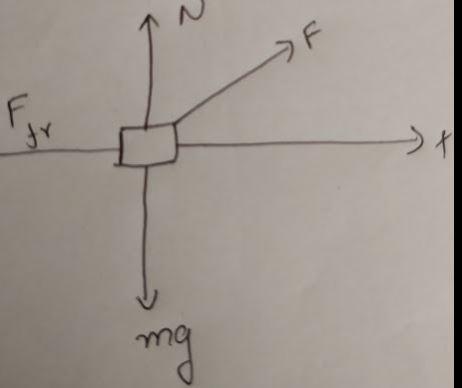
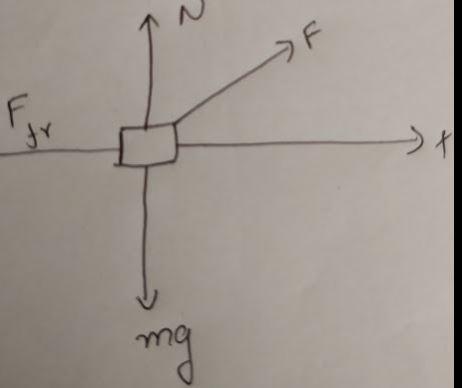
From the figure given below,

The work of friction is given by W₁  = F₁ d cos180°

The work of  pulling force is given by W₂ =F₂ dcos 30°

Change in object energy  ΔE = mv²/2.

Applying Newton first law along Y axis,

Fsin30° + N =mg

Normal force N =mg - Fsin30°

Frictional Force F₁ =μN =μ(mg - Fsin30°)

Substituting in eqn 1

mv²/2 = F₂ dcos 30°+ μ(mg - Fsin30°)d cos180°

          =\frac{\sqrt{3} }{2} F₂ d -  μ(mg - \frac{F}{2})d

v² = \sqrt{3} \frac{F}{m}d - 2μgd +

here m  = 12 kg,

        d = 2.9 m.

        μ = 0.21

        F = 29 N

Sub all values,              

v² =  7.2

v = 2.68m/s

<em>Paul speed after being pulled 2.9 m is 2.68m/s.</em>
You might be interested in
Cass is walking her dog (Oreo) around the neighborhood. Upon arriving at Calina's house (a friend of Oreo's), Oreo turns part mu
MArishka [77]

Answer:

Horizontal component: F_x = 58\ N

Vertical component: F_y = 33.5\ N

Explanation:

To find the horizontal and vertical components of the force, we just need to multiply the magnitude of the force by the cosine and sine of the angle with the horizontal, respectively.

Therefore, for the horizontal component, we have:

F_x = F * cos(angle)

F_x = 67 * cos(30)

F_x = 58\ N

For the vertical component, we have:

F_y = F * sin(angle)

F_y = 67 * sin(30)

F_y = 33.5\ N

So the horizontal component of the tension force is 58 N and the vertical component is 33.5 N.

4 0
2 years ago
An unspecified force causes a 0.20-kg object to accelerate at 0.40 m/s2. If 0.30 kg is added to the 0.20-kg object and the force
Naddik [55]

Answer:

a = 0.16

Explanation:

given,

mass of the object 1 = 0.2 kg

mass of the object 2 = 0.3 kg

acceleration when force is on 0.2 kg = 0.4 m/s²

acceleration when both mass are combine = ?

F = m a

F = 0.2 × 0.4

F = 0.08 N

force acting is same and total mass  = 0.2 + 0.3 = 0.5 Kg

F = m a

a = \dfrac{F}{m}

a = \dfrac{0.08}{0.5}

a = 0.16 m/s²

the acceleration  acting when both the body is attached is a = 0.16

4 0
2 years ago
Use the periodic table and your knowledge of isotopes to complete these statements.
klasskru [66]
<span><span>Use the periodic table and your knowledge of isotopes to complete these statements.

When polonium-210 emits an alpha particle, the child isotope has an atomic mass of </span><span> ⇒ 206</span>.</span>

<span><span>I-131 undergoes beta-minus decay. The chemical symbol for the new element is </span><span> ⇒ Xe</span>.</span>

<span><span>Fluorine-18 undergoes beta-plus decay. The child isotope has an atomic mass of </span><span> ⇒ 18</span>.</span>

7 0
2 years ago
Read 2 more answers
Racing greyhounds are capable of rounding corners at very high speeds. A typical greyhound track has turns that are 45-m-diamete
Margarita [4]

Explanation:

It is given that,

Diameter of the semicircle, d = 45 m

Radius of the semicircle, r = 22.5 m      

Speed of greyhound, v = 15 m/s

The greyhound is moving under the action of centripetal acceleration. Its formula is given by :

a=\dfrac{v^2}{r}

a=\dfrac{(15)^2}{22.5}

a=10\ m/s^2

We know that, g=9.8\ m/s^2

a=\dfrac{10\times g}{9.8}

a=1.02\ g

Hence, this is the required solution.                                              

5 0
2 years ago
Given an electron beam whose electrons have kinetic energy of 10.0 kev , what is the minimum wavelength λmin of light radiated b
kolbaska11 [484]
To answer the problem we would be using this formula which isE = hc/L where E is the energy, h is Planck's constant, c is the speed of light and L is the wavelength 
L = hc/E = 4.136×10⁻¹⁵ eV·s (2.998x10^8 m/s)/10^4 eV 

= 1.240x10^-10 m 

= 1.240x10^-1 nm
3 0
2 years ago
Read 2 more answers
Other questions:
  • A cave explorer travels 3.0 m eastward, then 2.5 m northward, and finally 15.0 m westward. use the graphical method to find the
    8·2 answers
  • A rock is thrown horizontally at a speed of 5.0 m/s from the top of a cliff 64.7 m high. The rock hits the ground 18.0 m from th
    14·2 answers
  • On a snowy day, when the coefficient of friction μs between a car’s tires and the road is 0.50, the maximum speed that the car c
    6·2 answers
  • A 0.500 kg aluminum pan on a stove is used to heat 0.250 liters of water from 20.0ºC to 80.0ºC. (a) How much heatis required? Wh
    15·1 answer
  • An astronaut exploring a distant solar system lands on an unnamed planet with a radius of 2530 km. When the astronaut jumps upwa
    11·1 answer
  • What is the force per meter on a lightning bolt at the equator that carries 20,000 A perpendicular to Earth’s 3.0e−5 T field? (b
    8·1 answer
  • 1)After catching the ball, Sarah throws it back to Julie. However, Sarah throws it too hard so it is over Julie's head when it r
    9·1 answer
  • Snowboarder Jump—Energy and Momentum
    9·1 answer
  • A rod bent into the arc of a circle subtends an angle 2θ at the center P of the circle (see below). If the rod is charged unifor
    9·1 answer
  • A quarterback passes a football from height h = 2.1 m above the field, with initial velocity v0 = 13.5 m/s at an angle θ = 32° a
    9·1 answer
Add answer
Login
Not registered? Fast signup
Signup
Login Signup
Ask question!