answer.
Ask question
Login Signup
Ask question
All categories
  • English
  • Mathematics
  • Social Studies
  • Business
  • History
  • Health
  • Geography
  • Biology
  • Physics
  • Chemistry
  • Computers and Technology
  • Arts
  • World Languages
  • Spanish
  • French
  • German
  • Advanced Placement (AP)
  • SAT
  • Medicine
  • Law
  • Engineering
NARA [144]
2 years ago
4

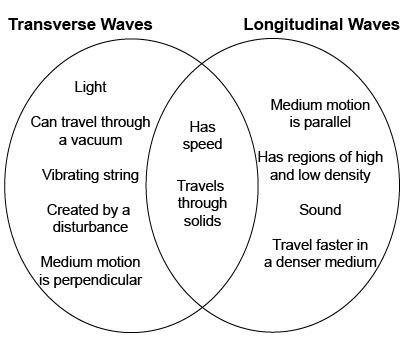
Following a lecture on transverse and longitudinal waves, four students make Venn diagrams to characterize these waves.

Physics
2 answers:
Pavel [41]2 years ago
9 0

Answer:

B

Explanation:

kotykmax [81]2 years ago
4 0

Answer:

B

Explanation:

Waves are periodic oscillations created by a disturbance, that travel carrying energy but not matter.

There exist two types of waves:

- Transverse waves: the direction of the oscillations is perpendicular to the direction of motion of the wave. These waves are characterized by the presence of crests (points of maximum positive displacement) and troughs (points of maximum negative displacement).An example of transverse wave are electromagnetic waves, which are produced by the oscillations of electric and magnetic field, and they are the only waves able to travel in a vacuum.

- Longitudinal waves: the direction of the oscillations is parallel to the direction of motion of the wave. These waves are characterized by the presence of compressions (regions where the particle density is higher) and rarefactions (regions where the particle density is lower). An example of longitudinal waves are sound waves.  Longitudinal waves are not able to travel trough a vacuum, but they travel faster in a denser medium.

We see that the correct Venn diagram that matches all the properties described above is diagram B.

You might be interested in
Consider an object with s=12cm that produces an image with s′=15cm. Note that whenever you are working with a physical object, t
Leni [432]

A. 6.67 cm

The focal length of the lens can be found by using the lens equation:

\frac{1}{f}=\frac{1}{s}+\frac{1}{s'}

where we have

f = focal length

s = 12 cm is the distance of the object from the lens

s' = 15 cm is the distance of the image from the lens

Solving the equation for f, we find

\frac{1}{f}=\frac{1}{12 cm}+\frac{1}{15 cm}=0.15 cm^{-1}\\f=\frac{1}{0.15 cm^{-1}}=6.67 cm

B. Converging

According to sign convention for lenses, we have:

- Converging (convex) lenses have focal length with positive sign

- Diverging (concave) lenses have focal length with negative sign

In this case, the focal length of the lens is positive, so the lens is a converging lens.

C. -1.25

The magnification of the lens is given by

M=-\frac{s'}{s}

where

s' = 15 cm is the distance of the image from the lens

s = 12 cm is the distance of the object from the lens

Substituting into the equation, we find

M=-\frac{15 cm}{12 cm}=-1.25

D. Real and inverted

The magnification equation can be also rewritten as

M=\frac{y'}{y}

where

y' is the size of the image

y is the size of the object

Re-arranging it, we have

y'=My

Since in this case M is negative, it means that y' has opposite sign compared to y: this means that the image is inverted.

Also, the sign of s' tells us if the image is real of virtual. In fact:

- s' is positive: image is real

- s' is negative: image is virtual

In this case, s' is positive, so the image is real.

E. Virtual

In this case, the magnification is 5/9, so we have

M=\frac{5}{9}=-\frac{s'}{s}

which can be rewritten as

s'=-M s = -\frac{5}{9}s

which means that s' has opposite sign than s: therefore, the image is virtual.

F. 12.0 cm

From the magnification equation, we can write

s'=-Ms

and then we can substitute it into the lens equation:

\frac{1}{f}=\frac{1}{s}+\frac{1}{s'}\\\frac{1}{f}=\frac{1}{s}+\frac{1}{-Ms}

and we can solve for s:

\frac{1}{f}=\frac{M-1}{Ms}\\f=\frac{Ms}{M-1}\\s=\frac{f(M-1)}{M}=\frac{(-15 cm)(\frac{5}{9}-1}{\frac{5}{9}}=12.0 cm

G. -6.67 cm

Now the image distance can be directly found by using again the magnification equation:

s'=-Ms=-\frac{5}{9}(12.0 cm)=-6.67 cm

And the sign of s' (negative) also tells us that the image is virtual.

H. -24.0 cm

In this case, the image is twice as tall as the object, so the magnification is

M = 2

and the distance of the image from the lens is

s' = -24 cm

The problem is asking us for the image distance: however, this is already given by the problem,

s' = -24 cm

so, this is the answer. And the fact that its sign is negative tells us that the image is virtual.
3 0
2 years ago
Which of the following are inertial reference frames? A. A car driving at steady speed on a straight and level road. B. A car dr
Aloiza [94]

Answers:

A. A car driving at steady speed on a straight and level road.

B. A car driving at steady speed up a 10∘ incline.

Explanation:

An object is said to be in an inertial reference frame if the net force acting on the object is zero. According to Newton's second law, this also means that the acceleration of the object is also zero:

F=ma

Since F=0, a=0 as well.

Let's now analyze each case.

A. A car driving at steady speed on a straight and level road. --> YES: this is an inertial reference frame, because the car is keeping a constant speed and a constant direction, so its velocity is not changing, and its acceleration is zero.

B. A car driving at steady speed up a 10∘ incline. --> YES: this is an inertial reference frame, because the car is keeping a constant speed and a constant direction, so its velocity is not changing, and its acceleration is zero.

C. A car speeding up after leaving a stop sign. --> NO: this is not an intertial reference frame, because the car is speeding up, so it is accelerating.

D. A car driving at steady speed around a curve. --> NO: this is not an inertial reference frame, because the car is changing direction, therefore its velocity is changing and so the car is accelerating.

So the only two choices which are correct are A and B.

8 0
2 years ago
Read 2 more answers
A uniform magnetic field of 0.50 T is directed along the positive x axis. A proton moving with a speed of 60 km s enters this fi
tatuchka [14]

Explanation:

It is given that,

Magnetic field, B = 0.5 T

Speed of the proton, v = 60 km/s = 60000 m/s

The helical path followed by the proton shown has a pitch of 5.0 mm, p = 0.005 m

We need to find the  angle between the magnetic field and the velocity of the proton. The pitch of the helix is the product of parallel component of velocity and time period. Mathematically, it is given by :

p=v_{||}\times T

p=v\ cos\theta\times \dfrac{2\pi m}{Bq}

cos\theta=\dfrac{pBq}{2\pi mv}

cos\theta=\dfrac{0.005\times 0.5\times 1.6\times 10^{-19}}{2\pi \times 1.67\times 10^{-27}\times 60000}

\theta=50.58^{\circ}

So, the angle between the magnetic field and the velocity of the proton is 50.58 degrees. Hence, this is the required solution.

3 0
2 years ago
A 0.200 kg plastic ball moves with a velocity of 0.30 m/s. It collides with a second plastic ball of mass 0.100 kg, which is mov
zzz [600]

Answer:

0.22m/s

Explanation:

The total momentum of the System is conserved. Total momentum of the system before the collision is equal to the total momentum of the system after collision. The total momentum is the sum of individual momentum of all the objects in that system.

momentum of an object = mass* velocity

Total Momentum before collision = 0.2*0.3 + 0.1*0.1= 0.07 kg⋅m/s;

Total momentum after collision = 0.1*0.26 + 0.2*x = 0.07;

Solve for x.

4 0
2 years ago
A DJ starts up her phonograph player. The turntable accelerates uniformly from rest, and takes t1 = 11.9 seconds to get up to it
Degger [83]

Answer:

a)\omega_1=8.168\,rad.s^{-1}

b)n_1=7.735 \,rev

c)\alpha_1 =0.6864\,rad.s^{-2}

d)\alpha_2=4.1454\,rad.s^{-2}

e)t_2=1.061\,s

Explanation:

Given that:

  • initial speed of turntable, N_0=0\,rpm\Rightarrow \omega_0=0\,rad.s^{-1}
  • full speed of rotation, N_1=78 \,rpm\Rightarrow \omega_1=\frac{78\times 2\pi}{60}=8.168\,rad.s^{-1}
  • time taken to reach full speed from rest, t_1=11.9\,s
  • final speed after the change,  N_2=120\,rpm\Rightarrow \omega_2=\frac{120\times 2\pi}{60}=12.5664\,rad.s^{-1}
  • no. of revolutions made to reach the new final speed,  n_2=11\,rev

(a)

∵ 1 rev = 2π radians

∴ angular speed ω:

\omega=\frac{2\pi.N}{60}\, rad.s^{-1}

where N = angular speed in rpm.

putting the respective values from case 1 we've

\omega_1=\frac{2\pi\times 78}{60}\, rad.s^{-1}

\omega_1=8.168\,rad.s^{-1}

(c)

using the equation of motion:

\omega_1=\omega_0+\alpha . t_1

here α is the angular acceleration

78=0+\alpha_1\times 11.9

\alpha_1 = \frac{8.168 }{11.9}

\alpha_1 =0.6864\,rad.s^{-2}

(b)

using the equation of motion:

\omega_1\,^2=\omega_0\,^2+2.\alpha_1 .n_1

8.168^2=0^2+2\times 0.6864\times n_1

n_1=48.6003\,rad

n_1=\frac{48.6003}{2\pi}

n_1=7.735\, rev

(d)

using equation of motion:

\omega_2\,^2=\omega_1\,^2+2.\alpha_2 .n_2

12.5664^2=8.168^2+2\alpha_2\times 11

\alpha_2=4.1454\,rad.s^{-2}

(e)

using the equation of motion:

\omega_2=\omega_1+\alpha_2 . t_2

12.5664=8.168+4.1454\times t_2

t_2=1.061\,s

4 0
2 years ago
Other questions:
  • A soccer player with a mass of 60 kg is traveling at 8 m/s when he completes a corner kick on a 0.45 kg soccer ball. The soccer
    13·2 answers
  • A runner has a momentum of 720 kg m/s and is traveling at a velocity of 5 m/s. What is his mass?
    12·2 answers
  • Determine the sign (+ or −) of the torque about the elbow caused by the biceps, τbiceps, the sign of the weight of the forearm,
    5·1 answer
  • A car came to a stop from a speed of 35 m/s in a time of 8.1 seconds. What was the acceleration of the car?
    14·2 answers
  • The simulation kept track of the variables and automatically recorded data on object displacement, velocity, and momentum. If th
    9·2 answers
  • For which of the following problems would a scientist most likely use carbon-14?
    7·1 answer
  • A uniform thin circular rubber band of mass M and spring constant k has an original radius R?
    11·1 answer
  • a)A concentration C(mol/L) varies with time (min) according to the equation C=3.00exp(−2.00t) a) What are the implicit units of
    7·1 answer
  • 500mL of He at 98 kPa expands to 750 mL. Find P2
    14·1 answer
  • What is the volume of an irregularly shaped object that has a mass 3.0 grams and a density of 6.0 g/mL
    11·1 answer
Add answer
Login
Not registered? Fast signup
Signup
Login Signup
Ask question!
