answer.
Ask question
Login Signup
Ask question
All categories
  • English
  • Mathematics
  • Social Studies
  • Business
  • History
  • Health
  • Geography
  • Biology
  • Physics
  • Chemistry
  • Computers and Technology
  • Arts
  • World Languages
  • Spanish
  • French
  • German
  • Advanced Placement (AP)
  • SAT
  • Medicine
  • Law
  • Engineering
Anika [276]
2 years ago
10

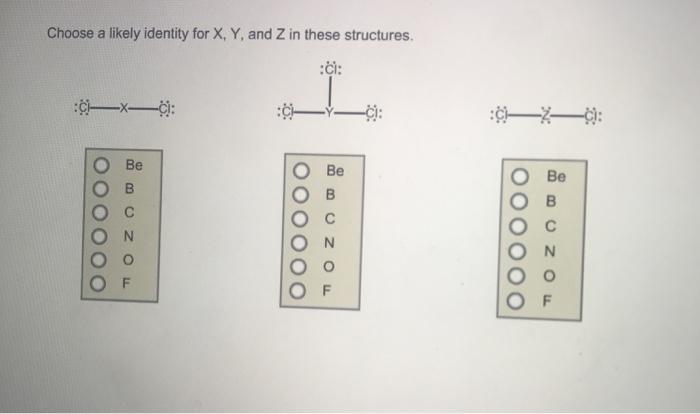
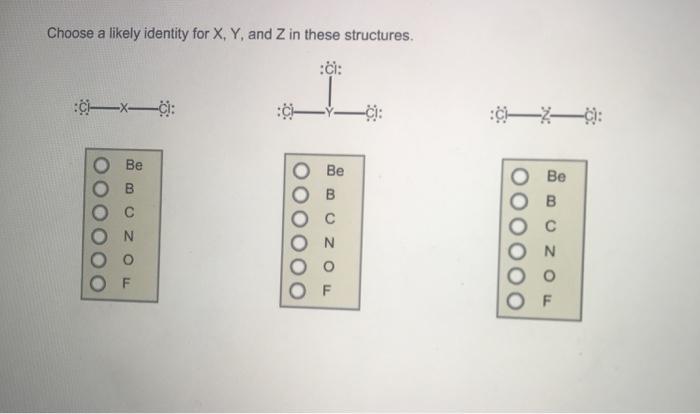
Choose a likely identity for X, Y, and Z in these structures. A central X atom is bonded to two chlorine atoms through single bo

nds. There are three lone pairs of electrons on each chlorine atom. C O B Be F N A central Y atom is bonded to three chlorine atoms through single bonds. There are three lone pairs of electrons on each chlorine atom. A central Z atom is bonded to two chlorine atoms through single bonds. There are three lone pairs of electrons on each chlorine atom and two lone pairs of electrons on the Z atom. C O N F Be B F C N Be B O

Chemistry
1 answer:
natka813 [3]2 years ago
6 0

Complete Question

The complete question is shown on the first uploaded image

Answer:

X  is Be

Y  is B

Z  is  O            

Explanation:

In order to understand the solution, we need to that the an element form a bond based on

1  The number of valence electron available in its atom

2 The  number of electron it require to attains its stable state i.e its Octet  state

        The number of valence electron for each of the option  are

                 F = 7,   N = 5 , O = 6 , C = 4 , B = 3 , Be = 2

 Considering the first element

           We see that  X is donating  two valence electron in its atom and it is donating it to 2  Cl as Cl  only requires a single electron to achieve its stable state

Now looking  option we can see that  Be has two valence  electron in it atom and in order for it to attain its stable state it needs to release the electron so the correct option for this question is Be

Considering the second  element              

      We see that  Y is donating  three valence electron in its atom and it is donating it to 3  Cl as Cl  only requires a single electron to achieve its stable state    

    Now looking  option we can see that  B has three valence  electron in it atom and in order for it to attain its stable state it needs to release the valence electron so the correct option for this question is B

Considering the second  element  

      We see that  Z is donating two valence electron in its atom and it is donating it to 2  Cl as Cl  only requires a single electron to achieve its stable state, also Z has 2 lone-pair valence electron

       Now looking at the option we can see that  O has 6 valence electron so if it donates 2 valence electron it will still be left with 4 - pair of electron

   Therefore the correct option to this question is  O                  
You might be interested in
A vessel contained N2, Ar, He, and Ne. The total pressure in the vessel was 987 torr. The partial pressures of nitrogen, argon,
xz_007 [3.2K]

Answer:

The partial pressure of neon in the vessel was 239 torr.

Explanation:

In all cases involving gas mixtures, the total gas pressure is related to the partial pressures, that is, the pressures of the individual gaseous components of the mixture. Put simply, the partial pressure of a gas is the pressure it exerts on a mixture of gases.

Dalton's law states that the total pressure of a mixture of gases is equal to the sum of the pressures that each gas would exert if it were alone. Then:

PT= P1 + P2 + P3 + P4…+ Pn

where n is the amount of gases present in the mixture.

In this case:

PT=PN₂ + PAr + PHe + PNe

where:

  • PT= 987 torr
  • PN₂= 44 torr
  • PAr= 486 torr
  • PHe= 218 torr
  • PNe= ?

Replacing:

987 torr= 44 torr + 486 torr + 218 torr + PNe

Solving:

987 torr= 748 torr + PNe

PNe= 987 torr - 748 torr

PNe= 239 torr

<u><em>The partial pressure of neon in the vessel was 239 torr.</em></u>

4 0
2 years ago
According to Newton's first law of physics, what will a bowling ball do as it rolls down the bowling alley?
Nitella [24]

Answer:

Because there is no friction, Newton's first law states that the ball should continue to roll. (continue at a constant speed)

Explanation:

Unless acted upon by an unbalanced force, Newton's first law of motion states that an object at rest stays at rest and an object in motion stays in motion with the same speed and direction.

6 0
2 years ago
An empty beaker is weighed and found to weigh 23.1 g. Some potassium chloride is then added to the beaker and weighed again. The
GuDViN [60]

Answer:Mass of Potassium chloride =1.762g

Explanation:

Mass of empty beaker = 23.100 g

Mass of beaker with Potassium chloride = 24.862g

Mass of Potassium chloride = Final weight - initial weight = Mass of beaker with Potassium chloride  - Mass of empty beaker = 24.862-23.100 = 1.762g

8 0
2 years ago
When explaining chemical reactions to a friend, Brianna models a reaction by taking several colors of modeling clay and making a
pickupchik [31]

Explanation: Here are the different coloured that are used to join and make one piece this method that Brianna is following is called synthesis.

7 0
2 years ago
Read 2 more answers
Which bond from each set has the greatest bond energy and why?. A.) N-O or N-F. B.) B-F or B-Cl. C.) B-C or O-F. D.) C-O or C=O.
sergiy2304 [10]
Bond energy is basically how much energy it takes to break that molecule apart. The main things that affect bond energy is electronegativity and the number of bonds. I believe the correct answer is C=O. It <span>has the greatest bond energy, because it is harder to break apart a double bond than a single bond.</span>
8 0
2 years ago
Other questions:
  • As ice transforms into steam, A)new molecules are formed. B)the types of atoms are changed. C)energy is absorbed by the molecule
    9·2 answers
  • What is the advantage of having large vertebrae at the base of the vertebral column?
    14·1 answer
  • Which diatomic molecule is formed when the two atoms share six electrons
    5·2 answers
  • In a scientific experiment, the factor that may change in response to the manipulated variable is called the ______ variable.
    9·1 answer
  • The [H3O+] in a solution is increased to twice the original concentration. Which change could occur in the pH? 2.0 to 4.0 1.7 to
    14·2 answers
  • PLEASEEE PLEASEEE HELP
    8·1 answer
  • Larisa pumps up a soccer ball until it has a gauge pressure of 61 kilopascals. The volume of the ball is 5.2 liters. The air tem
    15·1 answer
  • Sulfur dioxide has a vapor pressure of 462.7 mm Hg at –21.0 °C and a vapor pressure of 140.5 mm Hg at –44.0 °C. What is the enth
    8·1 answer
  • (g) On the graph in part (d) , carefully draw a curve that shows the results of the second titration, in which the student titra
    14·1 answer
  • In recent years, assistive technologies have been developed to give people
    12·1 answer
Add answer
Login
Not registered? Fast signup
Signup
Login Signup
Ask question!