answer.
Ask question
Login Signup
Ask question
All categories
  • English
  • Mathematics
  • Social Studies
  • Business
  • History
  • Health
  • Geography
  • Biology
  • Physics
  • Chemistry
  • Computers and Technology
  • Arts
  • World Languages
  • Spanish
  • French
  • German
  • Advanced Placement (AP)
  • SAT
  • Medicine
  • Law
  • Engineering
Eva8 [605]
2 years ago
9

Consider an oil-to-oil double-pipe heat exchanger whose flow arrangement is not known. The temperature measurements indicate tha

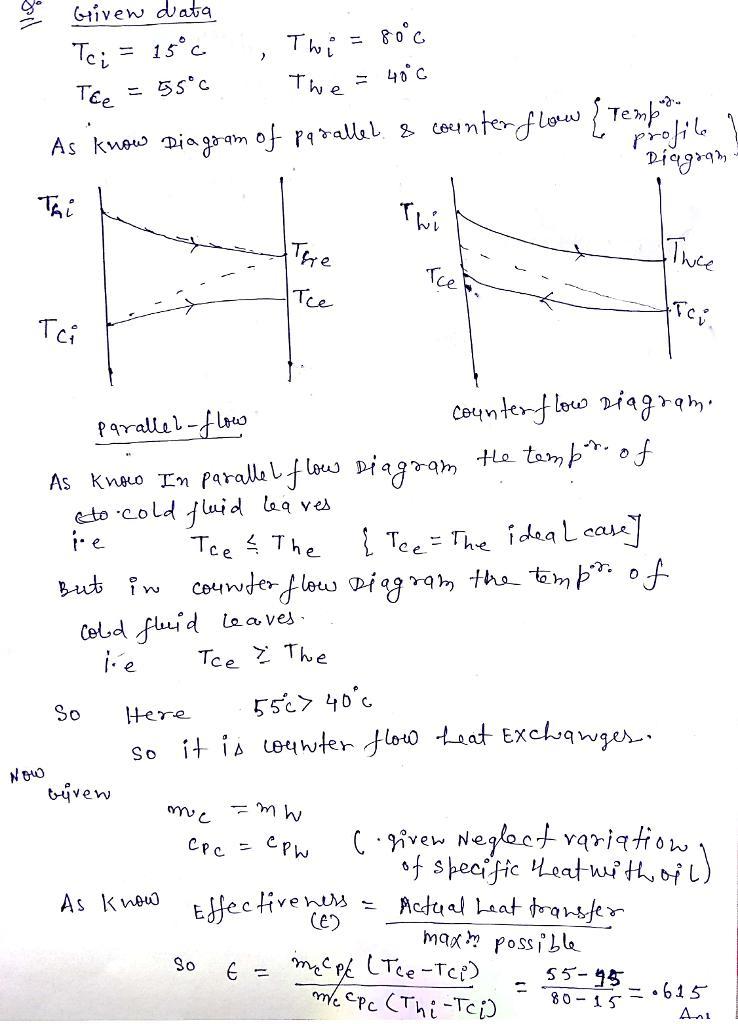
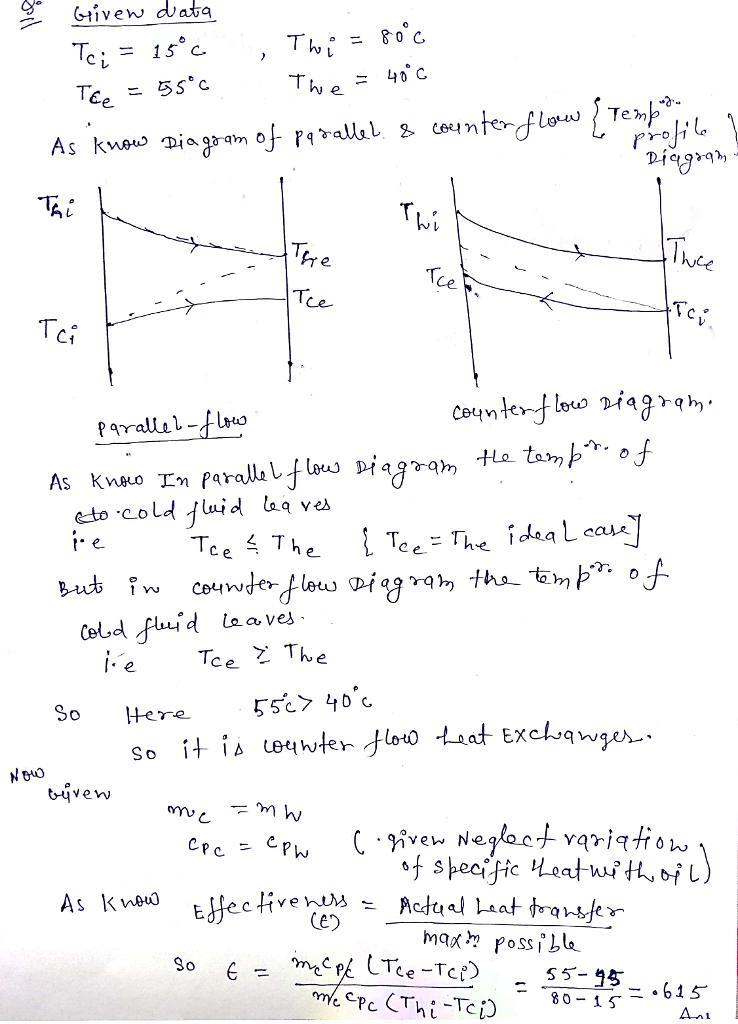
t the cold oil enters at 15°C and leaves at 55°C, while the hot oil enters at 80°C and leaves at 40°C. Do you think this is a parallel-flow or counter-flow heat exchanger? Why? Assuming the mass flow rates of both fluids to be identical, determine the effectiveness of this heat exchanger.

Chemistry
1 answer:
Leya [2.2K]2 years ago
5 0

Answer:

.615

Explanation:

Please refer to the attached file for the detailed step by step solution to the given problem.

You might be interested in
A substance is highly malleable and has a shiny luster. Which of the following best explains the probable position of the substa
Aleks04 [339]
The answer is D only metals are shiny and highly malleable
5 0
2 years ago
Read 2 more answers
5. A Dumas bulb is filled with chlorine gas at the ambient pressure and is found to contain 7.1 g of chlorine when the temperatu
kati45 [8]

Answer:

a. The original temperature of the gas is 2743K.

b. 20atm.

Explanation:

a. As a result of the gas laws, you can know that the temperature is inversely proportional to moles of a gas when pressure and volume remains constant. The equation could be:

T₁n₁ = T₂n₂

<em>Where T is absolute temperature and n amount of gas at 1, initial state and 2, final states.</em>

<em />

<em>Replacing with values of the problem:</em>

T₁n₁ = T₂n₂

X*7.1g = (X+300)*6.4g

7.1X = 6.4X + 1920

0.7X = 1920

X = 2743K

<h3>The original temperature of the gas is 2743K</h3><h3 />

b. Using general gas law:

PV = nRT

<em>Where P is pressure (Our unknown)</em>

<em>V is volume = 2.24L</em>

<em>n are moles of gas (7.1g / 35.45g/mol = 0.20 moles)</em>

R is gas constant = 0.082atmL/molK

And T is absolute temperature (2743K)

P*2.24L = 0.20mol*0.082atmL/molK*2743K

<h3>P = 20atm</h3>

<em />

7 0
2 years ago
A protein subunit from an enzyme is part of a research study and needs to be characterized. A total of 0.145 g of this subunit w
Hitman42 [59]

Answer:

The molar mass of the protein is 12982.8 g/mol.

Explanation:

The osmptic pressure is given by:

π=MRT

Where,

M: is molarity of the solution

R: the ideal gas constant (0.0821 L·atm/mol·K)

T: the temperature in kelvins

Hence, we look for molarity:

0.138 atm=M(0.0821\frac{l*atm}{mol*K} )(28+273K)

M=\frac{0.138atm}{(0.0821\frac{l*atm}{mol*K} )(301K)}= =5.584×10⁻³mol/l

As we have 2 ml of solution, we can get the moles quantity:

Moles of protein: 5.584×10⁻³\frac{mol}{l}\frac{1l}{1000ml}×2ml=1.117×10⁻⁵mol

Finally, the moles quantity is the division between the mass of the protein and the molar mass of the protein, so:

Moles=Mass/Molar mass

Molar mass= Mass/Moles=\frac{0.145g}{1.117*10^{-5}mol}=12982.8 g/mol

8 0
2 years ago
A sample of sodium reacts completely with 0.355 kg of chlorine, forming 585 g of sodium chloride. What mass of sodium reacted?
Kay [80]

Answer:

The mass of sodium that reacted is 230 grams

Explanation:

The balance equation of the reaction is first written .

sodium = Na

Chlorine = Cl2

sodium chloride = NaCl

2Na + Cl2 → 2NaCl

from the balance equation we calculate the molar mass involve in the reaction

Molar mass of sodium from the equation = 23(2) = 46 g

molar mass of sodium chloride from the eqaution = 23 × 2 + 35.5 × 2 = 46 + 71 = 117 g

If 46g of sodium is in 117 g of sodium chloride

? gram will be in 585 g of sodium chloride

cross multiply

46 × 585/117 = 26910/117  = 230 g

The mass of sodium that reacted is 230 grams

5 0
2 years ago
What should be done if particles of precipitate appear in the filtrate?
Volgvan
<span>The instructor should be questioned to see if the filtrate is able to be recycled. This precipitate can contaminate the filtrate, rendering it useless for repeated experiments. If it is able to be recycled, a second pass through the filter might be required to remove the precipitate.</span>
4 0
2 years ago
Other questions:
  • Do you think that solids can undergo convection? explain
    8·1 answer
  • A box contains equal amounts of helium, argon, and krypton (all gases) at 25 ∘c. part a consider the temperatures, masses, avera
    8·2 answers
  • Rank in increasing polarity the carbon-nitrogen single, double, and triple bonds. not enough information to compare. triple &lt;
    14·1 answer
  • What element has the electron configuration 1s22s22p63s23p64s23d104p65s24d105p66s24f145d106p2?
    8·2 answers
  • Movement of electrons about a central nucleus is a concept by whom?
    14·2 answers
  • How many grams of NH3 are needed to provide the same number of molecules as in 0.35 g of SF6 ?
    10·1 answer
  • Identify from the following list of molecules and ions which behave as Lewis acids: CO2, NH3, BCl3, Fe3+. (A) CO2 and NH3 (B) NH
    5·1 answer
  • What is the change in enthalpy in joules when 5.44 x 10- mol of AgCl dissolves in water according to the following chemical equa
    14·1 answer
  • Put the following elements into five pairs of elements that have similar chemical reactivity: F, Sr, P, Ca, O, Br, Rb, Sb, Li, S
    6·1 answer
  • Where does the energy required to break the interactions between butane molecules come from when butane boils?​
    10·1 answer
Add answer
Login
Not registered? Fast signup
Signup
Login Signup
Ask question!