answer.
Ask question
Login Signup
Ask question
All categories
  • English
  • Mathematics
  • Social Studies
  • Business
  • History
  • Health
  • Geography
  • Biology
  • Physics
  • Chemistry
  • Computers and Technology
  • Arts
  • World Languages
  • Spanish
  • French
  • German
  • Advanced Placement (AP)
  • SAT
  • Medicine
  • Law
  • Engineering
Zigmanuir [339]
2 years ago
8

The binary hydrogen compounds of the group 4a elements and their boiling points are: ch4, -162°c; sih4, -112°c; geh4, -88°c; and

snh4, -52°
c. explain the increase in boiling points from ch4 to snh4.
Chemistry
2 answers:
soldier1979 [14.2K]2 years ago
5 0

The polarity of the molecules determines the forces of attraction between the molecules in the liquid state. Polar molecules are attracted by the opposite charge effect (the positive end of one molecule is attracted to the negative end of another molecule. Molecules have different degrees of polarity as determined by the functional group present.

<span>Principle: The greater the forces of attraction the higher the boiling point or the greater the polarity the higher the boiling point.</span>

Citrus2011 [14]2 years ago
3 0

Explanation:

  • All the molecules of the 4a elements are nonpolar and tetrahedral (AH4).
  • The intermolecular forces found between these molecules are dispersion forces.
  • The critical factor behind the strength of dispersion forces is the number of electrons.
  • As the number of electrons increases, the strength of dispersion forces increases.
  • So, the dispersion forces and the boiling points increases as the molar mass increases from CH4 to SnH4.
You might be interested in
Calculate the freezing point of a 0.08500 m aqueous solution of nano3. the molal freezing-point-depression constant of water is
Citrus2011 [14]
Depression in freezing point (ΔT_{f}) = K_{f}×m×i,
where, K_{f} = cryoscopic constant = 1.86^{0} C/m,
m= molality of solution = 0.0085 m
i = van't Hoff factor = 2 (For NaNO_{3})

Thus, (ΔT_{f}) = 1.86 X 0.0085 X 2 = 0.03162^{0}C

Now, (ΔT_{f}) = T^{0} - T
Here, T = freezing point of solution
T^{0} = freezing point of solvent = 0^{0}C
Thus, T = T^{0} - (ΔT_{f}) = -0.03162^{0}C
8 0
2 years ago
Read 2 more answers
Determine the poh of a 0.348 m ba(oh)2 solution at 25°c.
vladimir1956 [14]

<u>Given:</u>

Concentration of Ba(OH)2 = 0.348 M

<u>To determine:</u>

pOH of the above solution

<u>Explanation:</u>

Based on the stoichiometry-

1 mole of Ba(OH)2 is composed of 1 mole of Ba2+ ion and 2 moles of OH- ion

Therefore, concentration of OH- ion = 2*0.348 = 0.696 M

pOH = -log[OH-] = - log[0.696] = 0.157

Ans: pOH of 0.348M Ba(OH)2 is 0.157

6 0
2 years ago
Read 2 more answers
The decomposition of nitramide, O2NNH2, in water has the chemical equation and rate law O2NNH2(aq)⟶N2O(g)+H2O(l)rate=k[O2NNH2][H
FinnZ [79.3K]

Answer:

It can be concluded that the third step of the reaction is very fast, in this way, it does not contribute to the rate law

Explanation:

Please, observe the solution in the attached Word document.

Download docx
7 0
2 years ago
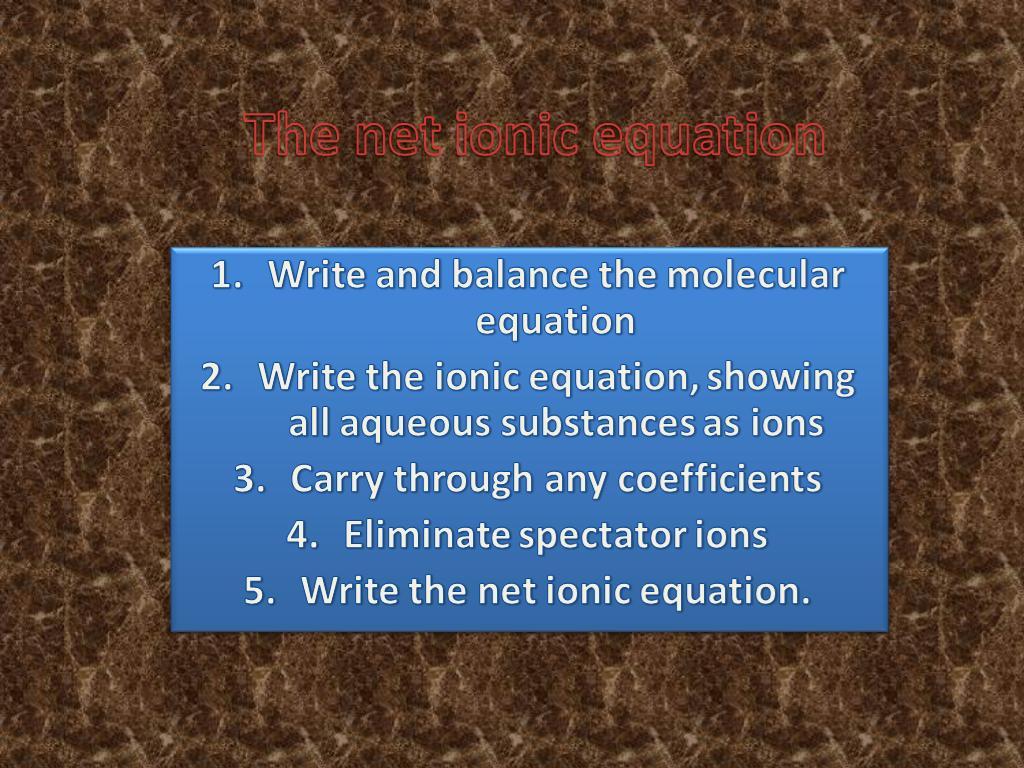
Enter the net ionic equation representing solid chromium (iii) hydroxide reacting with nitrous acid. express your answer as a ba
Colt1911 [192]

The net ionic equation of chromium (iii) hydroxide reacting with nitrous acid:

Cr(OH)₃ (s) + 3H⁺ (aq) ⇒ Cr³⁺ (aq) + 3H₂O (l)

<h3>Further explanation</h3>

The electrolyte in the solution produces ions.

The equation of a chemical reaction can be expressed in the equation of the ions

For strong electrolytes (the ionization rate = 1) is written in the form of separate ions, while the weak electrolyte (degree of ionization <1) is still written as an un-ionized molecule

In the ion equation, there is a spectator ion that is the ion which does not change (does not react) because it is present before and after the reaction

When these ions are removed, the ionic equation is called the net ionic equation

For gases and solids including water (H₂O) can be written as an ionized molecule

So only the dissolved compound is ionized ((expressed in symbol aq)

From the problem, it is stated that chromium (iii) hydroxide reacting with nitrous acid.

Reactions that occur:

Cr(OH)₃ (s) + 3HNO₂ (aq) ⇒ Cr(NO₂)₃ (aq) + 3H₂O (l)

Cr (OH)₃ solid form that does not decompose in the form of ions, as well as water (H₂O)

So the ionic equation becomes:

Cr(OH)₃ (s) + 3H⁺ (aq) + 3NO₂⁻ (aq) ⇒ Cr³⁺ (aq) + 3NO₂⁻ (aq) + 3H₂O (l)

There is an ion spectator that is 3NO₂⁻, so that if it is removed a net ionic equation will be formed:

Cr(OH)₃ (s) + 3H⁺ (aq) ⇒ Cr³⁺ (aq) + 3H₂O (l)

<h3>Learn more</h3>

the net ionic equation

brainly.com/question/11854070

brainly.com/question/10280219

brainly.com/question/9830467

Keywords: the net ionic equation, an ion spectator

5 0
2 years ago
Read 2 more answers
At a certain temperature K = 1.1 X 10^3 L/mol for the reaction given below. Calculate the concentrations of Fe3+, SCN?, and FeSC
lianna [129]

Answer:

Explanation:

Fe⁺³ + SCN⁻ =  FeSCN²⁺

x           x                x

If x mole of Fe⁺³ reacted , unreacted Fe⁺³ = .02 - x

Remaining SCN⁻  unreacted = .1 - x

K_c =   [ FeSCN²⁺] / [Fe⁺³] [ SCN⁻]

1.1 x 10³ =  x  / ( .02 - x ) (.1 - x )

1100 = x / .002 - .12x ( neglecting x² )

x = .0165

Concentration of Fe⁺³ = .02 - x = .0035 M

Concentration of SCN⁻ = .1 - x = .0835 M

Concentration of FeSCN²⁺ = x = .0165M

6 0
2 years ago
Other questions:
  • Which reactants would lead to a spontaneous reaction?
    13·1 answer
  • How many structures are possible for a trigonal bipyramidal molecule with a formula of ax3y2?
    15·1 answer
  • A particular experiment requires 13.5 µl hydrochloric acid solution. if 250 ml hydrochloric acid solution is available, how many
    6·2 answers
  • In an ionic bond:
    15·2 answers
  • ANSWER FOR: How did the lab activities help you answer the lesson question "How do the processes of conduction, convection, and
    12·2 answers
  • 1.35 Draw structures for all constitutional isomers with the following molecular formulas: (a) C6H14 (b) C2H5Cl (c) C2H4Cl2 (d )
    9·1 answer
  • A sample of an unknown compound was decomposed and found to be composed of 1.36 mol oxygen, 4.10 mol hydrogen, and 2.05 mol carb
    9·1 answer
  • Write chemical equations and corresponding equilibrium expressions for each of the two ionization steps of carbonic acid. Part A
    11·1 answer
  • What is the concentration of a solution made with 0.150 moles of KOH in 400.0 mL of solution?
    14·1 answer
  • Calcite is mineral that is found in limestone and marble. A model of the extended structure of calcite is
    5·1 answer
Add answer
Login
Not registered? Fast signup
Signup
Login Signup
Ask question!