answer.
Ask question
Login Signup
Ask question
All categories
  • English
  • Mathematics
  • Social Studies
  • Business
  • History
  • Health
  • Geography
  • Biology
  • Physics
  • Chemistry
  • Computers and Technology
  • Arts
  • World Languages
  • Spanish
  • French
  • German
  • Advanced Placement (AP)
  • SAT
  • Medicine
  • Law
  • Engineering
CaHeK987 [17]
2 years ago
10

The decomposition of Ca(OH)2(s) intoCaO(s) and H2O(g) at constant pressure requires the addition of 109 kJ of heat per mole of C

a(OH)2.
A. Write a balanced thermochemical equation for the reaction.
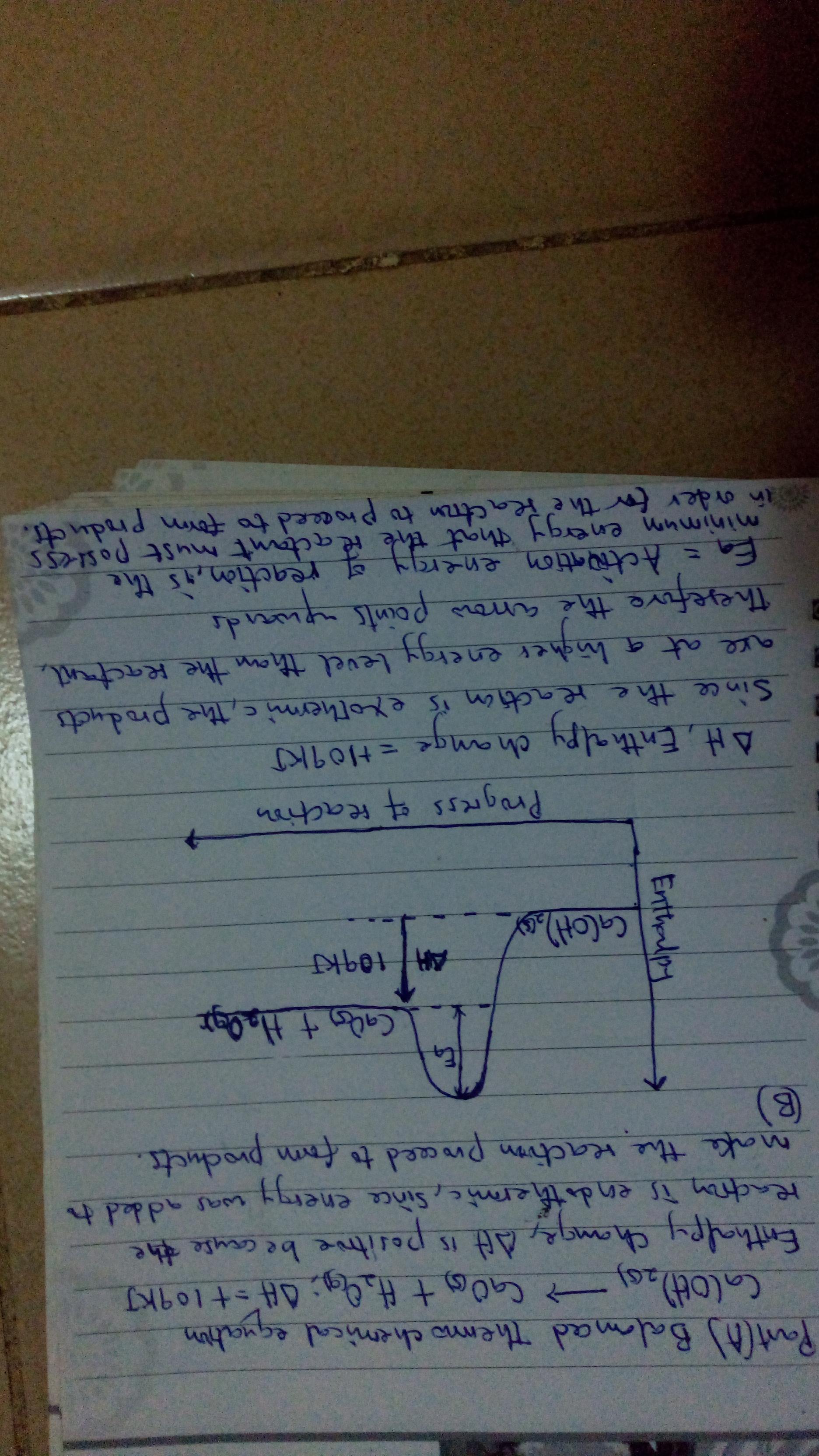
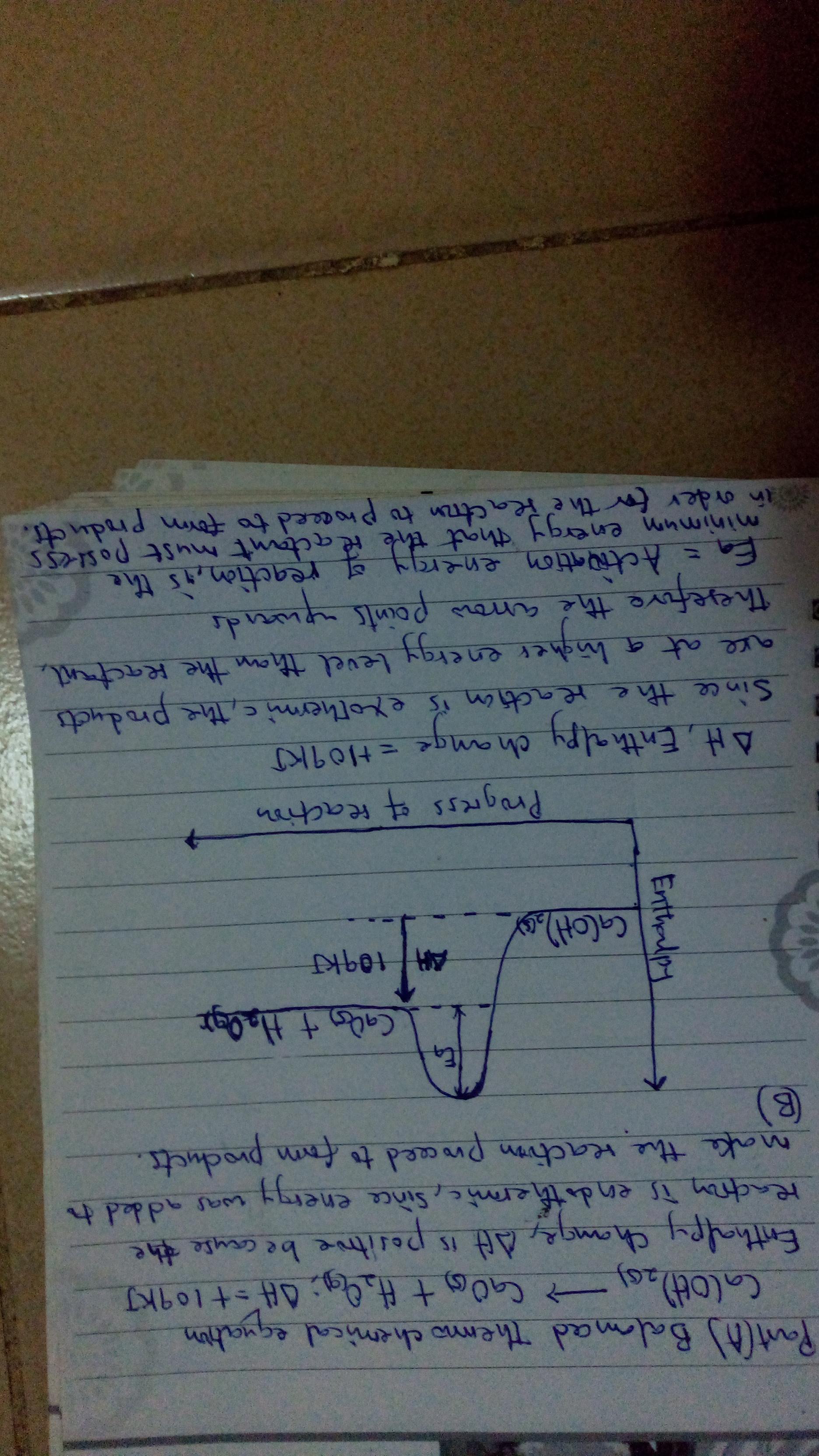
B. Draw an enthalpy diagram for the reaction, showing the activation energy, Ea, and the enthalpy change for the reaction.

Chemistry
1 answer:
larisa [96]2 years ago
4 0

Answer:

A. Ca(OH)2 ----> CaO + H2O; ∆H = +109KJ

B. Check attached document below for the enthalpy diagram

Explanation:

A thermochemical equation is a balanced chemical equation in which enthalpy change is variable. It tells about the nature of the reaction.

Enthalpy change is the difference between the heat content of the products and reactants in a thermochemical equation.

∆H is negative for an exothermic reaction (a reaction where heat is given out), while it is positive for an endothermic reaction ( a reaction in which heat is added).

The activation energy, Ea, is the minimum amount of energy reactant particles must possess in order for a reaction to proceed towards product formation.

You might be interested in
A 5.0 g sample of calcium nitrate (Ca(NO3)2, M = 164) contaminated with silica (SiO2, M = 60.1) is found to contain 1.0 g calciu
zhenek [66]

Answer:

= 82%

Explanation:

Percentage purity is calculated by the formula;

% purity = (mass of pure chemical/total mass of sample) × 100

In this case;

1 mole of Ca(NO3)2 = 164 g

but; 164 g of Ca(NO3)2 = 40 g Ca

Therefore; mass of Ca(NO3)2 = 164 /40

                                                  = 4.1 g

Thus;

% purity of Ca(NO3)2 = (Mass of Ca(NO3)2/ mass of the sample)× 100

                                    = (4.1 g/ 5 g) × 100

                                    = 82%

4 0
2 years ago
50 mL of CH3CH2Br (bromoethane) and 50 mL of water are poured into a separatory funnel. Bromoethane is a water‑insoluble compoun
umka21 [38]

Answer:

See explanation below

Explanation:

In this case, we can explain this in a very basic way.

We know that heavier objects will go always at the bottom when we are carrying two objects, one heavier than the other right?

In the same manner works the density of two liquids. In this case, we have a mix of water and bromoethane. Bromoethane is an organic compound and it's less polar than water which is extremely polar. When we mix these two liquids, we can see that both of them are insoluble, so no matter how much we shake the funnel, the liquids will not mix to form a solution.

Instead of that, both of them will be in the funnel, and they'll be gradually separating into two layers. The bromoethane has a higher density than water, this means that in the bottom layer we will have the bromoethane and in the top layer we will have the water.

In case you are wondering what happens if we added water first and then, the bromoethane?, it will happen the same, it does not matter the order you add the liquid, because density here is a very important factor, so when the water is added no matter which position, it will go to the top layer after the bromoethane is added.

Now when the hexane is added, it will form now three layers, and again, density plays an important factor. The higher density will go to the bottom, and the lowest to the top.

In this case, the order of layer will be:

Top layer: hexane (d = 0.66 g/mL)

Middle layer: water (d = 1 g/mL)

Bottom layer: bromoethane (d = 1.46 g/mL)

Hope this helps
6 0
2 years ago
An iron(iii) sulfate hydrate is 18.4% water. What is the formula of the hydrate? What is the name of the hydrate?
aleksley [76]

Answer:- Formula of the hydrate is Fe_2(SO_4)_3.5H_2O and it's name is Iron(III)sulfate pentahydrate.

Solution:- As per the given information, there is 18.4% water in the hydrate. If we assume the mass of the hydrate as 100 grams then there would be 18.4 grams of water and 81.6 grams of Iron(III)sulfate present in the hydrate.

Molar mass for Iron(III)sulfate is 399.88 gram per mol and the molar mass for water is 18.02 gram per mol.

We will calculate the moles of Iron(III)sulfate and water present in the compound on dividing their grams by their molar masses as:

81.6gFe_2(SO_4)_3(\frac{1mol}{399.88g})

= 0.204molFe_2(SO_4)_3

18.4gH_2O(\frac{1mol}{18.02g})

= 1.02molH_2O

Now, the next step is to calculate the mol ratio and for this we divide the moles of each by the least one of them means whose moles are less. Here, the moles of Iron(III)sulfate are less than moles of water. So, we divide the moles of each by 0.204.

Fe_2(SO_4)_3=\frac{0.204}{0.204}  = 1

H_2O=\frac{1.02}{0.204} = 5

There is 1:5 mol ratio between Iron(III)sulfate and water. So, the formula of the hydrate is Fe_2(SO_4)_3.5H_2O and the name of the hydrate is Iron(III)sulfate pentahydrate.


3 0
2 years ago
Which contains the greatest mass of oxygen: 0.75 mol of ethanol (C2H5OH), 0.60 mol of formic acid (HCO2H), or 1.0 mol of water (
alisha [4.7K]

Answer: formic acid (HCOOH) contains the greatest mass of oxygen

Explanation:Please see attachment for explanation

3 0
2 years ago
The image shows a wheel that's wound up and released. The wheel moves up and down as shown. Identify the position of the wheel w
Lesechka [4]

Explanation:

Since the wheel moves up and down, the position that represents the potential energy is that which has the maximum height from the ground.

Potential energy is the energy at rest of a body.

It is given as:

      Potential energy = m x g x h

m is the mass of the body

g is the acceleration due to gravity

h is the height of the body

We can see that mass and height are directly related to the potential energy a body exerts.

The higher the wheel from ground, the higher its potential energy.

learn more

Potential energy brainly.com/question/10770261

#learnwithBrainly

7 0
2 years ago
Other questions:
  • why does every human measurement have uncertainty associated with it? Why must we manage the uncertainty during calculations?
    13·1 answer
  • For an experiment, a biology student makes 1 liter of a solution containing the following substances, which are shown in the tab
    5·1 answer
  • What is [h3o ] in a solution of 0.25 m ch3co2h and 0.030 m nach3co2?
    10·1 answer
  • Determine the number of bonding electrons and the number of nonbonding electrons in the structure of cs2.
    14·2 answers
  • Water is dissolved into n-butanol (a polar liquid). Which is the second step at the molecular level as water dissolves into n-bu
    8·2 answers
  • In two or more complete sentences, explain how to calculate the amount of energy that is transferred when 150 g of cooper cools
    13·1 answer
  • Two stones resembling diamonds are suspected of being fakes. To determine if the stones might be real, the mass and volume of ea
    15·1 answer
  • What is the volume, in liters, occupied by 1.73 moles of N2 gas at 0.992 atm pressure and a temperature of 75º C? (R value- 0.08
    6·1 answer
  • How many moles of chromium metal equal 7.52 × 10²² atoms Cr?
    6·1 answer
  • Identify a process that is NOT reversible. Identify a process that is NOT reversible. melting of snow baking of bread deposition
    8·1 answer
Add answer
Login
Not registered? Fast signup
Signup
Login Signup
Ask question!