answer.
Ask question
Login Signup
Ask question
All categories
  • English
  • Mathematics
  • Social Studies
  • Business
  • History
  • Health
  • Geography
  • Biology
  • Physics
  • Chemistry
  • Computers and Technology
  • Arts
  • World Languages
  • Spanish
  • French
  • German
  • Advanced Placement (AP)
  • SAT
  • Medicine
  • Law
  • Engineering
denis23 [38]
2 years ago
3

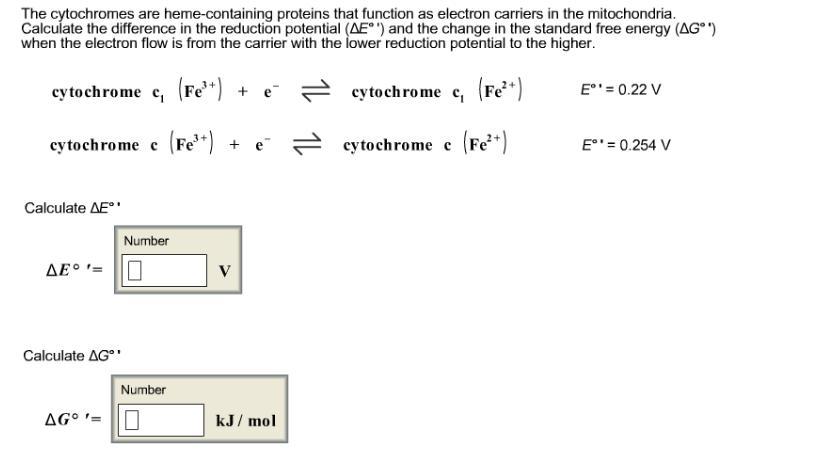
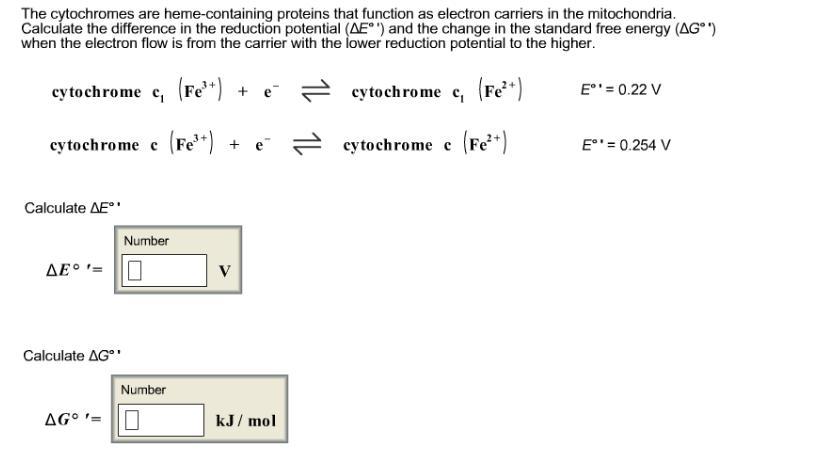
The cytochromes are heme‑containing proteins that function as electron carriers in the mitochondria. Calculate the difference in

the reduction potential (ΔE∘′) and the change in the standard free energy (ΔG∘′) when the electron flow is from the carrier with the lower reduction potential to the higher. cytochrome c1 (Fe3+)+e−↽−−⇀cytochrome c1 (Fe2+)E∘′=0.22 V cytochrome c (Fe3+)+e−↽−−⇀cytochrome c (Fe2+)E∘′=0.254 V Calculate ΔE∘′ and ΔG∘′ .

Chemistry
1 answer:
inn [45]2 years ago
4 0

Complete Question

The complete question is shown on the first uploaded image

Answer:

The change in reduction potential is  \Delta  E^o=E^o_{cell} = 0.034 V

The change in standard free energy is  \Delta  G^o  =  -3.2805 \ KJ/mol

Explanation:

From the question we are told that

At the anode

      cytochrome   \ c_1  \ (Fe^{3+}) + e^-⇔cytochrome \ c_1 \ (Fe^{2+}) \ \  E^o  = 0.22 \ V

At the cathode

      cytochrome   \ c  \ (Fe^{3+}) + e^-⇔cytochrome \ c \ (Fe^{2+}) \ \  E^o  = 0.254 \ V

The difference in the reduction potential is mathematically represented as

     \Delta  E^o = E^o_{cathode} - E^o_{anode}

substituting values

      \Delta  E^o = 0.254  - 0.220

     \Delta  E^o=E^o_{cell} = 0.034 V

The change in the standard free energy is mathematically represented as

      \Delta  G^o  =  -n *  F * E^o_{cell}

Where  F is the Faraday constant with value  F = 96485 C

and  n i the number of the number of electron = 1

   So

       \Delta  G^o  =  -(1) *  96485 * 0.034

       \Delta  G^o  =  -3.2805 \ KJ/mol

You might be interested in
the height of a column of mercury in barometer is 754.3mm. what us the atmospheric pressure in atm. in kPa.
Aleksandr-060686 [28]
1 atm = 760mmHg
754.3 mmHg / 760 mmHg * 1atm = 0.99 atm
760 mmHg = 101.3 KPa
754.3 mmHg/ 760mmHg *101.3 KPa = 100.54 KPa

Hope this helps!
8 0
2 years ago
29. A certain nut crunch cereal contains 11.0 grams of sugar (sucrose, C12H22O11) per serving size of 60.0 grams. How many servi
adoni [48]

Answer:

The answer is: 51.8 g (86% of serving size)

Explanation:

In order to solve the problem, we have to first determine the number of moles there are in 11.0 g of sucrose. Sucrose has a molecular weight of 342 g (we calculate this from the molar mass of the elements : 12 x 12 g/mol C + 22 x 1 g/mol H + 11 x 16 g/mol O). So, we divide the mass (11.0 g) into the molecular weight of sucrose:

11.0 g sucrose x 1 mol/342 g sucrose= 0.032 mol

We have 0.032 mol of sucrose in a serving of 60 g. But we need less moles (0.0278 mol):

0.032 mol ------------ 60 g serving

0.0278 mol------------ x= 0.0278 mol x 60 g serving/0.032 mol

                                x= 51.8 g

So,  lesser than 1 serving of 60 g must be eaten to consume 0.0278 mol os sucrose. Exactly, 51.8 g (which stands for a 86% of the serving size).

3 0
2 years ago
Methane and ethane are both made up of carbon and hydrogen. In methane, there are 12.0 g of carbon for every 4.00 g of hydrogen,
Sati [7]

Answer:

The answer is: Law of multiple proportions        

Explanation:

The law of multiple proportions is a law of chemical combination given by Dalton in 1803.

According to this law, if more than one chemical compound is formed by combining two elements, then the mass of an element that combines with the fixed mass of other element is represented in the form of small whole number ratio.

<u>Therefore, is an illustration of the law of the law of multiple proportions.</u>

8 0
2 years ago
One liter of ocean water contains 35.06 g of salt. What volume of ocean water would contain 1.00 kg of salt? Express your answer
sweet [91]

Answer:

28.52 L

Explanation:

First, let's calculate the density of the ocean, which is the mass divided by the volume:

d = m/V

d = 35.06/1

d = 35.06 g/L

So, for a mass of 1.00 kg = 1000.00 g

d = m/V

35.06 = 1000.00/V

V = 1000.00/35.06

V = 28.52 L

How all the data are expressed with two significant figures, the volume must also be expressed with two.

7 0
2 years ago
One of the most important chemical reactions is the Haber process, in which N2 and H2 are converted to ammonia which is used in
Lera25 [3.4K]

Answer:

c) 22

Explanation:

Let's consider the following balanced equation.

N₂(g) + 3 H₂(g) ----> 2 NH₃(l)

According to the balanced equation, 34.0 g of NH₃ are produced by 1 mol of N₂. For 170 g of NH₃:

170gNH_{3}.\frac{1molN_{2}}{34.0gNH_{3}} =5.00molN_{2}

According to the balanced equation, 34.0 g of NH₃ are produced by 3 moles of H₂. For 170 g of NH₃:

170gNH_{3}.\frac{3molH_{2}}{34.0gNH_{3}} =15.0molH_{2}

The total gaseous moles before the reaction were 5.00 mol + 15.0 mol = 20.0 mol.

We can calculate the pressure (P) using the ideal gas equation.

P.V = n.R.T

where

V is the volume (50.0 L)

n is the number of moles (20.0 mol)

R is the ideal gas constant (0.08206atm.L/mol.K)

T is the absolute temperature (400.0 + 273.15 = 673.2K)

P=\frac{n.R.T}{V} =\frac{20.0mol\times (0.08206atm.L/mol.K)\times 673.2K ) }{50.0L} =22.0atm

7 0
2 years ago
Other questions:
  • Which of these is a base? a-vinegar b-ammonia c-HCl d- HNO3
    5·2 answers
  • To determine the atomic mass of an element, the masses of all the naturally occurring isotopes of that element are averaged toge
    14·2 answers
  • What is the identity of the unknown ink?use evidence to support your claim.
    5·1 answer
  • Industrial production of nitric acid, which is used in many products including fertilizers and explosives, approaches 10 billion
    9·1 answer
  • Chlorine gas can be made from the reaction of manganese dioxide with hydrochloric acid. MnO2(s) + 4HCl(aq) → MnCl2(aq) + 2H2O(l)
    12·1 answer
  • What is the change in enthalpy associated with the combustion of 530 g of methane (CH4)?Report your answer in scientific notatio
    5·1 answer
  • Calculate the concentration of H3O in a solution that contains 5.5 × 10⁻⁵ M OH at 25°C. Identify the solution as acidic, basic o
    6·1 answer
  • 36g of KOH dissolved in 800mL of water. What is the molality of the solution?
    14·1 answer
  • How many moles of lithium chloride will be formed by the reaction of chlorine with 0.046 mol of lithium bromide in the following
    6·1 answer
  • 8. Explain how Elianto oil is obtained from maize seeds.​
    10·1 answer
Add answer
Login
Not registered? Fast signup
Signup
Login Signup
Ask question!