answer.
Ask question
Login Signup
Ask question
All categories
  • English
  • Mathematics
  • Social Studies
  • Business
  • History
  • Health
  • Geography
  • Biology
  • Physics
  • Chemistry
  • Computers and Technology
  • Arts
  • World Languages
  • Spanish
  • French
  • German
  • Advanced Placement (AP)
  • SAT
  • Medicine
  • Law
  • Engineering
MariettaO [177]
2 years ago
9

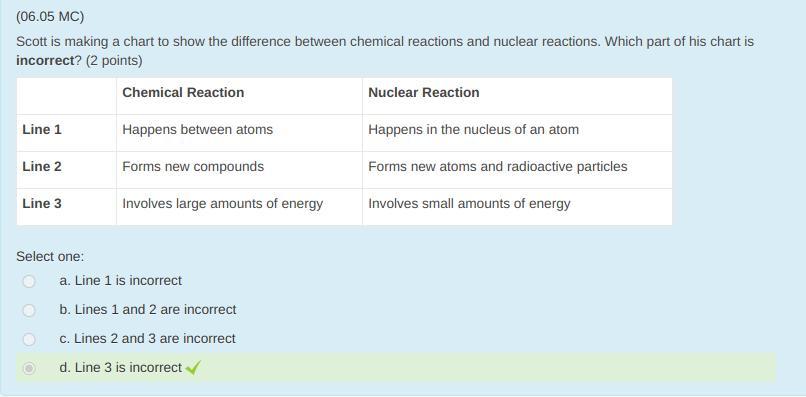
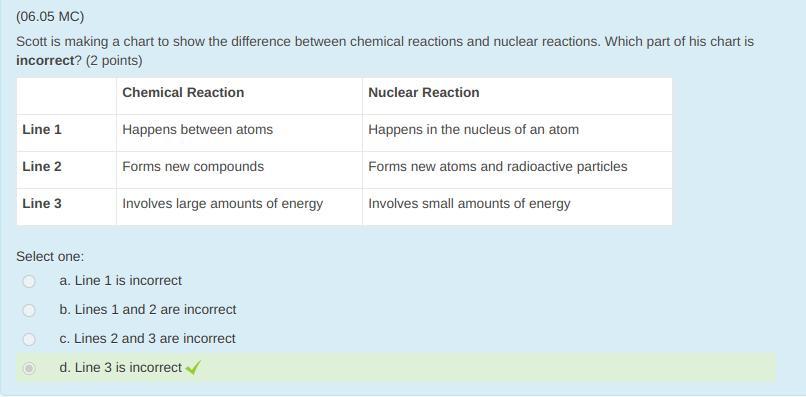
Scott is making a chart to show the difference between chemical reactions and nuclear reactions. Which part of his chart is inco

rrect? Line 1: Chemical Reaction - Happens in the nucleus of atoms. Nuclear Reaction - Happens between atoms. Line 2: Chemical Reaction - Forms new compounds. Nuclear Reaction - Forms new atoms and radioactive particles. Line 3: Chemical Reaction - Involves small amounts of energy. Nuclear Reaction - Involves large amounts of energy. Answer choices: A) Line 1 is incorrect B) Lines 1 & 2 are incorrect C) Lines 2 & 3 are incorrect D) Line 3 is incorrect

Chemistry
2 answers:
Sunny_sXe [5.5K]2 years ago
8 0

Answer:

Line 3 is incorrect

Explanation:

i took the test and got it right

yanalaym [24]2 years ago
5 0

Answer:

Line 3 is incorrect

Explanation:

In line 3, the statements should be switched. Chemical reactions involve small amounts of energy and nuclear reactions involve enourmous amounts of energy. Lines 1 and 2 are correct.

VOTE ME FOR BRAINLIEST!!

You might be interested in
2. A compound with the following composition by mass: 24.0% C, 7.0% H, 38.0% F, and 31.0% P. what is the empirical formula
Svetach [21]

Answer:

C₂H₇F₂P

Explanation:

Given parameters:

Composition by mass:

                C = 24%

                H = 7%

                 F  = 38%

                 P  = 31%

Unknown:

Empirical formula of compound;

Solution :

The empirical formula is the simplest formula of a compound. To solve for this, follow the process below;

                                   C                          H                         F                   P

% composition

by mass                     24                          7                        38                  31

Molar mass                 12                           1                         19                  31

Number of

moles                       24/12                          7/1                    38/19           31/31

                                     2                               7                       2                   1

Dividing

by the

smallest                      2/1                             7/1                       2/1                1/1

                                     2                                7                        2                   1

           Empirical formula        C₂H₇F₂P

5 0
2 years ago
A 5 mole sample of liquid acetone is converted to a gas at 75.0°C. If 628 J are required to raise the temperature of the liquid
Shkiper50 [21]
The total energy can be found by adding the different energies:
628 + 15,600 + 712
= 16.94 kJ
4 0
2 years ago
A mixture of three gases has a pressure at 298 K of 1380 mm Hg. The mixture is analysed and is found to contain 1.27 mol CO2, 3.
enot [183]

Answer:

The partial pressure of Ar is 356.04 mm Hg (= 0.4685 atm)

Explanation:

<u>Step 1:</u> Data given

A mixture of three gases has a total pressure of 1380 mm Hg (=1.81579 atm) at 298 K

Moles of CO2 = 1.27 moles

Moles of CO = 3.04 moles

Moles of Ar = 1.50 moles

<u>Step 2:</u> Calculate total number of moles

Total number of moles = n(CO2)+ n(CO)+ n(Ar) = 1.27 mol+ 3.04 mol+ 1.50 mol = 5.81 moles

<u>Step 3:</u> Calculate mol fraction Ar

Mol fraction Ar = 1.50 mol/5.81 mol = 0.258

<u>Step 4</u>: Calculate partial pressure

1380 mm Hg * 0.258 moles Ar = 356.04 mm Hg = 0.4685 atm

The partial pressure of Ar is 356.04 mm Hg (= 0.4685 atm)

8 0
2 years ago
For the Bradford assay, the instructor will make a Bradford reagent dye by mixing 50 ml of 95% v/v ethanol with 100 mg of Coomas
jolli1 [7]

Answer:

4,25% v/v H3PO4

Explanation:

The concentration of phosphoric acid (H3PO4) is expressed as a volume / volume percentage, which means:

%v/v H3PO4 = (mL of pure H3PO4/mL of solution)*100%

In other words, <u>we are only interested in the final volume of the solution to which the phosphoric acid was diluted, regardless of its composition</u>. Which in this case is 1 L (1000 mL).

We can then apply the following equation, commonly used to calculate the initial or final concentration (or volume) of a substance when it is diluted:

Ci*Vi=Cf*Vf

<u>Where</u>:

Ci, is the initial concentration of the substance.

Vi, the initial volume of the substance

Cf, the final concentration reached after dilution

Vf, the final volume of the solution at which the substance was diluted

In this case, the incognite would be the final concentration of H3PO4 reached after dilution, that is, Cf. Therefore, we proceed to clear Cf from the previous equation and replace our data:

Cf = (Ci*Vi)/Vf = (85% v/v * 50 mL)/1000 mL = 4,25 % v/v

Note that being up and down in the division, the mL unit is canceled to result in% v / v.
7 0
2 years ago
Old photographic flashbulbs burn magnesium metal in a reaction that causes a flash of brilliant white light. A photographer woul
OLga [1]

Answer is: A. Chemical energy to electromagnetic energy and thermal energy.  

Balanced chemical reaction: 2Mg(s) + O₂(g) → 2MgO(s) + energy.

This is chemical change (chemical reaction), because new substance (magnesium oxide MgO) is formed, the atoms are rearranged and the reaction is followed by an energy change (exothermic reaction because energy is released).

Chemical changes (chemical synthesis) is when a substance combines with another (in this example magnesium and oxygen) to form a new substance.


5 0
2 years ago
Read 2 more answers
Other questions:
  • Draw the best lewis structure for bro4- and determine the formal charge on bromine
    15·2 answers
  • What mass of zinc oxide would be produced by the thermal decomposition of 375 grams of zinc carbonate?
    10·1 answer
  • Formaldehyde, ch2o, is used as an embalming agent. draw the structure of ch2o including lone pairs.formaldehyde, ch2o, is used a
    14·1 answer
  • Part a write an equation for the formation of nh3(g) from its elements in its standard states. express your answer as a chemical
    11·2 answers
  • To neutralize 1.65g LiOH, how much .150 M HCl would be needed?
    6·1 answer
  • Identify the number of moles in 369 grams of calcium hydroxide. Use the periodic table and the polyatomic ion resource.
    6·1 answer
  • Gasoline has a density of 0.749 g/mL. There are 454 grams in a pound and 3.7854 litres in a gallon. How many pounds does 19.2 ga
    15·1 answer
  • According to the experimental procedure of Experiment F1, 135 microliters of acetophenone (120.15 g/mol, 1.03 g/mL) was reacted
    9·1 answer
  • Give the coordination number, the charge of the central metal ion, and select the correct name in each coordination compound: A.
    12·1 answer
  • An athlete has 15% body fat by mass. What is the weight of fat, in pounds, of a 74 kg-athlete?
    13·1 answer
Add answer
Login
Not registered? Fast signup
Signup
Login Signup
Ask question!