answer.
Ask question
Login Signup
Ask question
All categories
  • English
  • Mathematics
  • Social Studies
  • Business
  • History
  • Health
  • Geography
  • Biology
  • Physics
  • Chemistry
  • Computers and Technology
  • Arts
  • World Languages
  • Spanish
  • French
  • German
  • Advanced Placement (AP)
  • SAT
  • Medicine
  • Law
  • Engineering
mr_godi [17]
2 years ago
3

A cube with 45-cm-long sides is sitting on the bottom of an aquarium in which the water is one meter deep. (Round your answers t

o the nearest whole number. Use 9.8 m/s2 for the acceleration due to gravity. Recall that the weight density of water is 1000 kg/m3.)

Physics
1 answer:
Mkey [24]2 years ago
5 0

Questions

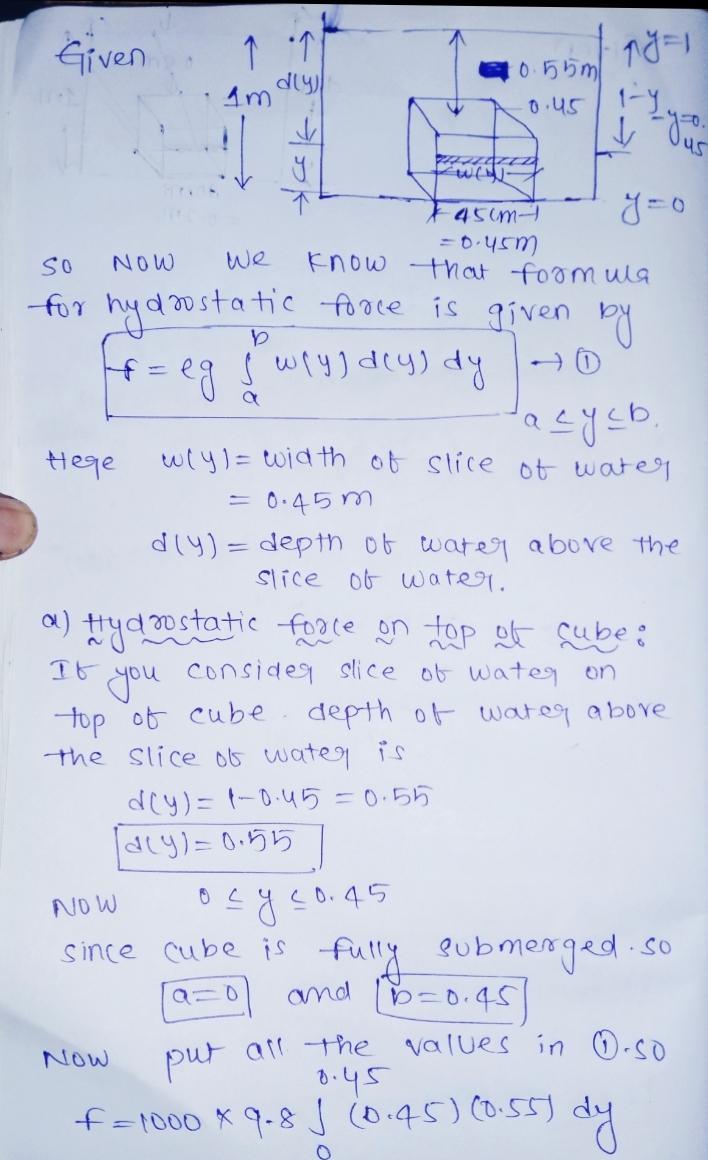
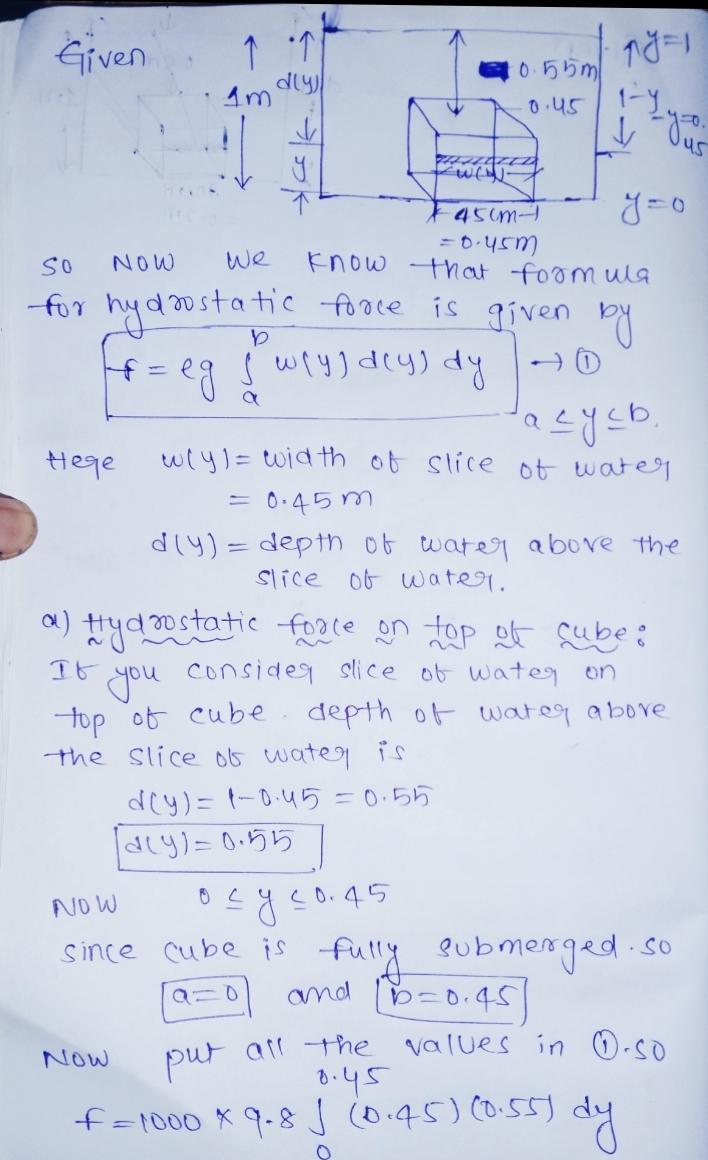
a. find the hydrostatic force on the top of the cube

b. find the hydrostatic force on the side of the cube

Answer:

a. F(top of the cube) = 1091 N

b F(side of the cube) = 1538 N

Explanation:

You might be interested in
A car travels 30 miles in 1 hour on a winding mountain road. Which of the following is a true statement?
siniylev [52]

Answer:

The true statement is:

"(C) The magnitude of the average velocity is equal to 30 m.p.h."

Explanation:

Given that a car travels 30 miles in 1 hour on a winding mountain road.

Let' check all the statements one by one:

(A) The magnitude of the total displacement is larger than the distance traveled.

Since the entire motion of the car is not exactly given in the question, so it is not possible to tell whether the magnitude of the total displacement is larger than the distance traveled or not.

Thus, this statement is not true.

(B) The magnitude of the average velocity is greater than 30 m.p.h.

The average velocity of an object is defined as the total displacement covered by the particle divided by the total time taken in covering that displacement.

Total distance covered by the car = 30 miles.

Total time taken by the car to cover this distance = 1 hour.

Therefore, the average velocity of the car for this time interval = \rm \dfrac{30\ miles}{1\ hour }= 30\ m.p.h.

Thus, this statement is also not true.

(C) The magnitude of the average velocity is equal to 30 m.p.h.

As is cleared in part (B) section above, the average velocity of the car in the given time interval is 30 m.p.h.

Thus, this statement is true.

(D)The magnitude of the average velocity is less than to 30 m.p.h.

Since. the average velocity of the car is 30 m.p.h.

Thus, this statement is not true.

(E)The car traveled with a constant speed of 30 m.p.h.

The motion of the car on the mountain road is not thoroughly given in the question, so again it is not possible to tell whether the car traveled with a constant speed of 30 m.p.h. or not.

Thus, this statement is also not true.
4 0
2 years ago
Read 2 more answers
Water has a specific heat of 4.186 J/g°C, and ethanol has a specific heat of 2.450 J/g°C. Based on this information, which best
arlik [135]
I think the correct answer from the choices listed above is the second option.  Based on this information, we can say that there are more molecules in a gram of water since more energy is required to raise the temperature 1 gram of water than to raise the temperature of  1 gram of ethanol.
5 0
2 years ago
Read 2 more answers
A trebuchet was a hurling machine built to attack the walls of a castle under siege. A large stone could be hurled against a wal
Studentka2010 [4]

(a) 18.9 m/s

The motion of the stone consists of two independent motions:

- A horizontal motion at constant speed

- A vertical motion with constant acceleration (g=9.8 m/s^2) downward

We can calculate the components of the initial velocity of the stone as it is launched from the ground:

u_x = v_0 cos \theta = (25.0)(cos 41.0^{\circ})=18.9 m/s\\u_y = v_0 sin \theta = (25.0)(sin 41.0^{\circ})=16.4 m/s

The horizontal velocity remains constant, while the vertical velocity changes due to the acceleration along the vertical direction.

When the stone reaches the top of its parabolic path, the vertical velocity has became zero (because it is changing direction): so the speed of the stone is simply equal to the horizontal velocity, therefore

v=18.9 m/s

(b) 22.2 m/s

We can solve this part by analyzing the vertical motion only first. In fact, the vertical velocity at any height h during the motion is given by

v_y^2 - u_y^2 = 2ah (1)

where

u_y = 16.4 m/s is the initial vertical velocity

v_y is the vertical velocity at height h

a=g=-9.8 m/s^2 is the acceleration due to gravity (negative because it is downward)

At the top of the parabolic path, v_y = 0, so we can use the equation to find the maximum height

h_{max} = \frac{-u_y^2}{2a}=\frac{-(16.4)^2}{2(-9.8)}=13.7 m

So, at half of the maximum height,

h = \frac{13.7}{2}=6.9 m

And so we can use again eq(1) to find the vertical velocity at h = 6.9 m:

v_y = \sqrt{u_y^2 + 2ah}=\sqrt{(16.4)^2+2(-9.8)(6.9)}=11.6 m/s

And so, the speed of the stone at half of the maximum height is

v=\sqrt{v_x^2+v_y^2}=\sqrt{18.9^2+11.6^2}=22.2 m/s

(c) 17.4% faster

We said that the speed at the top of the trajectory (part a) is

v_1 = 18.9 m/s

while the speed at half of the maximum height (part b) is

v_2 = 22.2 m/s

So the difference is

\Delta v = v_2 - v_2 = 22.2 - 18.9 = 3.3 m/s

And so, in percentage,

\frac{\Delta v}{v_1} \cdot 100 = \frac{3.3}{18.9}\cdot 100=17.4\%

So, the stone in part (b) is moving 17.4% faster than in part (a).

4 0
2 years ago
A system delivers 1275 j of heat while the surroundings perform 855 j of work on it. calculate ∆esys in j.
kakasveta [241]
The first law of thermodynamics says that the variation of internal energy of a system is given by:
\Delta U = Q + W
where Q is the heat delivered by the system, while W is the work done on the system.

We must be careful with the signs here. The sign convention generally used is:
Q positive = Q absorbed by the system
Q negative = Q delivered by the system
W positive = W done on the system
W negative = W done by the system

So, in our problem, the heat is negative because it is releaed by the system: 
Q=-1275 J
while the work is positive because it is performed by the surrounding on the system:
W=+855 J

So, the variation of internal energy of the system is
\Delta U = -1275 J+855 J=-420 J
6 0
2 years ago
Where is the steering nozzle located on a pwc?
Dvinal [7]
At the rear.

PWC stands for personal watercraft, and it is a small powerboat. The main components of a PWC are the hull (body of the boat), deck (surface where people walk/stand), throttle (controls speed), steering nozzle and water intake.
3 0
2 years ago
Read 2 more answers
Other questions:
  • A soccer player with a mass of 60 kg is traveling at 8 m/s when he completes a corner kick on a 0.45 kg soccer ball. The soccer
    13·2 answers
  • An object is falling from a height of 7.5 meters. At what height will its velocity be 7 meters/second?
    5·1 answer
  • The mass of the Sun is 2 × 1030 kg, and the mass of Saturn is 5.68 × 1026 kg. The distance between Saturn and the Sun is 9.58 AU
    12·2 answers
  • Workers do 8000 J of work on a 2000-N crate to push it up a ramp. If the ramp is 2 m high, what is the efficiency of the ramp?
    9·2 answers
  • A 2.80 kg mass is dropped from a height of 4.50 m. find its potential energy(PE) at the moment it is dropped. PLEASE HELP
    6·1 answer
  • A plastic cube with a coin taped to its top surface is floating partially submerged in water. A student marks the level of the w
    8·1 answer
  • A majorette in the Rose Bowl Parade tosses a baton into the air with an initial angular velocity of 2.5 rev/s. If the baton unde
    11·1 answer
  • A ball collides elastically with an immovable wall fixed to the earth’s surface. Which statement is false? 1. The ball's speed i
    5·1 answer
  • n atomic nucleus suddenly bursts apart (fissions) into two pieces. Piece A, of mass mA , travels off to the left with speed vA .
    7·1 answer
  • The same fluid flows through four different branching pipes. It enters each pipe from the left with the same speed, v0, and flow
    13·1 answer
Add answer
Login
Not registered? Fast signup
Signup
Login Signup
Ask question!