answer.
Ask question
Login Signup
Ask question
All categories
  • English
  • Mathematics
  • Social Studies
  • Business
  • History
  • Health
  • Geography
  • Biology
  • Physics
  • Chemistry
  • Computers and Technology
  • Arts
  • World Languages
  • Spanish
  • French
  • German
  • Advanced Placement (AP)
  • SAT
  • Medicine
  • Law
  • Engineering
Nezavi [6.7K]
2 years ago
12

The density of a gaseous chlorofluorocarbon (CFC) at 23.8 °C and 432 mmHg is 3.23 g/L. What is its molar mass?

Chemistry
1 answer:
Wewaii [24]2 years ago
6 0

Answer:

138.57 g/mol.

Explanation:

The following data were obtained from the question:

Temperature (T) = 23.8 °C

Pressure = 432 mmHg

Density (D) = 3.23 g/L

Next, we shall obtain an expression for the density in relation to molar mass, pressure and temperature.

This can be obtained by using the ideal gas equation as shown below:

PV = nRT.... (1)

Recall:

Mole (n) = maas(m) /Molar mass (M)

n = m/M

Substituting the value of n into equation 1

PV = nRT

PV = mRT/M

Divide both side by P

V = mRT/MP

Divide both side by m

V/m = RT/MP

Invert the above equation

m/V = MP /RT..... (2)

Recall:

Density (D) = mass(m) /volume (V)

D = m/V

Replace m/V with D in equation 2

m/V = MP /RT

D = MP /RT

Thus, with the above formula we can obtain the molar mass of chlorofluorocarbon (CFC) as shown below:

Temperature (T) = 23.8 °C = 23.8 °C + 273 = 296.8 K

Pressure = 432 mmHg = 432/760 = 0.568 atm

Density (D) = 3.23 g/L

Gas constant (R) = 0.0821 atm.L/Kmol

Molar mass (M) =..?

D = MP /RT

3.23 = M x 0.568 / 0.0821 x 296.8

Cross multiply

M x 0.568 = 3.23 x 0.0821 x 296.8

Divide both side by 0.568

M = (3.23 x 0.0821 x 296.8) / 0.568

M = 138.57 g/mol

Therefore the molar mass of CFC is 138.57 g/mol.

You might be interested in
25. In the investigation shown the changes in heat of the copper is greater than the change in the heat of the water. What error
forsale [732]

Answer:

Heat lost to the surroundings

Heat lost to the thermometer

Explanation:

All changes in heat, or energy, can be explained. Many of the reactions or changes we see in the world involve the conversion of energy. For example as we heat up a substance (eg. water), the amount of energy we put in should give us an exact temperature. However, this is a "perfect world" scenario, and does not occur in real life. Whenever heat is added to a substance like water, we always need to account for the energy that is going to be lost. For example, heat lost to evaporation or even the effect of measuring the temperature with a thermometer (the introduction of anything including a thermometer will affect the temperature).

3 0
2 years ago
A mysterious white powder could be powdered sugar (C12H22O11), cocaine (C17H21NO4), codeine (C18H21NO3), norfenefrine (C8H11NO2)
rodikova [14]

Norfenefrine (C₈H₁₁NO₂).

<h3>Further explanation</h3>

We will solve a case related to one of the colligative properties, namely freezing point depression.

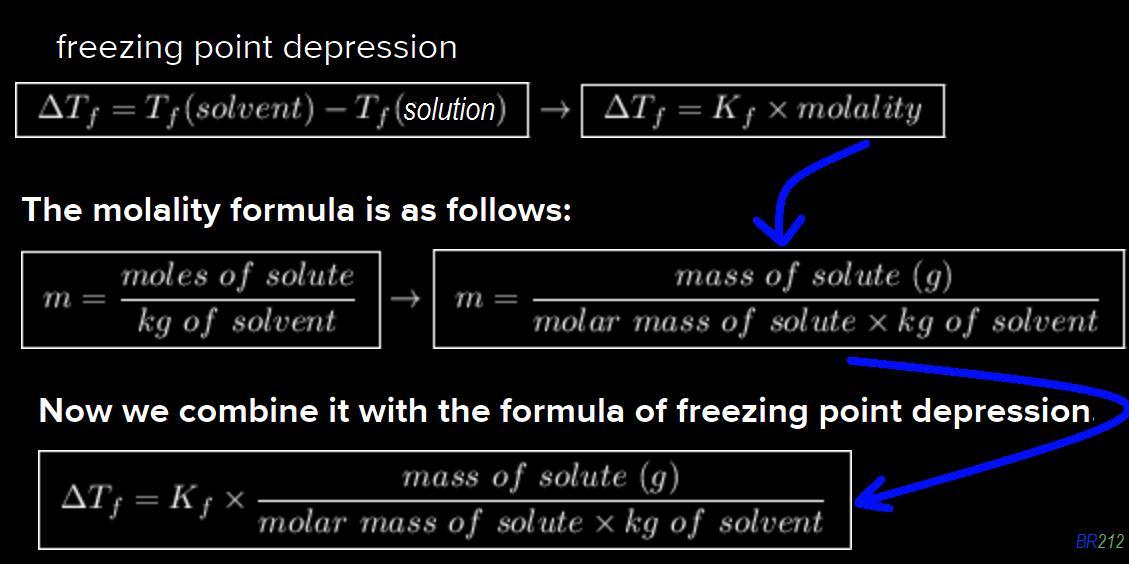
The freezing point of the solution is the temperature at which the solution begins to freeze. The difference between the freezing point of the solvent and the freezing point of the solution is called freezing point depression.

\boxed{ \ \Delta T_f = T_f(solvent) - T_f(solution) \ } \rightarrow \boxed{ \ \Delta T_f = K_f \times molality \ }

<u>Given:</u>

A mysterious white powder could be,

  • powdered sugar (C₁₂H₂₂O₁₁) with a molar mass of 342.30 g/moles,
  • cocaine (C₁₇H₂₁NO₄) with a molar mass of 303.35 g/moles,
  • codeine (C₁₈H₂₁NO₃) with a molar mass of 299.36 g/moles,
  • norfenefrine (C₈H₁₁NO₂) with a molar mass of 153.18 g/moles, or
  • fructose (C₆H₁₂O₆) with a molar mass of 180.16 g/moles.

When 82 mg of the powder is dissolved in 1.50 mL of ethanol (density = 0.789 g/cm³, normal freezing point −114.6°C, Kf = 1.99°C/m), the freezing point is lowered to −115.5°C.

<u>Question: </u>What is the identity of the white powder?

<u>The Process:</u>

Let us identify the solute, the solvent, initial, and final temperatures.

  • The solute = the powder
  • The solvent = ethanol
  • The freezing point of the solvent = −114.6°C
  • The freezing point of the solution = −115.5°C

Prepare masses of solutes and solvents.

  • Mass of solute = 82 mg = 0.082 g
  • Mass of solvent = density x volume, i.e., \boxed{ \ 0.789 \ \frac{g}{cm^3} \times 1.50 \ cm^3 = 1.1835 \ g = 0.00118 \ kg  \ }

We must prepare the solvent mass unit in kg because the unit of molality is the mole of the solute divided by the mass of the solvent in kg.

The molality formula is as follows:

\boxed{ \ m = \frac{moles \ of \ solute}{kg \ of \ solvent} \ } \rightarrow \boxed{ \ m = \frac{mass \ of \ solute \ (g)}{molar \ mass \ of \ solute \times kg \ of \ solvent} \ }

Now we combine it with the formula of freezing point depression.

\boxed{ \ \Delta T_f =  K_f \times \frac{mass \ of \ solute \ (g)}{molar \ mass \ of \ solute \times kg \ of \ solvent} \ }

It is clear that we will determine the molar mass of the solute (denoted by Mr).

We enter all data into the formula.

\boxed{ \ -114.6^0C - (-115.5^0C) = 1.99 \frac{^0C}{m} \times \frac{0.082 \ g}{Mr \times 0.00118 \ kg} \ }

\boxed{ \ 0.9 = \frac{1.99 \times 0.082}{Mr \times 0.00118} \ }

\boxed{ \ Mr = \frac{0.16318}{0.9 \times 0.00118} \ }

We get \boxed{ \ Mr = 153.65 \ }

These results are very close to the molar mass of norfenefrine which is 153.18 g/mol. Thus the white powder is norfenefrine.

<h3>Learn more</h3>
  1. The molality and mole fraction of water brainly.com/question/10861444
  2. About the mass and density of ethylene glycol as an  antifreeze brainly.com/question/4053884
  3. About the solution as a homogeneous mixture  brainly.com/question/637791

Keywords: a mysterious white powder, sugar, cocaine, codeine, norfenefrine, fructose, the solute, the solvent, dissolved, ethanol, normal freezing point, the freezing point depression, the identity


7 0
2 years ago
Read 2 more answers
Which of the following was most clearly, even uniquely perhaps, revealed by the discovery of the photoelectric effect?
nika2105 [10]

Answer : Option 3) Wave/Particle duality.

Explanation : The experiment on discovery of photoelectric effect revealed about the photoelectrons of light that can behave as particle or waves.

The photoelectric effect is observed when the emission of electrons or other free carriers occurs on shining a light radiation on a material. The electrons emitted from this can be called photo electrons. These photoelectrons may behave as wave or particle in duality which holds that light and matter exhibit properties of both waves and of particles.

7 0
2 years ago
Read 2 more answers
Franklin was performing an experiment by combining hydrochloric acid and sodium hydroxide. He measured the mass of his reactant
VARVARA [1.3K]

Answer:

B

Explanation:

took the test

4 0
1 year ago
Read 2 more answers
A sample from solution a and solution b were each tested with blue colored glucose indicator solution before the solutions were
vova2212 [387]
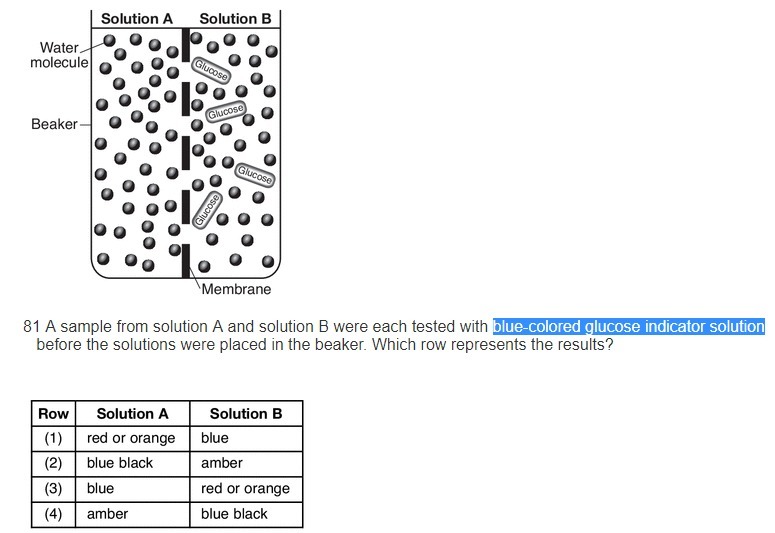
With the given problem you gave here, I can't answer the question because I need more details. Luckily, I found a similar problem that's provided with a diagram and a table shown in the attached picture.

This test is called the Benedict's test which is used as test for presence of sugars. If the solution contains sugar, like glucose, the solution would turn from blue to red. If not, it would stay blue. <em>Therefore, the correct results would be that in row 3.</em>

3 0
2 years ago
Other questions:
  • Convert 5.0x10^24 molecules to liters.
    11·1 answer
  • Complete this sentence. If volume remains the same while the mass of a substance ________, the density of the substance will____
    10·2 answers
  • What is the molarity of 4.35 moles kmno4 dissolved in 750 ml of solution?
    15·1 answer
  • How many pints of a 30% sugar solution must be added to a 5 pint of a 5% sugar solution to obtain a 20% sugar solution?
    14·1 answer
  • A certain mass of carbon reacts with 23.3 g of oxygen to form carbon monoxide. ________ grams of oxygen would react with that sa
    10·2 answers
  • Sulfur and oxygen react to produce sulfur trioxide. In a particular experiment, 7.9 grams of SO3 are produced by the reaction of
    12·1 answer
  • An experimental drug, D, is known to decompose in the blood stream. Tripling the concentration of the drug increases the decompo
    13·1 answer
  • One of the commercial uses of sulfuric acid is the production of calcium sulfate and phosphoric acid. If 19.9 g of Ca₃(PO₄)₂ rea
    8·1 answer
  • Each student in a class placed a 2.00 g sample of a mixture of Cu and Al in a beaker and placed the beaker in a fume hood. The s
    7·1 answer
  • Amino acids are the building blocks of proteins. The simplest amino acid is glycine (H2NCH2COOH). Draw a Lewis structure for gly
    9·1 answer
Add answer
Login
Not registered? Fast signup
Signup
Login Signup
Ask question!