answer.
Ask question
Login Signup
Ask question
All categories
  • English
  • Mathematics
  • Social Studies
  • Business
  • History
  • Health
  • Geography
  • Biology
  • Physics
  • Chemistry
  • Computers and Technology
  • Arts
  • World Languages
  • Spanish
  • French
  • German
  • Advanced Placement (AP)
  • SAT
  • Medicine
  • Law
  • Engineering
KengaRu [80]
2 years ago
3

long nonconducting cylinder (radius = 12 cm) has a charge of uniform density (5.0 nC/m3) distributed throughout its volume. Dete

rmine the magnitude of the electric field 15 cm from the axis of the cylinder.

Physics
1 answer:
kupik [55]2 years ago
8 0

Answer:

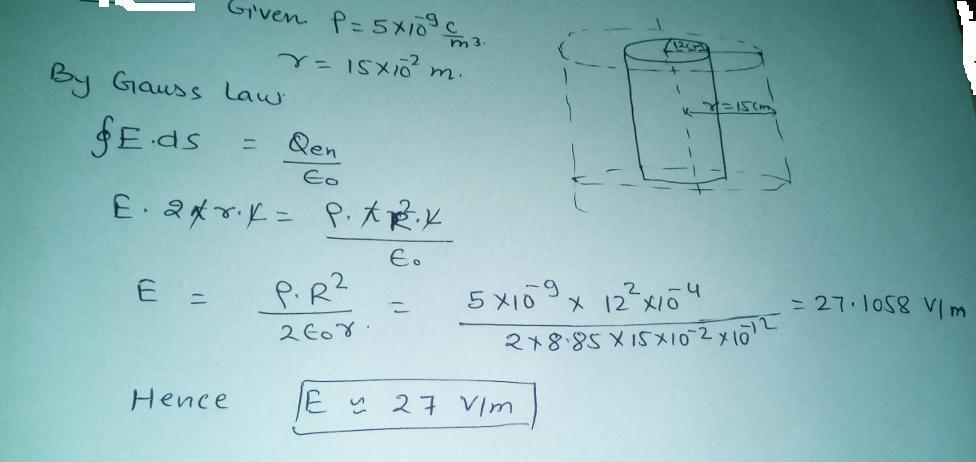
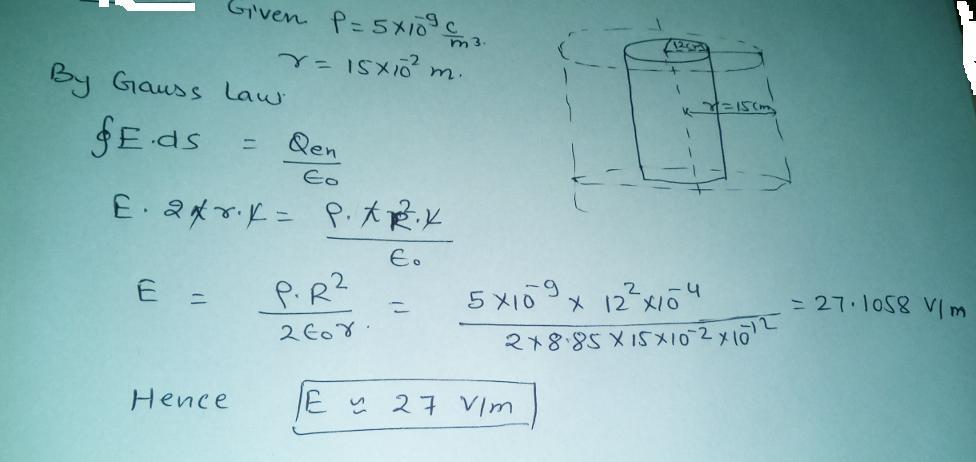
the magnitude of the electric field  = 27.1058 V/m

≈ 27 V/m

Explanation:

given

R(radius enclosed) = 12 cm = 0.12 m

ρ(charge density) = 5.0 nC/m³ = 5.0 × 10⁻⁹C/m³

r(radius from the axis) = 15 cm = 0.15 m

using Gauss law, which states that the electric flux through any closed surface is directly proportional to the total electric charge enclosed by this surface.

attached is the calculation of the question, using Gauss law of electrostatics

You might be interested in
A particle at 9 AM is moving towards the east at 4 ms At 12 noon, it changes its velocity and starts moving towards the north un
nexus9112 [7]

Answer:

Explanation:

Acceleration is the time rate of change of velocity.

Acceleration and velocity are vectors

If east and north are the positive directions, the east moving vector is reduced to zero and the north moving vector increases from zero to 4 m/s.

There are 3 hours or 10800 seconds between 10 AM and 1 PM

a1 = √((-4)² + 4²) / 10800 = (√32) / 10800 m/s² ≈ 4.2 x 10⁻⁴ m/s²

There are 14400 seconds between 10 AM and 2 PM

The velocity changes are still the same

a2 = √((-4)² + 4²) / 10800 = (√32) / 14400 m/s² ≈ 3.9 x 10⁻⁴ m/s²

7 0
2 years ago
1. A student is biking to school. She travels 0.7 km north, then realizes something has fallen out of her bag.
Snezhnost [94]

Explanation:

(a) Displacement of an object is the shortest path covered by it.

In this problem, a student is biking to school. She travels 0.7 km north, then realizes something has fallen out of her bag.  She travels 0.3 km south to retrieve her item. She then travels 0.4 mi north to arrive at school.

0.4 miles = 0.64 km

displacement = 0.7-0.3+0.64 = 1.04 km

(b) Average velocity = total displacement/total time

t = 15 min = 0.25 hour

v=\dfrac{1.04\ km}{0.25\ h}\\\\v=4.16\ km/h

Hence, this is the required solution.

8 0
2 years ago
Scientists studying an anomalous magnetic field find that it is inducing a circular electric field in a plane perpendicular to t
yarga [219]

Answer

The rate at which the magnetic field is changing is  [\frac{dB}{dt} ] =  0.000467 T/s

Explanation

From the question we are told that

   The electric field strength is E =  3.5mV/m =  3.5 *10^{-3} \ V/m

    The radius is  r =  1.5 \ m

The rate of change of the  magnetic  field  is mathematically represented as

        \frac{d \phi }{dt}  =  \int\limits^{} {E \cdot dl}

Where dl is change of a unit length

     \frac{d \phi}{dt}  =  A *  \frac{dB}{dt}

Where A is the area which is mathematically represented as

     A = \pi r^2

    So

    E \int\limits^{} {  dl} =  ( \pi r^2) (\frac{dB}{dt} )  

  E L  =  ( \pi r^2) (\frac{dB}{dt} )  

where L is the circumference of the circle which is mathematically represented as

     L = 2 \pi r

So

     E (2 \pi r ) =  (\pi r^2 ) [\frac{dB}{dt} ]

      E  =   \frac{r}{2}  [\frac{dB}{dt} ]

       [\frac{dB}{dt} ] = \frac{E}{ \frac{r}{2} }

substituting values

      [\frac{dB}{dt} ] = \frac{3.5 *10^{-3}}{ \frac{15}{2} }

      [\frac{dB}{dt} ] =  0.000467 T/s    

8 0
2 years ago
In Physics lab, Ellen has been given the task of constructing a simple motor. She must find common household items at home and b
Aleks [24]

Answer:

a) battery-->electrical current-->copper wire rotor -->magnet--> mechanical energy

Explanation:

6 0
2 years ago
Read 2 more answers
An LR circuit contains an ideal 60-V battery, a 42-H inductor having no resistance, a 24-ΩΩ resistor, and a switch S, all in ser
s2008m [1.1K]

Answer:

1.6 s

Explanation:

To find the time in which the potential difference of the inductor reaches 24V you use the following formula:

V_L=V_oe^{-\frac{Rt}{L}}

V_o: initial voltage = 60V

R: resistance = 24-Ω

L: inductance = 42H

V_L: final voltage = 24 V

You first use properties of the logarithms to get time t, next, replace the values of the parameter:

\frac{V_L}{V_o}=e^{-\frac{Rt}{L}}\\\\ln(\frac{V_L}{V_o})=-\frac{Rt}{L}\\\\t=-\frac{L}{R}ln(\frac{V_L}{V_o})\\\\t=-\frac{42H}{24\Omega}ln(\frac{24V}{60V})=1.6s

hence, after 1.6s the inductor will have a potential difference of 24V
3 0
2 years ago
Other questions:
  • Listed following are locations and times at which different phases of the moon are visible from earth’s northern hemisphere. mat
    9·1 answer
  • ____ 27. An amusement park ride has a frequency of 0.05 Hz. What is the ride’s period?
    15·1 answer
  • Which nucleus completes the following equation?
    5·2 answers
  • When you skid to a stop on your bike, you can significantly heat the small patch of tire that rubs against the road surface. Sup
    9·1 answer
  • Mantles for gas lanterns contain thorium, because it forms an oxide that can survive being heated to incandescence for long peri
    8·1 answer
  • How much heat Q1 is transferred by 25.0 g of water onto the skin? To compare this to the result in the previous part, continue t
    13·1 answer
  • Harmonics problem. A square wave of frequency f contains harmonics (sine waves) at f, 3f, 5f, 7f, ... . Suppose a system respond
    6·1 answer
  • A record player turntable initially rotating at 3313 rev/min is braked to a stop at a constant rotational acceleration. The turn
    12·1 answer
  • a horse gallops a distance of 60 meters in 15 seconds. then, he stops to eat some grass for 20 seconds. next, he trots for 25 se
    5·1 answer
  • A student is conducting a physics experiment and rolls four different-
    7·1 answer
Add answer
Login
Not registered? Fast signup
Signup
Login Signup
Ask question!