answer.
Ask question
Login Signup
Ask question
All categories
  • English
  • Mathematics
  • Social Studies
  • Business
  • History
  • Health
  • Geography
  • Biology
  • Physics
  • Chemistry
  • Computers and Technology
  • Arts
  • World Languages
  • Spanish
  • French
  • German
  • Advanced Placement (AP)
  • SAT
  • Medicine
  • Law
  • Engineering
elena55 [62]
2 years ago
10

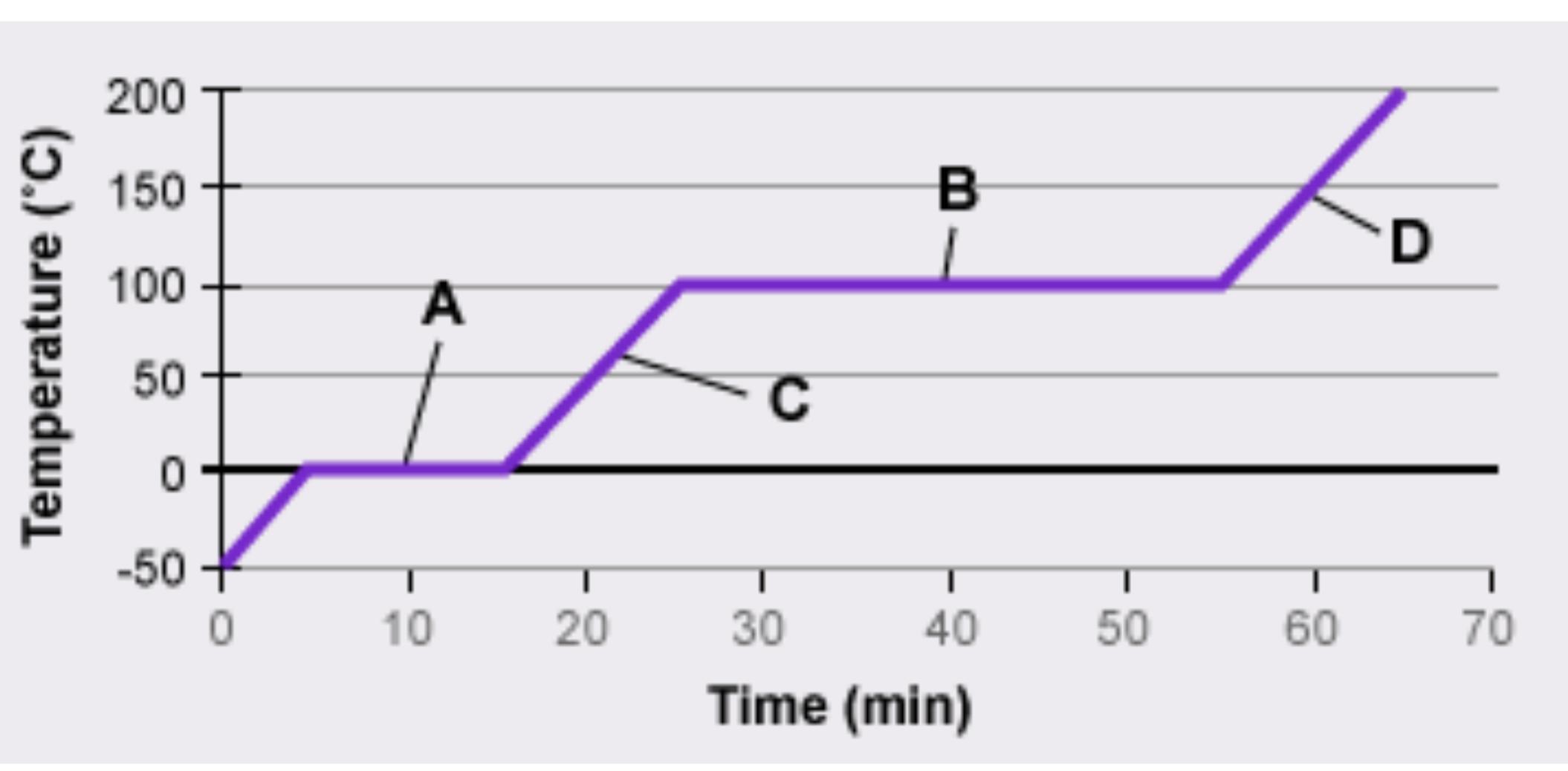
As a sample of water is heated, the kinetic energy of its molecules increases. Then, the energy is used to overcome the attracti

ons between the molecules so that they are no longer held close together. Which sections of the heating curve illustrate this process?

Physics
1 answer:
maks197457 [2]2 years ago
7 0

Answer: SECTION B (BOILING POINT)

Explanation: Boiling point (100°c)

This is the point in which the water molecules acquires sufficient kinetic energy to overcome the attraction binding them.(a point at which a liquid will boil).

When a liquid example water is heated to it's boiling point,there is a rapid vaporization,this is known as boiling.At this boiling point,the temperature of the vapour pressure of the liquid will be directly proportional to the pressure exerted on the liquid by the sorounding atmosphere.

You might be interested in
A 20~\mu F20 μF capacitor has previously charged up to contain a total charge of Q = 100~\mu CQ=100 μC on it. The capacitor is t
sertanlavr [38]

Explanation:

The given data is as follows.

       C = 20 \times 10^{-6} F

        R = 100 \times 10^{3} ohm

        Q_{o} = 100 \times 10^{-6} C

          Q = 13.5 \times 10^{-6} C

Formula to calculate the time is as follows.

          Q_{t}  = Q_{o} [e^{\frac{-t}{\tau}]

       13.5 \times 10^{-6} = 100 \times 10^{-6} [e^{\frac{-t}{2}}]

               0.135 = e^{\frac{-t}{2}}

         e^{\frac{t}{2}} = \frac{1}{0.135}

                         = 7.407

           \frac{t}{2} = ln (7.407)

                      t = 4.00 s

Therefore, we can conclude that time after the resistor is connected will the capacitor is 4.0 sec.

4 0
2 years ago
A particle decelerates uniformly from a speed of 30 cm/s to rest in a time interval of 5.0 s. It then has a uniform acceleration
wel

Answer:

V=20cm/s

Explanation:

The average speed is the distance total divided the time total:

V=X/T

First stage:

T1=5s

v_{f}  =v_{o} - at

But, v_{f}  =0   (decelerates to rest)

then: a =v_{o} /t=0.3/5=0.06m/s^{2}

on the other hand:

x =v_{o}*t - 1/2*at^{2}=0.3*5-1/2*0.06*5^{2}=0.75m

X1=75cm

Second stage:

T2=5s

x =v_{o}*t + 1/2*at^{2}=0+1/2*0.1*5^{2}=1.25m

X2=125cm

Finally:

X=X1+X2=200cm

T=T1+T2=10s

V=X/T=20cm/s

8 0
2 years ago
A ball weighing 1 lb is attached to a string 2 feet long and is whirled in a vertical circle at a constant speed of 10 ft/sec.
fredd [130]

Explanation:

It is given that,

Mass of the ball, m = 1 lb

Length of the string, l = r = 2 ft

Speed of motion, v = 10 ft/s

(a) The net tension in the string when the ball is at the top of the circle is given by :

F=\dfrac{mv^2}{r}-mg

F=m(\dfrac{v^2}{r}-g)

F=1\ lb\times (\dfrac{(10\ ft/s)^2}{2}-1\ lb\times 32\ ft/s^2)

F = 18 N

(b) The net tension in the string when the ball is at the bottom of the circle is given by :

F=\dfrac{mv^2}{r}+mg

F=m(\dfrac{v^2}{r}+g)

F=1\ lb\times (\dfrac{(10\ ft/s)^2}{2}+1\ lb\times 32\ ft/s^2)

F = 82 N

(c) Let h is the height where the ball at certain time from the top. So,

T=mg(\dfrac{r-h}{r})+\dfrac{mv^2}{r}

T=\dfrac{m}{r}(g(r-h)+v^2)

Since, v^2=u^2-2gh

T=\dfrac{m}{r}(u^2-3gh+gr)

Hence, this is the required solution.

6 0
2 years ago
Two electric force vectors act on a particle. Their x-components are 13.5 N and −7.40 N and their y-components are −12.0 N and −
guapka [62]

Answer:

Explanation:

Given two vectors as follows

E₁ = 13.5 i -12 j

E₂ = -7.4 i - 4.7 j

Resultant E = E₁ + E₂

= 13.5 i -12 j -7.4 i - 4.7 j

E = 6.1 i - 16.7 j

a ) X component of resultant = 6.1 N

b ) y component of resultant = -16.7 N

Magnitude of resultant = √ ( 6.1² + 16.7² )

= 17.75 N

d ) If θ be the required angle

tanθ = 16.7 / 6.1 = 2.73

θ = 70° .

counterclockwise = 360 - 70 = 290°

6 0
2 years ago
To crossing over the flooded canal.
zubka84 [21]

Answer:

F. jumping

Explanation:

you can't throw/toss yourself, you cant roll over water, catching?, you cant run over water, jumps are bigger than hops
4 0
2 years ago
Other questions:
  • How much heat must be absorbed by 375 grams of water to raise its temperature by 25°c
    8·2 answers
  • Select the volume units that are greater than one liter.
    11·2 answers
  • Zamir and Talia raced through a maze. Zamir walked 2 m north, 2 m east, 4 m south, 2 m east, 4 m north, 2 m east, 3 m south, 4 m
    11·2 answers
  • A car going initially with a velocity 13.5 m/s accelerates at a rate of 1.9 m/s for 6.2 s. It then accelerates at a rate of-1.2
    13·2 answers
  • Assume that a person bouncing a ball represents a closed system. Which statement best describes how the amounts of the ball's po
    8·1 answer
  • An electric pump rated 1.5 KW lifts 200kg of water through a vertical height of 6m in 10 secs: way is the efficiency of the pump
    13·1 answer
  • the millersburg ferry (m=13000.0 kg loaded) puts its engines in full reverse and stops in 65 seconds. if the speed before brakin
    14·1 answer
  • a) Suppose that the current in the solenoid is I(t). Within the solenoid, but far from its ends, what is the magnetic field B(t)
    12·1 answer
  • While practicing S-turns, a consistently smaller half-circle is made on one side of the road than on the other, and this turn is
    13·1 answer
  • In a closed system that has 45 J of mechanical energy, the gravitational
    11·1 answer
Add answer
Login
Not registered? Fast signup
Signup
Login Signup
Ask question!
