answer.
Ask question
Login Signup
Ask question
All categories
  • English
  • Mathematics
  • Social Studies
  • Business
  • History
  • Health
  • Geography
  • Biology
  • Physics
  • Chemistry
  • Computers and Technology
  • Arts
  • World Languages
  • Spanish
  • French
  • German
  • Advanced Placement (AP)
  • SAT
  • Medicine
  • Law
  • Engineering
Paraphin [41]
2 years ago
6

Which of the following ranges depicts the 2% tolerance range to the full 9 digits provided?

Engineering
1 answer:
Lyrx [107]2 years ago
4 0

Answer:

the only one that meets the requirements is option C .

Explanation:

The tolerance of a quantity is the maximum limit of variation allowed for that quantity.

To find it we must have the value of the magnitude, its closest value is the average value, this value can be given or if it is not known it is calculated with the formula

         x_average = ∑ x_{i} / n

The tolerance or error is the current value over the mean value per 100

         Δx₁ = x₁ / x_average

         tolerance = | 100 -Δx₁  100 |

bars indicate absolute value

let's look for these values ​​for each case

a)

    x_average = (2.1700000+ 2.258571429) / 2

    x_average = 2.2142857145

fluctuation for x₁

        Δx₁ = 2.17000 / 2.2142857145

        Tolerance = 100 - 97.999999991

        Tolerance = 2.000000001%

fluctuation x₂

        Δx₂ = 2.258571429 / 2.2142857145

        Δx2 = 1.02

        tolerance = 100 - 102.000000009

        tolerance 2.000000001%

b)

    x_average = (2.2 + 2.29) / 2

    x_average = 2,245

fluctuation x₁

         Δx₁ = 2.2 / 2.245

         Δx₁ = 0.9799554

         tolerance = 100 - 97,999

         Tolerance = 2.00446%

fluctuation x₂

          Δx₂ = 2.29 / 2.245

          Δx₂ = 1.0200445

          Tolerance = 2.00445%

c)

   x_average = (2.211445 +2.3) / 2

   x_average = 2.2557225

       Δx₁ = 2.211445 / 2.2557225 = 0.9803710

       tolerance = 100 - 98.0371

       tolerance = 1.96%

       Δx₂ = 2.3 / 2.2557225 = 1.024624

       tolerance = 100 -101.962896

       tolerance = 1.96%

d)

   x_average = (2.20144927 + 2.29130435) / 2

   x_average = 2.24637681

       Δx₁ = 2.20144927 / 2.24637681 = 0.98000043

       tolerance = 100 - 98.000043

       tolerance = 2.000002%

       Δx₂ = 2.29130435 / 2.24637681 = 1.0200000017

       tolerance = 2.0000002%

e)

   x_average = (2 +2,3) / 2

   x_average = 2.15

   Δx₁ = 2 / 2.15 = 0.93023

   tolerance = 100 -93.023

   tolerance = 6.98%

   Δx₂ = 2.3 / 2.15 = 1.0698

   tolerance = 6.97%

Let's analyze these results, the result E is clearly not in the requested tolerance range, the other values ​​may be within the desired tolerance range depending on the required precision, for the high precision of this exercise the only one that meets the requirements is option C .


You might be interested in
An annealed copper strip of 228 mm wide and 25 mm thick being rolled to a thickness of 20 mm, in one pass. The roll radius is 30
sdas [7]

Answer:

The roll force is 1.59 MN

The power required in this operation is 644.96 kW

Explanation:

Given;

width of the annealed copper, w = 228 m

thickness of the copper, h₀ = 25 mm

final thickness, hf = 20 mm

roll radius, R = 300 mm

The roll force is given by;

F = LwY_{avg}

where;

w is the width of the annealed copper

Y_{avg} is average true stress of the strip in the roll gap

L is length of arc in contact, and for frictionless situation it is given as;

L = \sqrt{R(h_o-h_f)} \\\\L = \sqrt{300(25-20)}\\\\L = 38.73 \ mm

Now, determine the average true stress, Y_{avg}, for the annealed copper;

The absolute value of the true strain, ε = ln(25/20)

ε = 0.223

from true stress vs true strain graph; at true strain of 0.223, the true stress is 280 MPa.

Then, the average true stress = ¹/₂(280 MPa.) = 180 MPa

Finally determine the roll force;

F = LwY_{avg}

F = (\frac{38.73 }{1000})(\frac{228}{1000})*180 \ MPa\\\\F =   1.59 \ MN

The power required in this operation is given by;

P = \frac{2\pi FLN}{60}\\\\P =  \frac{2\pi (1.59*10^6)(0.03873)(100)}{60}\\\\P = 644955.2 \ W\\\\P = 644.96 \ kW

5 0
2 years ago
The legend that Benjamin Franklin flew a kite as a storm approached is only a legend—he was neither stupid nor suicidal. Suppose
Delicious77 [7]

Answer: 0.93 mA

Explanation:

In order to calculate the current passing through the water layer, as we have the potential difference between the ends of the string as a given, assuming that we can apply Ohm’s law, we need to calculate the resistance of the water layer.

We can express the resistance as follows:

R = ρ.L/A

In order to calculate the area A, we can assume that the string is a cylinder with a circular cross-section, so the Area of the water layer can be written as follows:

A= π(r22 – r12) = π( (0.0025)2-(0.002)2 ) m2 = 7.07 . 10-6 m2

Replacing by the values, we get R as follows:

R = 1.4 1010 Ω

Applying Ohm’s Law, and solving for the current I:

I = V/R = 130 106 V / 1.4 1010 Ω = 0.93 mA

7 0
2 years ago
A woodcutter wishes to cause the tree trunk to fall uphill, even though the trunk is leaning downhill. With the aid of the winch
Sedbober [7]

Answer:

The correct answer will be "400.4 N". The further explanation is given below.

Explanation:

The given values are:

Mass of truck,

m = 600 kg

g = 9.8 m/s²

On equating torques at the point O,

⇒  T\times Cos(10+5)\times (1.3+4)=mg\times Sin(5)\times 4

So that,

On putting the values, we get

⇒  T\times Cos(15^{\circ})\times 5.3=600\times 9.8\times Sin(5^{\circ})\times 4

⇒                             T=400.4 \ N

8 0
2 years ago
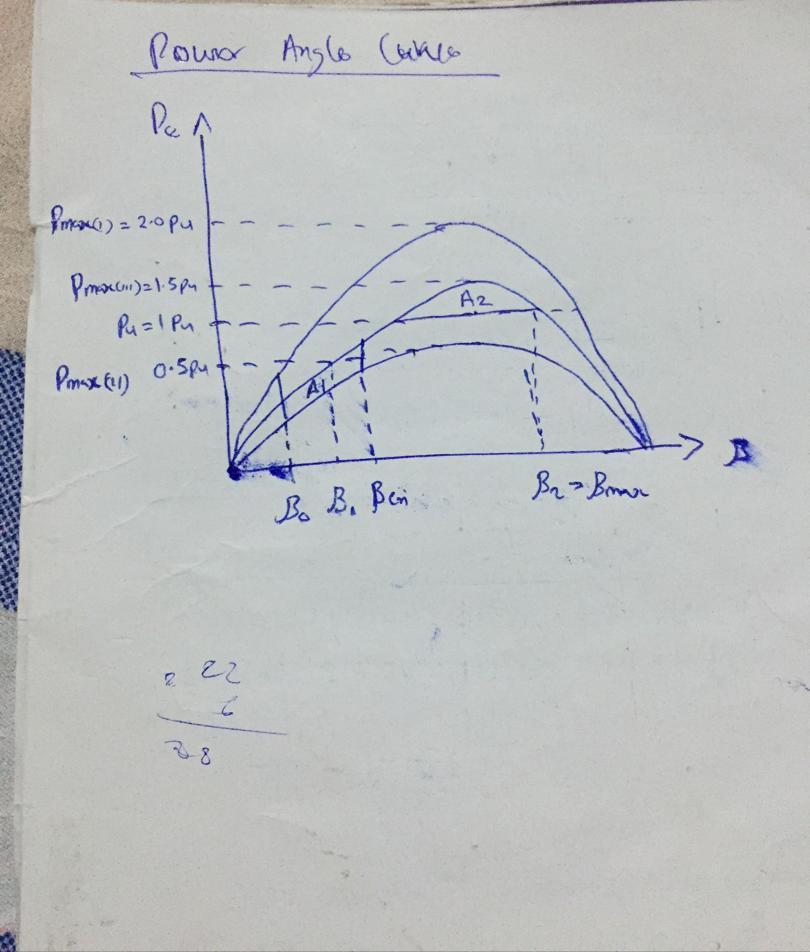
A generator operating at 50 Hz delivers 1 pu power to an infinite bus through a transmission circuit in which resistance is igno
olga55 [171]

Answer:

critical clearing angle = 70.3°

Explanation:

Generator operating at = 50 Hz

power delivered = 1 pu

power transferable when there is a fault = 0.5 pu

power transferable before there is a fault = 2.0 pu

power transferable after fault clearance = 1.5 pu

using equal area criterion to determine the critical clearing angle

Attached is the power angle curve diagram and the remaining part of the solution.

The power angle curve is given as

= Pmax sinβ

therefore :  2sinβo = Pm

                   2sinβo = 1

                   sinβo = 0.5 pu

                   βo = sin^{-1} (0.5) = 30⁰

also ;   1.5sinβ1 = 1

               sinβ1 = 1/1.5

               β1 = sin^{-1} (\frac{1}{1.5} ) = 41.81⁰

∴ βmax = 180 - 41.81  = 138.19⁰

attached is the remaining solution

The critical clearing angle = cos^{-1} 0.3372  ≈ 70.3⁰

3 0
2 years ago
Q9. A cylindrical specimen of a metal alloy 54.8 mm long and 10.8 mm in diameter is stressed in tension. A true stress of 365 MP
wolverine [178]

Answer:

σ = 391.2 MPa

Explanation:

The relation between true stress and true strain is given as:

σ = k εⁿ

where,

σ = true stress = 365 MPa

k = constant

ε = true strain = Change in Length/Original Length

ε = (61.8 - 54.8)/54.8 = 0.128

n = strain hardening exponent = 0.2

Therefore,

365 MPa = K (0.128)^0.2

K = 365 MPa/(0.128)^0.2

k = 550.62 MPa

Now, we have the following data:

σ = true stress = ?

k = constant = 550.62 MPa

ε = true strain = Change in Length/Original Length

ε = (64.7 - 54.8)/54.8 = 0.181

n = strain hardening exponent = 0.2

Therefore,

σ = (550.62 MPa)(0.181)^0.2

<u>σ = 391.2 MPa</u>

7 0
2 years ago
Other questions:
  • Oil in an engine is being cooled by air in a cross-flow heat exchanger, where both fluids are unmixed. Oil (cp = 2000 J/kg. K) f
    12·1 answer
  • A 0.9% solution of NaCl is considered isotonic to mammalian cells. what molar concentration is this?
    10·1 answer
  • A meter stick can be read to the nearest millimeter and a travelling microscope can be read to the nearest 0.1 mm. Suppose you w
    11·1 answer
  • Two physical properties that have a major influence on the cracking of workpieces, tools, or dies during thermal cycling are the
    13·1 answer
  • The Hamming encoder/decoder in the lecture detected and corrected one error bit. By adding a thirteen bit which is the exclusive
    13·1 answer
  • An air standard cycle with constant specific heats is executed in a closed pistoncylinder system and is composed of the followin
    10·1 answer
  • 49. A solenoid coil with a resistance of 30 ohms and an inductance of 200 milli-henrys, is connected to a 230VAC, 50Hz supply. D
    8·1 answer
  • What is the linear distance traveled in one revolution of a 36-inch wheel
    6·1 answer
  • Who can work on a fixed ladder that extends more than 24 feet?
    11·1 answer
  • You are the scheduler for a large commercial building project. The schedule that you prepared (based on feedback from the projec
    7·1 answer
Add answer
Login
Not registered? Fast signup
Signup
Login Signup
Ask question!