answer.
Ask question
Login Signup
Ask question
All categories
  • English
  • Mathematics
  • Social Studies
  • Business
  • History
  • Health
  • Geography
  • Biology
  • Physics
  • Chemistry
  • Computers and Technology
  • Arts
  • World Languages
  • Spanish
  • French
  • German
  • Advanced Placement (AP)
  • SAT
  • Medicine
  • Law
  • Engineering
umka21 [38]
2 years ago
9

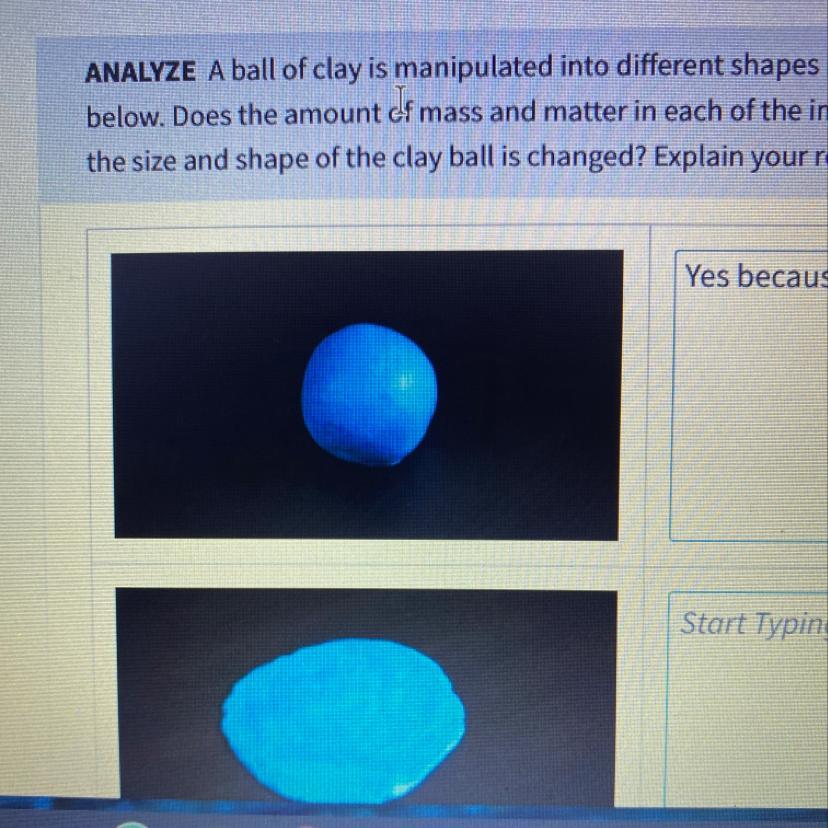
ANALYZE A ball of clay is manipulated into different shapes in each of the images

Chemistry
1 answer:
alekssr [168]2 years ago
7 0

Answer:

The amount of mass and matter in all the transformations of the clay ball will remain the same or constant

Explanation:

From the  law of conservation of mass we have, for an enclosed system to and from which there is no transfer of matter or energy, mass cannot be created nor destroyed, and remains constant at the given value, but the matter which make up the mass can be changed into different forms

Therefore, the clay ball can be transformed into different shapes and will still posses the same initial mass before the transformation, provided there are no transfer of matter or energy from the clay ball system.

You might be interested in
Urea is a common fertilizer with the formula CO(NH2)2 that is sometimes used as a chemical de-icer for icy road surfaces in the
nordsb [41]

Answer:

The answer to your question is  molality = 0.61

Explanation:

Freezing point is the temperature at which a liquid turns into a solid if a solute is added to a solution, the freezing point changes.

Data

Kf = 1.86 °C/m

molality = ?

ΔTc = 1.13°C

Formula

ΔTc = kcm

Solve for m

m = ΔTc/kc

Substitution

m = 1.13 / 1.86

Simplification and result

m = 0.61

4 0
2 years ago
 A reaction container holds 5.77 g of P4 and 5.77 g of O2.
Dvinal [7]

Answer:

a) O2 is the limiting reactant

b) 5.75 grams P4O10

c) 5.79 grams P4O6

Explanation:

Step 1: Data given

Mass of P4 = 5.77 grams

Mass of O2 = 5.77 grams

Molar mass of P4 = 123.90 g/mol

Molar mass O2 = 32.0 g/mol

Step 2: The balanced equation

P4 + 3O2 → P4O6

Step 3: Calculate moles of P4

Moles P4 = mass P4 / molar mass P4

Moles P4 = 5.77 grams / 123.90 g/mol

Moles P4 = 0.0466 moles

Step 4: Calculate moles O2

Moles O2 = mass O2 / molar mass O2

Moles O2 = 5.77 grams / 32.0 g/mol

Moles O2 = 0.1803 moles

Step 5: Calculate limiting reactant

P4 is the limiting reactant in this reaction. It will completely be consumed (0.0466 moles). O2 is in excess, there will react 3*0.0466 = 0.1398 moles

There will remain 0.1803 - 0.1398 = 0.0405 moles O2

Step 6: Calculate the amount of P4O6

For 1 mol P4 we'll have 1 mol P4O6

For 0.0466 moles P4 we'll have 0.0466 moles P4O6

Step 7: The balanced equatio

P4O6 + 2O2 → P4O10

We have 0.0466 moles P4O6 and 0.0405 moles O2

Step 8: Calculate the limiting reactant

For 1 mol P4O6 we need 2 moles O2 to produce 1 mol P4O10

O2 is the limiting reactant. It will completely be consumed (0.0405 moles)

P4O6 is in excess. There will react 0.0405/2 = 0.02025 moles

There will remain 0.0466 - 0.02025 = 0.02635 moles P4O6

This is 0.02635 * 219.88 g/mol = 5.79 grams P4O6

Step 9: Calculate moles and mass of P4O10

For 1 mol P4O6 we need 2 moles O2 to produce 1 mol P4O10

For 0.0405 moles O2 we'll have 0.02025 moles P4O10

This is 0.02025 * 283.89 g/mol = 5.75 grams P4O10
3 0
2 years ago
The decomposition of AB given here in this balanced equation 2AB (g)⟶ A2 (g) + B2 (g), has rate constants of 8.58 x 10⁻⁹ L/mol s
denis-greek [22]

Answer:

3.24 × 10^5 J/mol

Explanation:

The activation energy of this reaction can be calculated using the equation:

ln(k2/k1) = Ea/R x (1/T1 - 1/T2)

Where; Ea = the activation energy (J/mol)

R = the ideal gas constant = 8.3145 J/Kmol

T1 and T2 = absolute temperatures (K)

k1 and k2 = the reaction rate constants at respective temperature

First, we need to convert the temperatures in °C to K

T(K) = T(°C) + 273.15

T1 = 325°C + 273.15

T1 = 598.15K

T2 = 407°C + 273.15

T2 = 680.15K

Since, k1= 8.58 x 10⁻⁹ L/mol, k2= 2.16 x 10⁻⁵ L/mol, R= 8.3145 J/Kmol, we can now find Ea

ln(k2/k1) = Ea/R x (1/T1 - 1/T2)

ln(2.16 x 10⁻⁵/8.58 x 10-9) = Ea/8.3145 × (1/598.15 - 1/680.15)

ln(2517.4) = Ea/8.3145 × 2.01 × 10^-4

7.831 = Ea(2.417 × 10^-5)

Ea = 3.24 × 10^5 J/mol

8 0
2 years ago
Sodium acetate spontaneously crystallizes out of a supersaturated solution upon standing or upon the addition of a seed crystal.
AlekseyPX

Answer:

Option (c) is correct.

Explanation:

According to 2nd law of thermodynamics, every spontaneous process is associated with increase in entropy (\Delta S>0).

As sodium acetate crystallizes out spontaneously therefore it is associated with \Delta S>0.

During crystallization, bond formation takes place which results evolution of heat. In other words, crystallization phenomenon is exothermic (\Delta H).

So, the given crystallization process renders the following thermodynamic quantities- \Delta S>0 J/K and \Delta H J

Option (c) is correct.

6 0
2 years ago
Calculate the pka of hypochlorous acid. The ph of a 0.015 m solution of hypochlorous acid has a ph of 4.64.
o-na [289]

Answer:

  • pKa = 7.46

Explanation:

<u>1) Data:</u>

a) Hypochlorous acid = HClO

b) [HClO} = 0.015

c) pH = 4.64

d) pKa = ?

<u>2) Strategy:</u>

With the pH calculate [H₃O⁺], then use the equilibrium equation to calculate the equilibrium constant, Ka, and finally calculate pKa from the definition.

<u>3) Solution:</u>

a) pH

  • pH = - log [H₃O⁺]

  • 4.64 = - log [H₃O⁺]

  • [H_3O^+]= 10^{-4.64} = 2.29.10^{-5}

b) Equilibrium equation: HClO (aq) ⇄ ClO⁻ (aq) + H₃O⁺ (aq)

c) Equilibrium constant: Ka =  [ClO⁻] [H₃O⁺] / [HClO]

d) From the stoichiometry: [CLO⁻] = [H₃O⁺] = 2.29 × 10 ⁻⁵ M

e) By substitution: Ka = (2.29 × 10 ⁻⁵ M)² / 0.015M = 3.50 × 10⁻⁸ M

f) By definition: pKa = - log Ka = - log (3.50 × 10 ⁻⁸) = 7.46

5 0
2 years ago
Other questions:
  • How many flies can fit into a 10 oz coffee cup?
    12·1 answer
  • A beaker contains a dilute sodium chloride solution at 1 atmosphere. What happens to the number of solute particles in the solut
    6·2 answers
  • Question 1(Multiple Choice Worth 3 points)
    14·1 answer
  • Acetylene burns in air according to the following equation: C2H2(g) + 5 2 O2(g) → 2 CO2(g) + H2O(g) ΔH o rxn = −1255.8 kJ Given
    5·1 answer
  • Mendeleev placed thallium (Tl) in the same group as lithium (Li), sodium (Na), potassium (K), rubidium (Rb), and cesium (Cs). Ho
    11·1 answer
  • When a sample of oxygen gas in a closed container of constant volume is heated until its absolute temperature is doubled, which
    13·1 answer
  • Copper has been used for thousands of years, either as a pure metal or in alloys. It is frequently used today in the production
    8·1 answer
  • A cylinder container can hold 2.45 L of water. It’s radius is 4.00 cm. What is the volume of it in cubic centimeters?
    7·1 answer
  • What information does not need to be included a chemical waste label? Select one: Relative amounts of chemical compounds in the
    7·1 answer
  • Heating a particular ether with HBr yielded a single organic product. Which of the following conclusions can be reached?
    15·1 answer
Add answer
Login
Not registered? Fast signup
Signup
Login Signup
Ask question!
