answer.
Ask question
Login Signup
Ask question
All categories
  • English
  • Mathematics
  • Social Studies
  • Business
  • History
  • Health
  • Geography
  • Biology
  • Physics
  • Chemistry
  • Computers and Technology
  • Arts
  • World Languages
  • Spanish
  • French
  • German
  • Advanced Placement (AP)
  • SAT
  • Medicine
  • Law
  • Engineering
jekas [21]
2 years ago
9

A delivery company has just unloaded a 500 N crate full of home exercise equipment in your level driveway. Suppose you try to mo

ve the crate by pulling upward on the rope at an angle of 30∘ above the horizontal. How hard do you have to pull to keep the crate moving with constant velocity? Is this easier or harder than pulling horizontally? For this crate the coefficient of kinetic friction, μk, is 0.40.

Physics
1 answer:
USPshnik [31]2 years ago
6 0

Answer:

i) A force of 187.612 newtons at a direction of 30º above the horizontal to keep the crate moving at constant velocity, ii) The force found in item i) makes pulling easier than pulling horizontally.

Explanation:

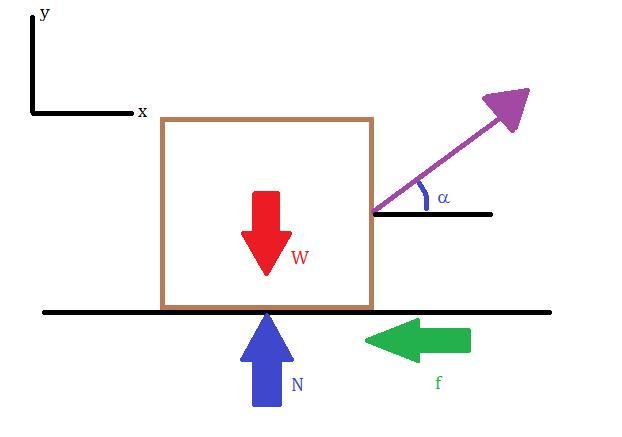
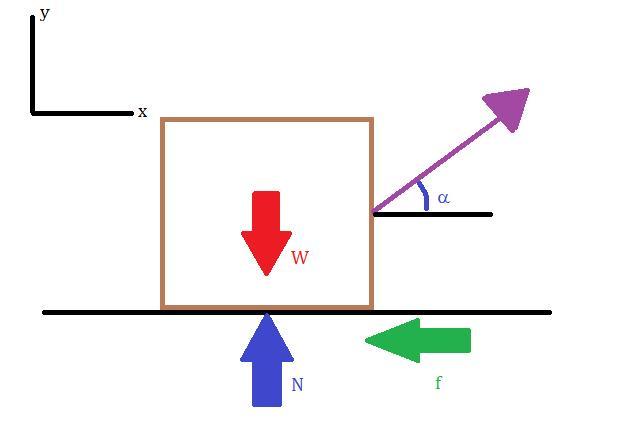
i) Let be the crate our system. As first step we draw a free body diagram on the crate, whose outcome is included as attachment below. Tension exerts a force on the crate which moves on the horizontal ground.

By Newton's Laws, a system moving at constant speed must have a net acceleration of zero. The equations of equilibrium are now described:

\Sigma F _{x} = F \cdot \cos \alpha - \mu_{k}\cdot N = 0 (Eq. 1)

\Sigma F_{y} = F\cdot \sin \alpha -m\cdot g +N = 0 (Eq. 2)

Where:

F - Tension force exerted on crate, measured in newtons.

\alpha - Angle of the tension force, measured in sexagesimal degrees.

\mu_{k} - Coefficient of kinetic friction, dimensionless.

N - Normal force, measured in newtons.

m - Mass of the crate, measured in kilograms.

g - Gravitational acceleration, measured in meters per square second.

We eliminate the normal force in (Eq. 1) by substitution:

(Eq. 2) in (Eq. 1)

F\cdot \cos \alpha -\mu_{k}\cdot (m\cdot g -F\cdot \sin \alpha) = 0

Then, tension force is cleared within:

F \cdot \cos \alpha -\mu_{k}\cdot m \cdot g + \mu_{k}\cdot F\cdot \sin \alpha = 0

F \cdot (\cos \alpha + \mu_{k}\cdot \sin \alpha) = \mu_{k}\cdot m \cdot g

F = \frac{\mu_{k}\cdot m \cdot g}{\cos \alpha + \mu_{k}\cdot \sin \alpha}

If m\cdot g = 500\,N, \mu_{k} = 0.40 and \alpha = 30^{\circ}, the force needed to pull the crate is:

F = \frac{(0.40)\cdot (500\,N)}{\cos 30^{\circ}+(0.40)\cdot \sin 30^{\circ}}

F = 187.612\,N

A force of 187.612 newtons at a direction of 30º above the horizontal to keep the crate moving at constant velocity.

ii) Now, we assume that \alpha = 0^{\circ}, the force needed to pull the crate is:

F = \frac{(0.40)\cdot (500\,N)}{\cos 0^{\circ}+(0.40)\cdot \sin 0^{\circ}}

F = 200\,N

Which leads to the conclusion that previous force makes pulling the crate easier than pulling horizontally.
You might be interested in
A small ball of mass 2.00 kilograms is moving at a velocity 1.50 meters/second. It hits a larger, stationary ball of mass 5.00 k
rewona [7]

The kinetic energy of the small ball before the collision is

                             KE  =  (1/2) (mass) (speed)²

                                     = (1/2) (2 kg) (1.5 m/s)

                                     =    (1 kg)  (2.25 m²/s²)

                                     =        2.25 joules.

Now is a good time to review the Law of Conservation of Energy:

                     Energy is never created or destroyed. 
                     If it seems that some energy disappeared,
                     it actually had to go somewhere.
                     And if it seems like some energy magically appeared,
                     it actually had to come from somewhere.

The small ball has 2.25 joules of kinetic energy before the collision.
If the small ball doesn't have a jet engine on it or a hamster inside,
and does not stop briefly to eat spinach, then there won't be any
more kinetic energy than that after the collision.  The large ball
and the small ball will just have to share the same 2.25 joules.

3 0
2 years ago
A box sliding on a horizontal frictionless surface runs into a fixed spring, compressing it a distance x1 from its relaxed posit
inn [45]

Answer:twice of initial value

Explanation:

Given

spring compresses x_1 distance for some initial speed

Suppose v is the initial speed and k be the spring constant

Applying conservation of energy

kinetic energy converted into spring Elastic potential energy

\dfrac{1}{2}mv^2=\dfrac{1}{2}kx_1^2----1

When speed doubles

\dfrac{1}{2}m(2v)^2=\dfrac{1}{2}kx_2^2----2

divide 1 and 2

\dfrac{1}{4}=\dfrac{x_1^2}{x_2^2}

x_2=2x_1

Therefore spring compresses twice the initial value


7 0
2 years ago
during convection, hot material _____ (expands & sinks, cools & rises, expands & rises, deflates & rises) then m
Lady bird [3.3K]

Answer:

During convection, hot material expands & rises then moves to the side and cools & sinks. this circular pattern is called a convection current.

Explanation:

Convection is one of the three methods of transfer of heat. It occurs only in fluids (liquids or gases).

Convection occurs when there is a source of heat that heats a fluid, such as in a boiling pot of water. The water which is on the bottom of the pot becomes warmer before than the water at the top (because it is closer to the flame), and so it becomes less dense: for this reason, it expands and it becomes rising. On the contrary, the water on top is colder, so it is more dense and starts sinking, replacing the warmer water. As the new part of water gets warmer, it starts rising, and so the process is continuously repeated. This circular current is called convection current.

4 0
2 years ago
Read 2 more answers
Suppose that a sound has initial intensity β1 measured in decibels. This sound now increases in intensity by a factor f. What is
topjm [15]

Answer:

β2= β1+10*f

Explanation:

comparing β2 and β1, it is said that β2 is increased by a factor of f.

for each factor of f, there is a 10*f dB increase.

therefore if the β1 is increases by an intensity of factor f

the new intensity would be β1+ 10*f

4 0
2 years ago
A 2.0 m × 4.0 m flat carpet acquires a uniformly distributed charge of −10 μC after you and your friends walk across it several
mamaluj [8]

Answer:

The  charge on the dust particle is  q_d  = 6.94 *10^{-13} \  C

Explanation:

From the question we are told that

    The length is  l = 2.0 \ m

    The width is  w = 4.0 \ m

   The charge is  q =  -10\mu C= -10*10^{-6} \ C

    The mass suspended in mid-air is m_a =  5.0 \mu g =  5.0 *10^{-6} \ g =  5.0 *10^{-9} \  kg


Generally the electric field on the carpet is mathematically represented as

           E =  \frac{q}{ 2 *  A  *  \epsilon _o}

Where \epsilon _o is the permittivity of free space with value \epsilon_o = 8.85*10^{-12}  \ \  m^{-3} \cdot kg^{-1}\cdot  s^4 \cdot A^2

substituting values

           E =  \frac{-10*10^{-6}}{ 2 *  (2 * 4 )  *  8.85*10^{-12}}

           E = -70621.5 \  N/C

Generally the electric force keeping the dust particle on the air  equal to the force of gravity acting on the particles

        F__{E}} =  F__{G}}

=>     q_d *  E  =  m * g

=>      q_d  =  \frac{m * g}{E}

=>      q_d  =  \frac{5.0 *10^{-9} * 9.8}{70621.5}

=>     q_d  = 6.94 *10^{-13} \  C

4 0
2 years ago
Other questions:
  • A constant torque of 200Nm turns a wheel about its centre. The moment of inertia of it about the axis is 100kgm^s . Find the kin
    13·2 answers
  • How does energy from the sun affect the motion of molecules in a gas compared to molecules in a liquid?
    11·2 answers
  • When a driver presses the brake pedal, his car stops with an acceleration of -2.1 m/s2. How far will the car travel while coming
    8·1 answer
  • Charina says that when waves interact with an object, they will interfere with the object, and that when waves interact with oth
    13·2 answers
  • You throw a baseball at an angle of 30.0∘∘ above the horizontal. It reaches the highest point of its trajectory 1.05 ss later. A
    13·1 answer
  • An observer O is standing on a platform of length L = 90 m on a station. A rocket train passes at a relative (constant) speed of
    12·1 answer
  • Is velocity ratio of a machine affected by applying oil on it?Explain with reason.​
    9·1 answer
  • Yamel is heating up leftover mashed potatoes from Thanksgiving. She forgot to put gravy on them. So she puts the cold gravy on t
    6·1 answer
  • a block weighing (Fg) 50 N is resting on a steel table (us = 0.74). The minimum force to start this block moving is what N
    8·1 answer
  • Although human beings have been able to fly hundreds of thousands of miles into outer space, getting inside the earth has proven
    12·1 answer
Add answer
Login
Not registered? Fast signup
Signup
Login Signup
Ask question!
