answer.
Ask question
Login Signup
Ask question
All categories
  • English
  • Mathematics
  • Social Studies
  • Business
  • History
  • Health
  • Geography
  • Biology
  • Physics
  • Chemistry
  • Computers and Technology
  • Arts
  • World Languages
  • Spanish
  • French
  • German
  • Advanced Placement (AP)
  • SAT
  • Medicine
  • Law
  • Engineering
Ksivusya [100]
2 years ago
4

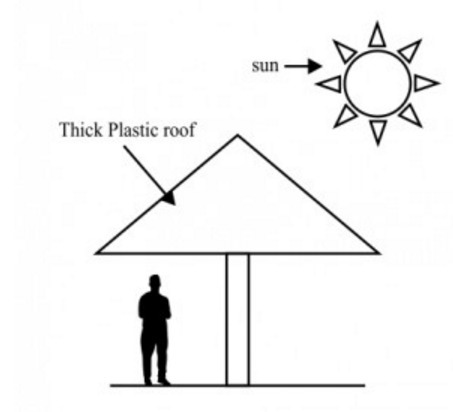
The diagram shows a man standing under a shelter on a sunny day. Given that the man feels hot, which of the following shows the

processes of how thermal energy from the sun reaches the man?
A.Radiation to Conduction to Radiation
B.Radiation to Conduction to Convection
C.Radiation to Convection to Radiation
D.Radiation to Convection to Convection

Chemistry
1 answer:
svetlana [45]2 years ago
5 0
The answer is A.Radiation to Conduction to Radiation
You might be interested in
In a laboratory setting, concentrations for solutions are measured in molarity, which is the number of moles per liter (mol/L).
slamgirl [31]

Answer:

im pretty sure its A or C im leaning more toward A tho

Explanation:

6 0
1 year ago
Read 2 more answers
How does 0.5 m sucrose (molecular mass 342) solution compare to 0.5 m glucose (molecular mass 180) solution?
mash [69]

Answer : Both solutions contain 3.011 X 10^{23} molecules.

Explanation : The number of molecules of 0.5 M of sucrose is equal to the number of molecules in 0.5 M of glucose. Both solutions contain 3.011 x 10^{23} molecules.

Avogadro's Number is  N_{A} =  6.022 X 10^{23} which represents particles per mole and particles may be typically molecules, atoms, ions, electrons, etc.

Here, only molarity values are given; where molarity is a measurement of concentration in terms of moles of the solute per liter of solvent.

Since each substance has the same concentration, 0.5 M, each will have the same number of molecules present per liter of solution.

Addition of molar mass for individual substance is not needed. As if both are considered in 1 Liter they would have same moles which is 0.5.

We can calculate the number of molecules for each;

Number of molecules  = N_{A} X M;

∴  Number of molecules =  6.022 X 10^{23} X 0.5 mol/L X 1 L which will be  = 3.011 X 10^{23}

Thus, these solutions compare to each other in that they have not only the same concentration, but they will have the same number of solvated sugar molecules. But the mass of glucose dissolved will be less than the mass of sucrose.

7 0
2 years ago
Read 2 more answers
After heating the solution, you decant the liquid and wash the remaining solid with distilled water. What you are removing by th
solniwko [45]

Answer:

The solvent

Explanation:

After the solid is recoverd by decanting the liquid, some solvent particles may still adhere to the solid.

In order to remove the solvent that may have adhered to the solid completely , the solid is washed before it is now dried.

7 0
2 years ago
In a certain experiment, 28.0 mL of 0.250 M HNO3and 53.0 mL of 0.320 M KOH are mixed. Calculate the number of moles of water for
Xelga [282]

Answer:

The number of moles of water formed in the resulting reaction is 6.03

[H+]: 37,2 M

[OH-]: 37,2 M

Explanation:

HNO3  +  KOH ----> KNO3 + H2O

First, we must discover the limiting reagent and we need to find out the moles, we use for this.

Moles that are used = Molarity / volume

HNO3 : 0,250 mol/L / 0,028L = 8,93 moles

KOH : 0,320 mol/L / 0,053L = 6,03 moles

The ratio of the reagents by stoichiometry is 1 to 1, so the limiting reagent is KOH, if I need 1 mole of nitric per mole of KOH, for every 8.93 moles I will need the same. However I have only 6.03 moles of KOH

The ratio of the reagents/products by stoichiometry is 1 to 1 so if I need 1 mol of KOH to make 1 mol of Water, 6,03 moles of KOH are used to make 6,03 moles of H2O.

The equilibrium of water is this:

2H2O ⇄ H3O+  +  OH-

2 moles of water are broken down into 1 mole of hydronium (H3O +) and 1 mole of hydroxyl (OH-)

6,03 moles of water are broken down into the half of those moles, so we have 3,015 moles of H3O+ and 3,015 moles of OH- but these moles are in 81,0 mL (the volume of the two solutions, 28 mL + 53 mL)

We must find out the moles in 1000 mL (1 L) so let's apply the rule of three.

81 mL ____ 3,015 moles

1000 mL ___ ( 1000 . 3,015) /81 = 37,2 M
7 0
2 years ago
A chemist describes a particular experiment in this way: "0.0400 mol of H2O2 decomposed into 0.0400 mol of H2O and 0.0200 mol of
frez [133]
It’s a nutreal stage
4 0
2 years ago
Other questions:
  • Which of the following would most likely contain a fossil?
    11·2 answers
  • For no2−, write an equation that shows how the anion acts as a base. express your answer as a chemical equation. identify all of
    12·2 answers
  • Microwave ovens are able to cook food because they increase the_______ of water molecules in the food.
    11·1 answer
  • Consider the following reaction: A(g)⇌2B(g). Find the equilibrium partial pressures of A and B for each of the following differe
    11·1 answer
  • NH4NO3, whose heat of solution is 25.7 kJ/mol, is one substance that can be used in cold pack. If the goal is to decrease the te
    15·1 answer
  • Click the "draw structure" button to launch the drawing utility. under certain reaction conditions, 2,3−dibromobutane reacts wit
    6·1 answer
  • Help please?
    9·2 answers
  • PLEASE HELP!!! The image represents the reaction between a certain number of molecules of N2 and H2.
    14·2 answers
  • Lastly, Snape thinks we should try one more calculation. What is the retention factor if the distance traveled by the solvent fr
    8·1 answer
  • A student in a chemistry laboratory has access to two acid solutions. The first one is 20% acid and the second solution is 45% a
    12·1 answer
Add answer
Login
Not registered? Fast signup
Signup
Login Signup
Ask question!
