answer.
Ask question
Login Signup
Ask question
All categories
  • English
  • Mathematics
  • Social Studies
  • Business
  • History
  • Health
  • Geography
  • Biology
  • Physics
  • Chemistry
  • Computers and Technology
  • Arts
  • World Languages
  • Spanish
  • French
  • German
  • Advanced Placement (AP)
  • SAT
  • Medicine
  • Law
  • Engineering
Helen [10]
2 years ago
3

Suppose you mix Na2SO4 and KCl solutions according to the given equation.

Chemistry
1 answer:
Alona [7]2 years ago
8 0

Answer:

No reaction should occur

Explanation:

Water cannnot be made from the components

Nothing will be released as a gas

Both products are soluible in water therefore will not form a precipitate.

You might be interested in
The equilibrium constant for the reaction sr(s) + mg2+(aq) ⇌ sr2+(aq) + mg(s) is 2.69 × 10¹² at 25°c. calculate e o for a cell m
Mariulka [41]
Sr(s)+Mg²+(aq)→Sr²+(aq)+Mg(s)
Number of e-'s transfered are, n=2. Equilibrium constant,
K=2.69×10∧12
ΔG=-2.303RT logK
R=gasconstant=8.314J/mol-k
T= temperature in K= 25 oC=25+273=298K
The value we get ΔG = -70922.3J. But ΔG = -nFE
n= number of e-'s transfered in the reaction =2
F= farady = 96500C
E=potential of the cell is what?
∴E = ΔG.nF
=-(-70922.3)/2×96500)
=0.367v.
8 0
2 years ago
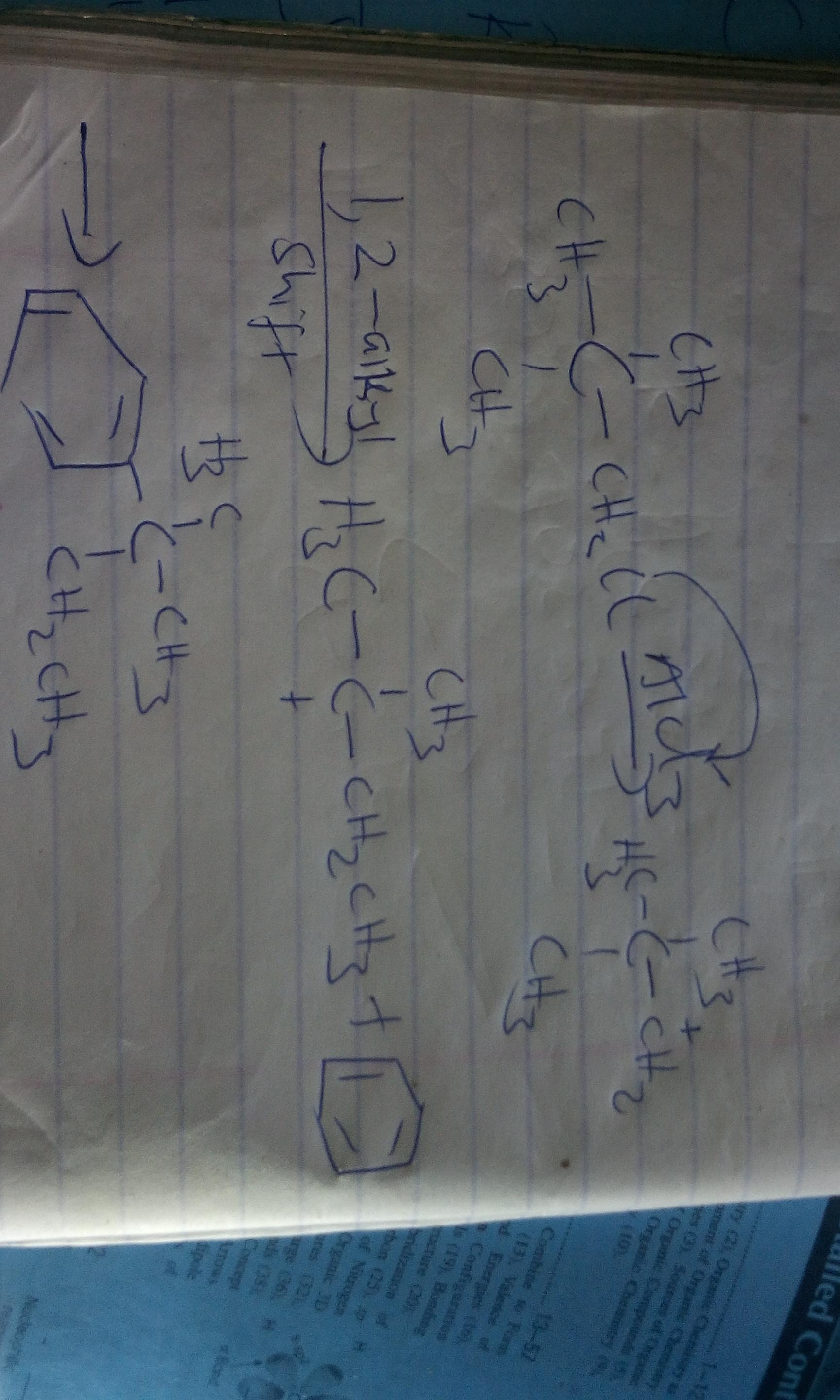
The reaction of benzene with (CH3)3CCH2Cl in the presence of anhydrous aluminum chloride produces principally which of these?
Sedaia [141]

Answer:

See explanation and image attached

Explanation:

When the carbocation is formed by the action of AlCl3 on the (CH3)3CCH2Cl, a primary carbocation is formed. The formation of the carbonation is followed by a 1,2-alkyl shift to give a tertiary carbocation which subsequently adds to the benzene ring as shown in the image attached to this answer.

6 0
2 years ago
Iron (Fe) undergoes an allotropic transformation at 912°C: upon heating from a BCC (α phase) to an FCC (γ phase). Accompanying t
Alex

Answer:

false thought ia ion of neon = clarity active

Explanation:

x = 81254 \: and \: y = 91284

8 0
2 years ago
Read 2 more answers
One mole of an ideal gas in a closed system, initially at 25°C and 10 bar, is first expanded adiabatically, then heated isochori
Igoryamba

Answer:

P_2=0.398bar=39800Pa

T_2=118.7K\\

Q=-3729.9J

W=-61753.24J

ΔU_T=0J

ΔH_T=0J

Explanation:

Hello,

At the first state, the molar volume is:

v_1=\frac{RT}{P_1} =\frac{8.314\frac{Pa*m^3}{molK}*298.15}{1x10^6Pa}=2.48x10^{-3}m^3

The volume in both the second and third state:

v_2=v_3=\frac{RT}{P_1} =\frac{8.314\frac{Pa*m^3}{molK}*298.15}{1x10^5Pa}=2.48x10^{-2}m^3

Now, as it is about an adiabatic process, one remembers the following relationships:

PV^\alpha =K\\TV^{\alpha-1}\\\alpha=\frac{Cp}{Cv}=\frac{7/2R}{5/2R}=1.4

- Next, for the aforesaid volumes and the first pressure, one computes the second pressure as:

P_2=\frac{P_1V_1^\alpha }{V_2^\alpha} =\frac{10bar*(2.48x10^{-3}m^3)^{1.4}}{(2.48x10^{-2}m^3)^{1.4}} =0.398bar=39800Pa

- And the temperature:

T_2=\frac{T_1V_1^{\alpha-1}}{V_2^{\alpha-1}} =\frac{298.15K*(2.48x10^{-3}m^3)^{1.4-1}}{(2.48x10^{-2}m^3)^{1.4-1}} =118.7K\\

- Q:

It is clear that the heat for the first process is 0 as it is adiabatic, but for the second one, it is computed as:

Q_2=nCv(T_2-T_1)=1mol*\frac{5}{2}(8.314\frac{J}{mol*K})*(118.7K-298.15K)=-3729.9J

Then the total heat:

Q=Q_1+Q_2=0-3729.9J=-3729.9J

- The work for the first process is:

W_1=\frac{P_2V_2-P_1V_1}{1-\alpha }=\frac{39800Pa*2.48x10^{-3}m^3-1x10^6Pa*2.48x10^{-2}m^3}{0.4} \\W_1=-61753.24J

It is clear that the second process is isochoric, so the work here is zero, thus, the total work is:

W=W_1+W_2=-61753.24J+0J=-61753.24J

- For the two processes, ΔU becomes the same value since the system returns to the initial temperature, so ΔU total is 0, thus, for each process, one's got:

U_1=nCv(T_2-T_1)=1mol*\frac{5}{2}(8.314\frac{J}{mol*K})*(118.7K-298.15K)=-3729.9J\\U_2=nCv(T_3-T_2)=1mol*\frac{5}{2}(8.314\frac{J}{mol*K})*(298.15K-118.7K)=3729.9J\\

- Finally, the total enthapy is also 0 due to same aforesaid reason, thus, each enthalpy is:

H_1=nCp(T_2-T_1)=1mol*\frac{7}{2}(8.314\frac{J}{mol*K})*(118.7K-298.15K)=-5221.86J\\H_2=nCv(T_3-T_2)=1mol*\frac{7}{2}(8.314\frac{J}{mol*K})*(298.15K-118.7K)=5221.86J\\

Best regards.

8 0
2 years ago
Convert 1.21 kg to grams
MissTica

Answer:

1210 grams

Explanation:

Message me for extra info.

snap- parkguy786

7 0
2 years ago
Read 2 more answers
Other questions:
  • How many moles of O2 should be supplied to burn 1 mol of C3H8 (propane) molecules in a camping stove
    11·1 answer
  • Which equilibrium expression represents the ionization of water?
    12·2 answers
  • Illustrate a model of a calcium atom including the number and position of protons neutrons and electrons in the atom
    14·1 answer
  • Type the correct answer in the box. Express the answer to three significant figures.
    8·1 answer
  • If you have a graduated cylinder, containing 15.5 mL and this volume changes to 95.2 mL after a metal with a mass of 7.95g is dr
    13·1 answer
  • Washing soda is a hydrate of sodium carbonate. Elemental analysis of a sample of washing soda gave 4.20% C and 7.05% H. What is
    8·1 answer
  • C5H12, pentane, is a liquid at room temperature.
    15·1 answer
  • An ion has 24 protons and 19 electrons. Write the symbol for this ion.
    9·1 answer
  • How are NGC 1427A and U different? How are they the same?
    11·2 answers
  • During a process called photoact, ________ give up an electron as a part of the light-dependent reactions.
    6·1 answer
Add answer
Login
Not registered? Fast signup
Signup
Login Signup
Ask question!