answer.
Ask question
Login Signup
Ask question
All categories
  • English
  • Mathematics
  • Social Studies
  • Business
  • History
  • Health
  • Geography
  • Biology
  • Physics
  • Chemistry
  • Computers and Technology
  • Arts
  • World Languages
  • Spanish
  • French
  • German
  • Advanced Placement (AP)
  • SAT
  • Medicine
  • Law
  • Engineering
Artist 52 [7]
2 years ago
13

A series of waves with decreasing wavelength labeled radio waves, microwaves, infrared, visible light, ultraviolet, X-rays, gamm

a rays from left to right as wavelength decreases. At visible light is at a place with colored bands crossing the waves with dotted lines down to a colored spectrum from red to blue labeled in nanometers from 700 to 400. Above the waves are a label Frequency with an arrow pointing left labeled decreased and an arrow pointing right labeled increasing. Topmost is a label Wavelength (meters) with an arrow pointing left labeled longer and an arrow pointing right labeled shorter. Use the image to rank the colors from the color that will refract the least to the color that will refract the most. Least Most
Physics
2 answers:
kotegsom [21]2 years ago
6 0

Answer:

label A= radio waves, label C= infrared, Label D= visible Light, Label G= gamma rays.

Explanation:

hope it helped??

can i have a thanks, a 5 star, and a brainliest please

can we be friends  

Guest
1 year ago
thanks and if you want to be friends
Sergeeva-Olga [200]2 years ago
6 0

Answer:

Label A: red

Label B: yellow

Label C: green

Label D: blue

Label E: violet/purple

I think this should be correct. I'm sorry if I'm incorrect

Guest
1 year ago
it is correct thank you
You might be interested in
A cart, which has a mass of 2.30 kg is sitting at the top of an inclined plane, which is 4.50 meters long and meets the horizont
expeople1 [14]

Answer:

a) The gravitational potential energy before the cart rolls down the incline is 24.6 J.

b) The magnitude of the force that causes the cart to roll down is 5.47 N.

c) The acceleration of the cart is 2.38 m/s²

d) It takes the cart 1.94 s to reach the bottom of the incline.

e) The velocity of the cart at the bottom of the inclined plane is 4.62 m/s.

f) The kinetic energy of the cart as it reaches the bottom of the incline is 24.6 J.

g) The work done by the gravitational force is 24.6 J.

Explanation:

Hi there!

a) The gravitational potential energy is calculated using the following equation:

EP = m · g · h

Where:

EP = gravitational potential energy.

m = mass of the object.

g = acceleration due to gravity.

h = height at which the object is located.

The height of the inclined plane can be calculated using trigonomoetry:

sin 14.0° = height / lenght

sin 14.0° = height / 4.50 m

4.50 m · sin 14.0° = height

height = 1.09 m

Then, the gravitational potential energy will be:

EP = m · g · h

EP = 2.30 kg · 9.81 m/s² · 1.09 m = 24.6 J

The gravitational potential energy before the cart rolls down the incline is 24.6 J.

b) Please, see the attached figure for a graphical description of the problem and the forces acting on the cart. The force that causes the cart to accelerate down the incline is the horizontal component of the weight (Fwx in the figure). The magnitude of this force can be obtained using trigonometry:

sin 14° = Fwx / Fw

The weight of the cart (Fw) is calculated as follows:

Fw = m · g

Fw = 2.30 kg · 9.81 m/s²

Fw = 22.6 N

Then, the x-component of the weight will be:

FW · sin 14° = Fwx

22.6 N · sin 14° = Fwx

Fwx = 5.47 N

The magnitude of the force that causes the cart to roll down is 5.47 N.

c)Using the equation of Fwx we can calculate the acceleration of the cart:

Fwx = m · a

Where "m" is the mass of the cart and "a" is the acceleration.

Fwx / m = a

5.47 N / 2.30 kg = a

a = 2.38 m/s²

The acceleration of the cart is 2.38 m/s²

d) To calculate the time it takes the cart to reach the bottom of the incline, let´s use the equation of position of the cart:

x = x0 + v0 · t + 1/2 · a · t²

Where:

x = position of the cart at time t.

x0 = initial position.

v0 = initial velocity.

a = acceleration.

t = time.

Considering the initial position as the point at which the cart starts rolling (x0 = 0) and knowing that the cart starts from rest (v0 = 0), let´s find the time it takes the cart to travel the 4.50 m of the inclined plane:

x = 1/2 · a · t²

4.50 m = 1/2 · 2.38 m/s² · t²

2 · 4.50 m / 2.38 m/s² = t²

t = 1.94 s

It takes the cart 1.94 s to reach the bottom of the incline.

e) The velocity of the cart at the bottom of the inclined plane can be obtained using the following equation:

v = v0 + a · t

v = 0 m/s + 2.38 m/s² · 1.94 s

v = 4.62 m/s

The velocity of the cart at the bottom of the inclined plane is 4.62 m/s.

f) The kinetic energy can be calculated using the following equation:

KE = 1/2 · m · v²

Where:

KE =  kinetic energy.

m = mass of the cart.

v = velocity of the cart.

KE = 1/2 · 2.30 kg · (4.62 m/s)²

KE = 24.6 J

The kinetic energy of the cart as it reaches the bottom of the incline is 24.6 J.

The gain of kinetic energy is equal to the loss of gravitational potential energy.

g) The work done by the gravitational force can be calculated using the work-energy theorem: the work done by the gravitational force is equal to the negative change in the gravitational potential energy:

W = -ΔPE

W = -(final potential energy - initial potential energy)

W = -(0 - 24.6 J)

W = 24.6 J

This can also be calculated using the definition of work:

W = Fw · d

Where "d" is the distance traveled in the direction of the force, that is the height of the inclined plane:

W = 22.6 N · 1.09 m = 24.6 J.

The work done by the gravitational force is 24.6 J.

4 0
2 years ago
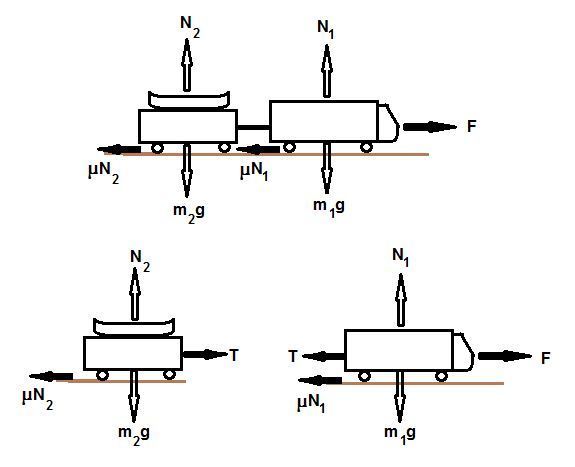
A 1100kg car pulls a boat on a trailer. (a) what total force resists the motion of the car, boat,and trailer, if the car exerts
likoan [24]
Refer to the figure shown below.

m₁ = 1100 kg, the mass of the car
m₂ = 700 kg, the mass of the trailer and boat
F = 1900 N, the driving force acting on the car
N₁ = m₁g,  the normal reaction on the car
N₂ = m₂g, the normal force on the trailer and boat
μN₁ and μN₂ are frictional forces, where  =  kinetic coefficient of friction
T = the force in the hitch between the car and trailer.

Part (a)
Let R₁ = the total force that resists the motion of the car, boat, and trailer.
Because the acceleration is 0.550m/s², therefore
(m₁ + m₂ kg)*(0.55 m/s²) = F
(1100+700 kg)*(0.55 m/s²) = (1900 - R₁) N
990 = 1900 - R
R₁ = 910 N

Answer: The resistive force is 910 N

Part (b)
80% of the resistive forces are experienced by the boat and trailer.
Let the resistive force be R₂.
Then
R₂ = 0.8*R₁ = 728 N
If the tension in the hitch between the car and the trailer is T, then
T - R₂ = m₂(0.55 m/s²)
(T - 728 N) = (700 kg)*(0.55 m/s²)
T - 728 = 385
T = 1113 N

Answer: The force in the hitch is 1113 N

3 0
2 years ago
A filamentary conductor is formed into an equilateral triangle with sides of length carrying current i . find the magnetic field
arsen [322]

magnetic field due to a finite straight conductor is given by

B = \frac{\mu_0 i}{4\pi r}(sin\theta_1 + sin\theta_2)

here since it forms an equilateral triangle so we will have

\theta_1 = \theta_2 = 60 degre

also the perpendicular distance of the point from the wire is

r = \frac{a}{2\sqrt3}

now from the above equation magnetic field due to one wire is given by

B = \frac{\mu_0 i}{4\pi \frac{a}{2\sqrt3}(sin60 + sin60)

B = \frac{\mu_0 i*2\sqrt3}{4\pi a}(\sqrt3)

B = \frac{3\mu_0 i}{2\pi a}

now since in equilateral triangle there are three such wires so net magnetic field will be

B = \frac{9\mu_0 i}{2\pi a}

5 0
2 years ago
Calculate the force between charges of 5.0 x 10^-8 c and 1.0 x 10^-7 if they are 5.0 feet apart
weqwewe [10]

Answer:

F = 19.375 x 10^-6  N

Explanation:

This problem can be solved by applying Coulomb's Law, which lets us determine the force between two electrically charged particles.

It is defined as

F = (ke * q1 * q2)/ r^2

Where,

ke =  is Coulomb's constant ≈ 9×10^9 N⋅m^2⋅C^−2

q1 = 5.0 x 10^-8 C

q2 = 1.0 x 10^-7 C

r = 5 ft = 1,524 m

F  = (9×10^9 N⋅m^2⋅C^−2)*(5.0 x 10^-8 C)*(1.0 x 10^-7 C)/ ((1,524 m)^2)

F  = (9×10^9 N⋅m^2⋅C^−2)*(5.0 x 10^-8 C)*(1.0 x 10^-7 C)/ ((1,524 m)^2)

F = 19.375 x 10^-6  N

6 0
2 years ago
the mass of piece of granite is 15.6g when it is suspended can a mass of 5.5g of water is displaced find the dencity of granite
Blababa [14]

Answer:

2836.36 kg/m³

Explanation:

Applying,

Densty of granite(D')/Density of water(D) = weight of granite(W')/weight of water displaced(W)

D'/D = W'/W................... Equation 1

Make D' the subject of the equation

D' = W'D/W............... Equation 2.

From the question,

Given: W' = mg = 9.8(15.6/1000) = 0.15288 N, W = 9.8(5.5/1000) = 0.0539 N, Constant: D = 1000 kg/m³

Substitute these values into equation 2

D' = 1000(0.15288)/0.0539

D' = 2836.36 kg/m³

3 0
1 year ago
Other questions:
  • A cart moves along a track at a velocity of 3.5 cm/s. when a force is applied to the cart, its velocity increases to 8.2 cm/s. i
    15·2 answers
  • The best way to cool soft and thick foods (such as beans, sauce or chili) when using the refrigerator is?
    11·2 answers
  • Carbon dioxide (CO2) gas within a piston–cylinder assembly undergoes a process from a state where p1 = 5 lbf/in.2 , V1 = 2.5 ft3
    9·1 answer
  • An object moves in a circle of radius R at constant speed with a period T. If you want to change only the period in order to cut
    8·1 answer
  • A black, totally absorbing piece of cardboard of area A = 1.7 cm2 intercepts light with an intensity of 8.1 W/m2 from a camera s
    11·2 answers
  • In the sport of curling, large smooth stones are slid across an ice court to land on a target. Sometimes the stones need to move
    12·1 answer
  • Kevin is a black high school senior. While walking home from a sporting event at school, he sees a police car and decides to tak
    14·1 answer
  • An iguana runs back and forth along the ground. The horizontal position of the iguana in meters over time is shown
    7·1 answer
  • A 70kg man runs at a pace of 4 m/s and a 50g meteor travels at 2 km/s. Which has the most kinetic energy?.
    5·1 answer
  • A physics teacher pushes an environmental science teacher out of a stationary helicopter without a parachute from a height of 48
    8·1 answer
Add answer
Login
Not registered? Fast signup
Signup
Login Signup
Ask question!