answer.
Ask question
Login Signup
Ask question
All categories
  • English
  • Mathematics
  • Social Studies
  • Business
  • History
  • Health
  • Geography
  • Biology
  • Physics
  • Chemistry
  • Computers and Technology
  • Arts
  • World Languages
  • Spanish
  • French
  • German
  • Advanced Placement (AP)
  • SAT
  • Medicine
  • Law
  • Engineering
devlian [24]
2 years ago
4

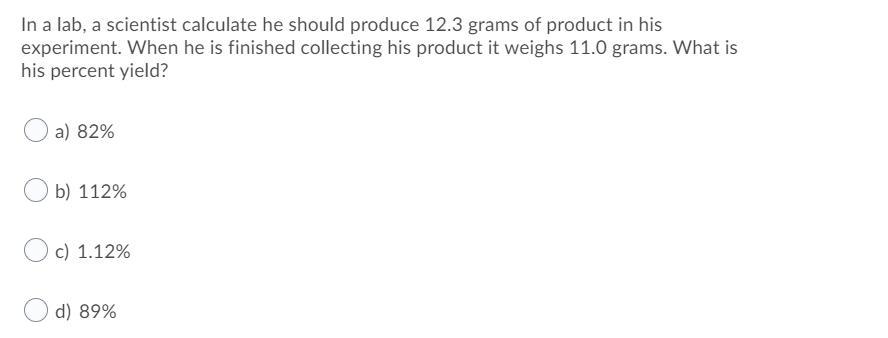
In a lab, a scientist calculate he should produce 12.3 grams of product in his experiment. When he is finished collecting his pr

oduct it weighs 11.0 grams. What is his percent yield?

Chemistry
1 answer:
Anestetic [448]2 years ago
8 0

Answer:

Option D.

Explanation:

Percentage yield = Actual yield / Theoretical yield * 100%

Actual yield = 11.0 grams

Theoretical yield = 12.3 grams

Percentage yield = 11.0 / 12.3  *  100

Percentage yield = 89.43%

You might be interested in
One container of turns costs 4 dollars. Each container has eighty 1g tablets. Assume each turns is 40% caco₃. Using only turns,
stealth61 [152]

<u>Answer:</u> The cost is coming out to be $ 1.25

<u>Explanation:</u>

To calculate the number of moles for given molarity, we use the equation:

\text{Molarity of the solution}=\frac{\text{Moles of solute}}{\text{Volume of solution (in L)}}

Molarity of HCl solution = 0.4 M

Volume of solution = 0.5 L

Putting values in equation 1, we get:

0.4M=\frac{\text{Moles of HCl}}{0.5L}\\\\\text{Moles of HCl}=(0.4mol/L\times 0.5L}=0.2mol

The chemical equation for the reaction of HCl and calcium carbonate follows:

CaCO_3+2HCl\rightarrow CaCl_2+H_2O+CO_2

By Stoichiometry of the reaction:

2 moles of HCl reacts with 1 mole of calcium carbonate

So, 0.2 moles of HCl will react with = \frac{1}{2}\times 0.2=0.1mol of calcium carbonate

To calculate the mass of calcium carbonate for given moles, we use the equation:

\text{Number of moles}=\frac{\text{Given mass}}{\text{Molar mass}}

Molar mass of calcium carbonate = 100 g/mol

Moles of calcium carbonate = 0.1 moles

Putting values in equation 1, we get:

0.1mol=\frac{\text{Mass of calcium carbonate}}{100g/mol}\\\\\text{Mass of calcium carbonate}=(0.1mol\times 100g/mol)=10g

  • Calculating the mass of calcium carbonate in 1 container:

We are given:

One container contains eighty 1 g of tablets, this means that in total 80 g of tablets are there.

Every container has 40 % calcium carbonate.

Mass of calcium carbonate in 1 container = 40 % of 80 g = \frac{40}{100}\times 80=32g

  • Calculating the containers for amount of calcium carbonate that neutralized HCl by using unitary method:

32 grams of calcium carbonate is present in 1 container

So, 10 g of calcium carbonate will be present in = \frac{1}{32}\times 10=0.3125 container

  • Calculating the cost of turns:

1 container of turns costs $4

So, 0.3125 containers of turns will cost = \frac{\$ 4}{1}\times 0.3125=\$ 1.25

Hence, the cost is coming out to be $ 1.25
4 0
2 years ago
A tank of oxygen has a volume of 40.0L and is held at a pressure of 159atm at 25∘C. What volume of O2 gas (in liters) would ther
Advocard [28]

Answer:

V2 = 6616 L

Explanation:

From the question;

Initial volume = 40L

Initial Pressure, P1 = 159atm

Initial Temperature T1 = 25 + 273 = 298K (Upon converting to Kelvin unit)

Final Volume, V2 = ?

Final Pressure, P2 = 1 atm

Final Temperature T2 = 37 + 273= 310K (Upon converting to Kelvin unit)

These quantities are related by the equation;

P1V1 / T1  = P2V2 / T2

V2 = T2 * P1 * V1 / T1 * P2

V2 = 310 * 159 * 40  /   (298 * 1)

V2 = 6616 L

6 0
1 year ago
What evidence do you have that atoms of certain elements produce a flame of a specific color?
AVprozaik [17]
Light acts as a wave so when you burn a certain element it generates a specific wavelength which represents a specific color light. ^-^
7 0
2 years ago
Unit Conversion Help Thank you
AlekseyPX

Answer : 1721.72 g/qt are in 18.2 g/cL

Explanation :

As we are given: 18.2 g/cL

Now we have to convert 18.2 g/cL to g/qt.

Conversions used are:

(1) 1 L = 100 cL

(2) 1 L = 1000 mL

(3) 1 qt = 946 qt

The conversion expression will be:

\frac{18.2g}{1cL}\times \frac{100cL}{1L}\times \frac{1L}{1000mL}\times \frac{946mL}{1qt}

=1721.72\text{ g/qt}

Therefore, 1721.72 g/qt are in 18.2 g/cL

5 0
2 years ago
Silver (ag) has a molar mass of 107.8682 g, nitrogen has a molar mass of 14.0067 g, and oxygen has a molar mass of 15.9994 g. wh
ASHA 777 [7]
AgNO3=
(ag + n + o3) =  \\  (107.8682) + (14.0067) + (15.9994 \times 3) \\  = 169.8731g \: per \: mole
3 0
2 years ago
Read 2 more answers
Other questions:
  • A gem has a mass of 4.50 g. When the gem is placed in a graduated cylinder 12.00 mL of water, the water level rises to 13.45 mL.
    12·1 answer
  • Calculate the mass (in grams) of cobalt that has the same number of atoms as 521 mg of silicon.
    10·1 answer
  • Which three temperature readings all mean the same thing? Question options: 273 Kelvin, 0 degrees Celsius, 32 degrees Fahrenheit
    8·2 answers
  • What is 3.5x10^2 x 8.0x10^-2 in scientific notation
    12·1 answer
  • How many grams of C5H12 must be burned to heat 1.39 kg of water from 21.2 °C to 97.0 °C? Assume that all the heat released durin
    8·1 answer
  • A 23.74-mL volume of 0.0981 M NaOH was used to titrate 25.0 mL of a weak monoprotic acid solution to the stoi- chiometric point.
    5·2 answers
  • The volume of an air bubble at the bottom of a lake is 1.35 mL. If the pressure at the bottom of the lake is 125 kPa and the air
    13·1 answer
  • In an experiment, 170.9 g of C2H4 was reacted with an excess of O2, 164.1 g of CO2 is produced.
    12·1 answer
  • Suppose a 20.0 g gold bar at 35.0°C absorbs 70.0 calories of heat energy. Given that the specific heat of gold is 0.0310 cal/g °
    9·1 answer
  • Complete this sentence: Atoms emit visible and ultraviolet light A. as electrons jump from lower energy levels to higher levels.
    13·1 answer
Add answer
Login
Not registered? Fast signup
Signup
Login Signup
Ask question!
