answer.
Ask question
Login Signup
Ask question
All categories
  • English
  • Mathematics
  • Social Studies
  • Business
  • History
  • Health
  • Geography
  • Biology
  • Physics
  • Chemistry
  • Computers and Technology
  • Arts
  • World Languages
  • Spanish
  • French
  • German
  • Advanced Placement (AP)
  • SAT
  • Medicine
  • Law
  • Engineering
elena55 [62]
2 years ago
3

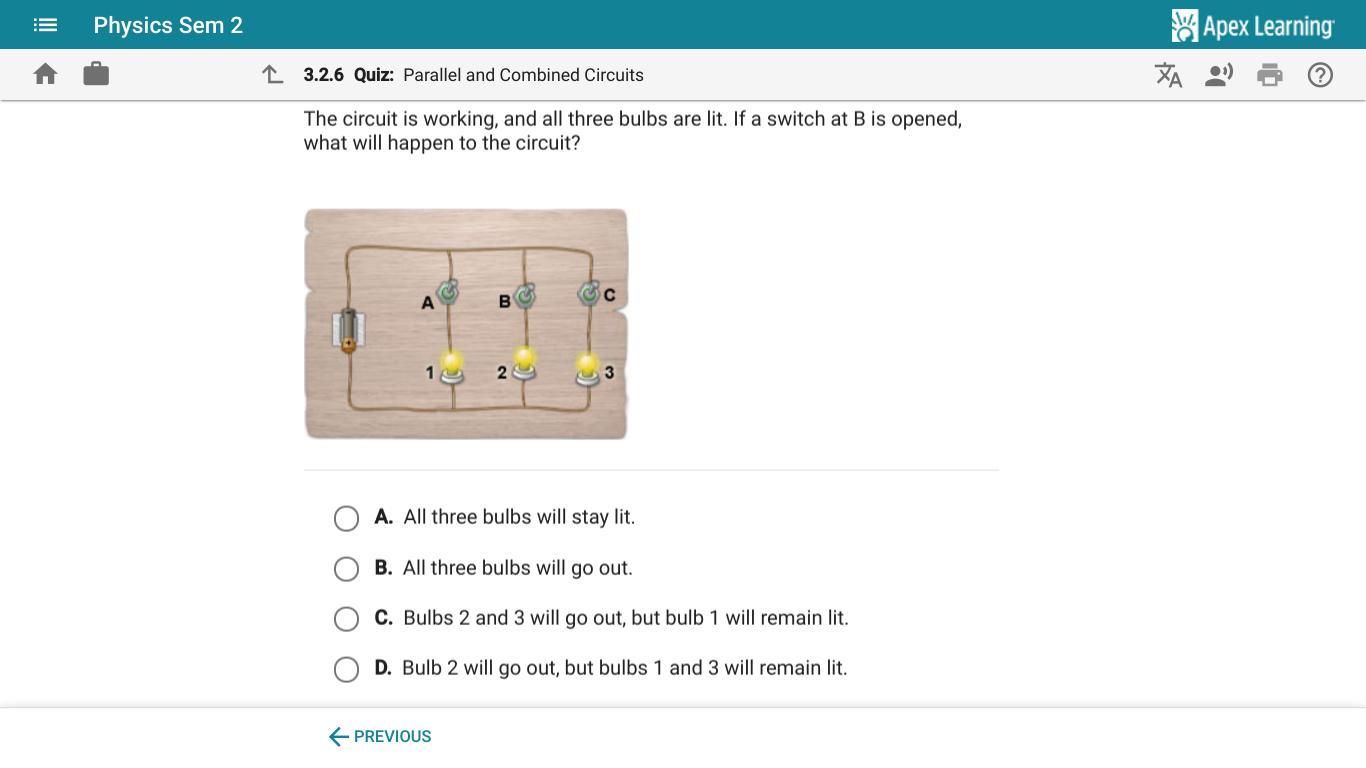
The circuit is working, and all three bulbs are lit. If a switch at B is opened, what will happen to the circuit? Photo included

PLS ONLY ANSWER IF YOU KNOW 100%

Physics
2 answers:
dalvyx [7]2 years ago
5 0

Answer:

D. Bulb 2 will go out but bulbs 1 and 3 will remain lit.

Explanation:

If switch at B is opened then, Bulb 2 will go out but bulbs 1 and 3 will remain lit. This is because the positive and negative current flow still fully passes through the two closed switches at switch A and C which allows the bulbs to receive both currents and thus allowing it to turn on. When Switch B is opened it cuts off access for the negative charge to get to bulb 2 and without it, bulb 2 will not turn on.

weqwewe [10]2 years ago
3 0

Answer:all 3 bulbs will go out

Explanation:

Just did it and got it right

You might be interested in
Zoe has 25 grams of water (c = 4.186 ) at 10°C, which she mixes with 12 grams of water at 30°C. Assume that no heat is lost to t
fenix001 [56]
Since heat here is conserved that means that the heat out is equal to the heat in. We use the expression Q = mC(T2-T1). We caclulate as follows:

Q absorbed = Q released
m1 C (T-T1) = -m2 C (T-T1)

C can be cancelled since they are the same substance.

m1 (T-T1) = -m2 (T-T1)
25 (T-10) = -12 (T-30)
T = 16.49 degrees Celsius

3 0
2 years ago
Read 2 more answers
In certain cases, using both the momentum principle and energy principle to analyze a system is useful, as they each can reveal
SpyIntel [72]

Answer:

A) F_g = 26284.48 N

B) v = 7404.18 m/s

C) E = 19.19 × 10^(10) J

Explanation:

We are given;

Mass of satellite; m = 3500 kg

Mass of the earth; M = 6 x 10²⁴ Kg

Earth circular orbit radius; R = 7.3 x 10⁶ m

A) Formula for the gravitational force is;

F_g = GmM/r²

Where G is gravitational constant = 6.67 × 10^(-11) N.m²/kg²

Plugging in the relevant values, we have;

F_g = (6.67 × 10^(-11) × 3500 × 6 x 10²⁴)/(7.3 x 10⁶)²

F_g = 26284.48 N

B) From the momentum principle, we have that the gravitational force is equal to the centripetal force.

Thus;

GmM/r² = mv²/r

Making v th subject, we have;

v = √(GM/r)

Plugging in the relevant values;

v = √(6.67 × 10^(-11) × 6 x 10²⁴)/(7.3 x 10⁶))

v = 7404.18 m/s

C) From the energy principle, the minimum amount of work is given by;

E = (GmM/r) - ½mv²

Plugging in the relevant values;

E = [(6.67 × 10^(-11) × 3500 × 6 × 10²⁴)/(7.3 x 10⁶)] - (½ × 3500 × 7404.18)

E = 19.19 × 10^(10) J
5 0
2 years ago
three neutral metal cans mounted on isulating stands are touching a negatively charge ballon is brought near can a can b is then
Nimfa-mama [501]
Charge on can A is positive. 
Charge on can C is negative.  
Punctuation and capitalization are very useful things to pay attention to and this question would be a lot easier to understand if you had actually used both capitalization and punctuation. If I'm understanding the question, you have 3 metal can that are insulated from the environment and initially touching each other in a straight line. Then a negatively charged balloon is brought near, but not touching one of the cans in that line of cans. While the balloon is near, the middle can is removed. Then you want to know the charge on the can that was nearest the balloon and the charge on the can that was furthermost from the balloon. 
 As the balloon is brought near to can a, the negative charge on the balloon repels some of the electrons from can a (like charges repel). Some of those electrons will flow to can b and in turn flow to can c. Basically you'll have a charge gradient that's most positive on that part of the can that's closest to the balloon, and most negative on the part of the cans that's furthest from the balloon. You then remove can B which causes cans A and C to be electrically isolated from each other and prevents the flow of elections to equalize the charges on cans A and C when the balloon is removed. So you're left with a deficiency of electrons on can A, so can A will have a positive overall charge, and an excess of electrons on can C, so can C will have a negative overall charge.
7 0
2 years ago
A floating leaf oscillates up and down two complete cycles in one second as a water wave passes by. The wave's wavelength is 10
postnew [5]

Answer:

C) 20 m/s

Explanation:

Wave: A wave is a disturbance that travels through a medium and transfers energy from one point to another, without causing any permanent displacement of the medium itself. Examples of wave are, water wave, sound wave, light rays, radio waves. etc.

The velocity of a moving wave is

v = λf ............................ Equation 1

Where v = speed of the wave, λ = wave length, f = frequency of the wave.

Given: f = 2 Hz (two complete cycles in one seconds), λ = 10 meters

Substituting these values into equation 1

v = 2×10

v = 20 m/s.

Thus the speed of the wave = 20 m/s

The right option is C) 20 m/s

7 0
2 years ago
a cannonball with a mass of 1.0 kilogram is fired horizontally from a 500.- kilogram cannon, initially at rest, on a horizontal,
nirvana33 [79]

(a) According to Newton’s third law, for every action there is an equal yet opposite reaction. In this case, the cannonball is affected by 8.0x10^3 newtons in one direction. Now the cannon must also be affected by the same amount of net force on the opposite direction.

- 8.0x10^3 Newtons (the negative symbol only shows that it is opposite direction)


(b) We solve this using the formula:

F = m a

8.0x10^3 N = (1.0 kg) a

a = 8,000 m/s^2

8 0
2 years ago
Other questions:
  • Object A with a mass of 500 kilograms hits stationary object B with a mass of 920 kilograms. If the collision is elastic, what h
    14·1 answer
  • Which best describes what occurs when a body accelerates?
    6·1 answer
  • Charge is distributed uniformly on the surface of a large flat plate. the electric field 2 cm from the plate is 30 n/c. the elec
    9·1 answer
  • How does the sun's energy help maintain Earth's energy budget? A part of it is trapped by carbon dioxide and methane. A part of
    7·2 answers
  • New York and Los Angeles are about 3000 mi apart, the time difference between these two cities is 3 h. Calculate the circumferen
    15·1 answer
  • What affects the way a projectile performs when it is shot from a firearm?
    10·2 answers
  • an ice skater, standing at rest, uses her hands to push off against a wall. she exerts an average force on the wall of 120 N and
    14·1 answer
  • Calculate the orbital period of a dwarf planet found to have a semimajor axis of a = 4.0x 10^12 meters in seconds and years.
    6·1 answer
  • Use the ratio version of Kepler’s third law and the orbital information of Mars to determine Earth’s distance from the Sun. Mars
    5·2 answers
  • Two masses, each having a value of M, are vibrating vertically on a spring with a Hooke's law constant, k. At the lowest point o
    9·1 answer
Add answer
Login
Not registered? Fast signup
Signup
Login Signup
Ask question!
