answer.
Ask question
Login Signup
Ask question
All categories
  • English
  • Mathematics
  • Social Studies
  • Business
  • History
  • Health
  • Geography
  • Biology
  • Physics
  • Chemistry
  • Computers and Technology
  • Arts
  • World Languages
  • Spanish
  • French
  • German
  • Advanced Placement (AP)
  • SAT
  • Medicine
  • Law
  • Engineering
Mama L [17]
2 years ago
11

what is the limiting reactant of 20.0 moles of o2 react with 30.0 moles of h2 according to the following reaction ? 2H2 + O2 = 2

H2O
Chemistry
1 answer:
IRINA_888 [86]2 years ago
5 0

Answer:

The limiting reactant is hydrogen.

Explanation:

According to the balanced equation for synthesis of water, hydrogen is used up twice as fast as oxygen -- we need two moles of H2 for every one mole of O2 when creating water.

Since we have 20 moles of oxygen, this means we would need twice as much hydrogen, or 40 moles, to use it all up. There is only 30 moles of hydrogen, which means that all the hydrogen will be used before the 20 moles of oxygen is used. Hydrogen limits production in this case.

You might be interested in
The volume of a gas is 27.5 mL at 22.0°C and 0.974 atm. What will the volume be at 15.0°C and 0.993 atm? Use Ideal Gas Law (PV =
Scorpion4ik [409]

Answer:

26.3 mL

Explanation:

Step 1:

Obtaining an appropriate gas law from the ideal gas equation.

This is illustrated below:

From the ideal gas equation:

PV = nRT

Divide both side by T

PV/T = nR

At this stage, we'll assume the number of mole (n) to be constant.

Note: R is the gas constant.

PV/T = constant.

We can thus, write the above equation as:

P1V1/T1 = P2V2/T2

The above equation is called the general gas equation.

Step 2:

Data obtained from the question. This includes the following:

Initial volume (V1) = 27.5 mL

Initial temperature (T1) = 22.0°C = 22.0°C + 273 = 295K

Initial pressure (P1) = 0.974 atm.

Final temperature (T2) = 15.0°C = 15.0°C + 273 = 288K

Final pressure (P2) = 0.993 atm

Final volume (V2) =..?

Step 3:

Determination of the final volume of the gas using the general gas equation obtained. This is illustrated below:

P1V1 /T1 = P2V2/T2

0.974 x 27.5/295 = 0.993 x V2/288

Cross multiply to express in linear.

295x0.993xV2 = 0.974x27.5x288

Divide both side by 295 x 0.993

V2 = (0.974x27.5x288)/(295x0.993)

V2 = 26.3 mL

Therefore, the new volume of the gas is 26.3 mL

4 0
2 years ago
Consider the hypothetical atom x. if the molecular formula for lithium carbonate is li2co3 and the formula of x chloride is xcl3
eduard
First step is to determine the valency of each of x and CaCO3 from the given compounds:

1- As for Li2CO3: we can deduce that the valency of lithium is one while that of CO3 is two

2- As for XCl3: we can deduce that the valency of chlorine is one while that of X is three

Second step is to write the required compound: 
X : CO3  (elements involved)
3 : 2        (write the valency of each)
Then write the positive ion (X) followed by the valency of the negative ion (2) and then the negative ion (CO3) followed by the valency of the positive ion (3).
The final x carbonate is written as: X2(CO3)3
7 0
2 years ago
Zinc has a mass of 4.50g calculate the volume
Neko [114]
Divide the mass by the density

4 0
2 years ago
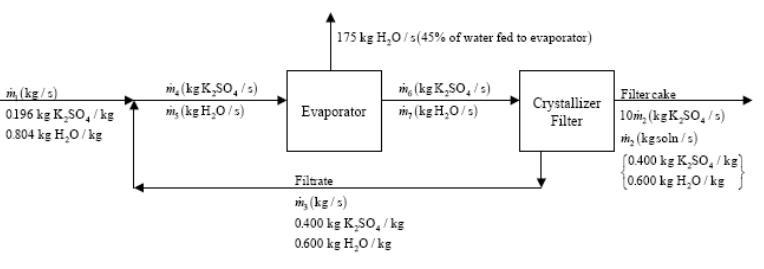
An evaporation–crystallization process of the type described in Example 4.5-2 is used to obtain solid potassium sulfate from an
timofeeve [1]

Answer:

feed = 220.77 kg/s; maximum production rate of solid crystal = 416 kg/s; the rate of supplying fresh feed to obtain the production rate = 1.6

Explanation:

Material or mass balance can be used to estimate the mass flow rates of all the streams in the diagram shown in the attached file.

Overall balance: M_{1} = 175 + 11M_{2}

Water: 0.804M_{1} = 175 + 0.6M_{2}

Using substitution method, we have:

M_{1} = 220.77 kg/s

M_{2}  = 4.16 kg/s

The maximum production rate of solid crystal is 10M_{2} = 10*4.16 = 416 kg/s

Around evaporator:

0.45M_{5} = 175

M_{5} = 175/0.45 = 389 kg/s

Around the mixing point:

M_{1} + M_{3} = M_{4} + M_{5}

Solid crystal: 0.196M_{1} + 0.4M_{3} = M_{4}

Using the last two equations, we can obtain:

0.804M_{1} + 0.6M_{3} = M_{5}

0.6M_{3} = 389 - 0.804*220.77 = 389 - 177.5 = 211.5

M_{3} = 211.5/0.6 = 352.5 kg/s

The rate of supplying fresh feed to obtain the production rate is:

\frac{M_{3}}{M_{1}} = 352.5/220.77 = 1.6

7 0
3 years ago
Mengapakah gelung pemanas di dalam cerek elektrik berada di dasar cerek?​
shepuryov [24]
English, please. Does this have something to do with an electrical barometer
5 0
2 years ago
Other questions:
  • why does every human measurement have uncertainty associated with it? Why must we manage the uncertainty during calculations?
    13·1 answer
  • Consider the equation: 2NO2(g) N2O4(g). Using ONLY the information given by the equation which of the following changes would in
    15·2 answers
  • A certain electrochemical cell has for its cell reaction: zn + hgo → zno + hg which is the half-reaction occurring at the anode?
    5·1 answer
  • 40pionts
    9·1 answer
  • Calculate the nuclear binding energy for 5525mn in megaelectronvolts per nucleon (mev/nucleon). express your answer numerically
    10·1 answer
  • Ethyl butyrate, CH3CH2CH2CO2CH2CH3, is an artificial fruit flavor commonly used in the food industry for such flavors as orange
    14·1 answer
  • What is the total number of sp2-hybridized carbon atoms present in the fluorophore used in the experiments
    5·1 answer
  • If Maria winks exactly 5 times every minute while she is awake and she sleeps exactly 8 hours a day, how many times does Maria w
    10·1 answer
  • A student places four identical cells into four different liquids. Over time which cell will look the smallest WXY or Z
    12·1 answer
  • Compound X has a molar mass of 104.01·gmol−1 and the following composition: element mass % nitrogen 26.93% fluorine 73.07% Write
    6·2 answers
Add answer
Login
Not registered? Fast signup
Signup
Login Signup
Ask question!