answer.
Ask question
Login Signup
Ask question
All categories
  • English
  • Mathematics
  • Social Studies
  • Business
  • History
  • Health
  • Geography
  • Biology
  • Physics
  • Chemistry
  • Computers and Technology
  • Arts
  • World Languages
  • Spanish
  • French
  • German
  • Advanced Placement (AP)
  • SAT
  • Medicine
  • Law
  • Engineering
Bad White [126]
2 years ago
4

A container with a specific volume “V” changes to “2V.” What happens to the average distance between gas molecules? Assume that

pressure and temperature of the gas remain constant.
Chemistry
2 answers:
garri49 [273]2 years ago
8 0

Explanation:

It is given that the volume is changing from V to 2V whereas both pressure and temperature remains the same.

So, this also means that number of moles of the substance remains the same but only change in volume is occurring. Therefore, greater volume of container will lead to more space for the movement of molecules.

As a result, molecules will start to move away from each other. Hence, space between them will increase.

Thus, we can conclude that the average distance between gas molecules will increase.

lora16 [44]2 years ago
4 0
The average distance between the gas molecules will INCREASE.
You might be interested in
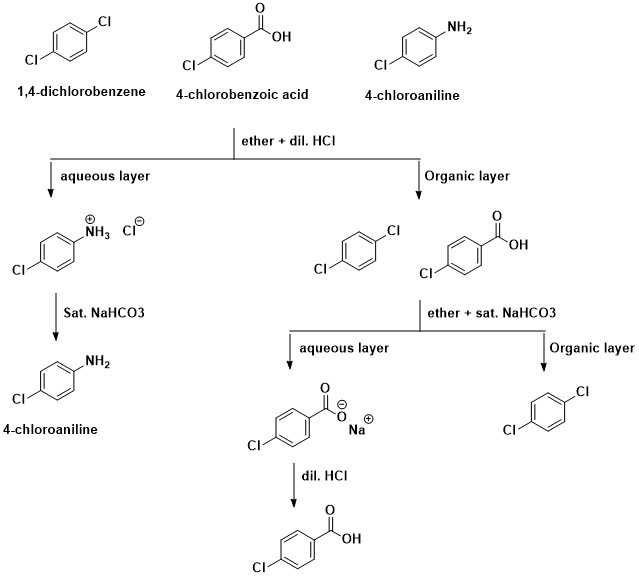
Construct a flow chart to demonstrate how you could separate a mixture of 1,4- dichlorobenzene, 4-chlorobenzoic acid, and 4-chlo
notsponge [240]

Hey there!:


Attached response

6 0
2 years ago
Read 2 more answers
How much maleic anhydride would you need to react 178 mg of anthracene? Assume 1:1 ratio from maleic anhydride to anthracene.
Licemer1 [7]

Answer:

(1) 0.10      (2) 17.8 g

Explanation:

Since the reaction ratio is 1:1 what we need is to convert the given masses to moles and you will have the answer:

MW anthracene = 178.23 g/mol

MW maleic anhydride = 98.06 g/mol

a) mass anthracene = 178 mg x 1 g/ 1000 mg = 0.178 g anthracene

Moles anthracene = 0.178 g anthracene/ 178.23 g/mol

= 0.001 mol anthracene

0.001 mol anthracene x 1 mol maleic acid/mol anthracene

= 0.001 mol maleic anhydride

mass maleic anhydride  = 0.001 mol x 98.06 g/mol =  0.10 g

b) moles maleic anhydride = 9.8 g/ 98.06 g/mol = 0.099 moles

0.099 moles maleic anhydride x 1 mol anthracene/mol  maleic anhydride =

0.099 mol anthracene

g anthracene = 0.10mol x 178 g/mol = 17.8 g

8 0
2 years ago
Two weak acids, A and B, have pKa values of 4 and 6, respectively. Which statement is true?A) Acid A dissociates to a greater ex
zalisa [80]

Answer:

A) Acid A dissociates to a greater extent in water than acid B

Explanation:

A) Acid A dissociates to a greater extent in water than acid B

We are given the pKa for both acids, and we know

pKa = - log Ka

Taking antilog to both sides of the equation we can solve for Ka

⇒ -pKa = log Ka

-antilog pKa = Ka

10 ^-pka = Ka

So ka for acid A = 10⁻⁴

and

ka for acid B = 10⁻⁶

True the equilibrium constant for acid A is greater, so it dissociates more.

B) For solutions of equal concentration, acid B will have a lower pH.

We know the stronger acid is A, and it dissociates more. Since pH is the negative log of H₃O⁺ concentration, it follows that at equal concentrations the acid A will have at equilibrium a greater [H₃O⁺] and hence a lower pH

C) B is the conjugate base of A

False:

If B were the conjugate base of A, its  Kb would have been given by:

Ka x Kb = Kw

Kb = 10⁻¹⁴/10⁻⁶ = 10⁻⁸ for the conjugate base of acid B

Kb = 10⁻¹⁴/10⁻⁴ = 10⁻¹⁰ for the conjugate base of acid A

which are not equal.

D) Acid A is more likely to be a polyprotic acid than acid B.

False

Just having the pkas for both acids one cannot know if any of the acids is polyprotic. We will need the formula for the acids.

E) The equivalence point of acid A is higher than that of acid B

False

The equivalence point depends on the the concentration of the acids  and their volumes.

The equivalence point is reached in the titration when the number of equivalents of base equals the number of equivalents of acid:

# equivalents acid = # equivalents of base  @ end point

and

# equivalents acid = Molarity of acid x Volume of acid

4 0
2 years ago
The combustion of propane occurs when propane interacts with oxygen gas to produce water and carbon dioxide in the following rea
gtnhenbr [62]

Answer:

  • 20 atm

Explanation:

<u>1) Data:</u>

a) n = 2 moles

b) T = 373 K

c) V = 2.5 liter

d) P = ?

<u>2) Chemical principles and formula</u>

You need to calculate the pressure of the propane gas in the mixture before reacting. So, you can apply the partial pressure principle which states that each gas exerts a pressure as if it occupies the entire volume.

Thus, you just have to use the ideal gas equation: PV = nRT

<u>3) Solution:</u>

  • PV = nRT ⇒ P = nRT / V

P = 2 mol × 0.08206 atm-liter /K-mol × 373K / 2.5 liter = 24.5 atm

Since the number of moles are reported with one significant figure, you must round your answer to one significant figure, and that is 20 atm (20 is closer to 24.5 than to 30).

5 0
2 years ago
The reaction N2 + 3 H2 → 2 NH3 is used to produce ammonia. When 450. g of hydrogen was reacted with nitrogen, 1575 g of ammonia
tiny-mole [99]

Answer:

The percent yield of this reaction is 70%

Explanation:

The reaction is: N₂ + 3H₂ → 2NH₃

We only have the mass of H₂, so we assume that N₂ is in excess

We convert the mass to moles, to work with the reaction:

450 g . 1mol / 2 g = 225 moles

Ratio is 2:3. 3 moles of H₂ can produce 2 moles of ammonia

Therefore 225 moles of H₂ will produce (225 .2)/ 3 = 150 moles

This is the 100% yield reaction → We convert the moles of NH₃ to mass

150 mol . 17g /1mol = 2550 g

Percent yield = (Produced yield/Theoretical yield) .100

Percent yield = (1575g/2550g) . 100 = 70%

7 0
2 years ago
Other questions:
  • Which solution below most likely shows a vivid color?
    6·2 answers
  • Which organ removes excess water, salts, uric acids, and chemicals from the blood?
    15·1 answer
  • Explain why the spectrum produced by a 1-gram sample of element Z would have the same spectral lines at the same wavelengths as
    6·2 answers
  • Determine whether each of the examples or phrases describes an essential amino acid, a nonessential amino acid, or both essentia
    10·2 answers
  • The empirical formula for a compound is CH2. If n is a whole number, which shows a correct relationship between the molecular fo
    15·2 answers
  • Ethyl achohol has a heat of vaporization of 850. J/g. What mass of ethyl alcohol can be boiled using 15000 j of energy
    14·2 answers
  • How did the scientific method impact work of scientists beginning in the 16th century
    7·2 answers
  • The identity of an element depends on the number of
    10·2 answers
  • When food spoils, it is a chemical reaction. For example, rancid butter is produced when the fat molecules in the butter undergo
    15·1 answer
  • What is the IUPAC name of the following compound?
    13·1 answer
Add answer
Login
Not registered? Fast signup
Signup
Login Signup
Ask question!