answer.
Ask question
Login Signup
Ask question
All categories
  • English
  • Mathematics
  • Social Studies
  • Business
  • History
  • Health
  • Geography
  • Biology
  • Physics
  • Chemistry
  • Computers and Technology
  • Arts
  • World Languages
  • Spanish
  • French
  • German
  • Advanced Placement (AP)
  • SAT
  • Medicine
  • Law
  • Engineering
Naddika [18.5K]
2 years ago
11

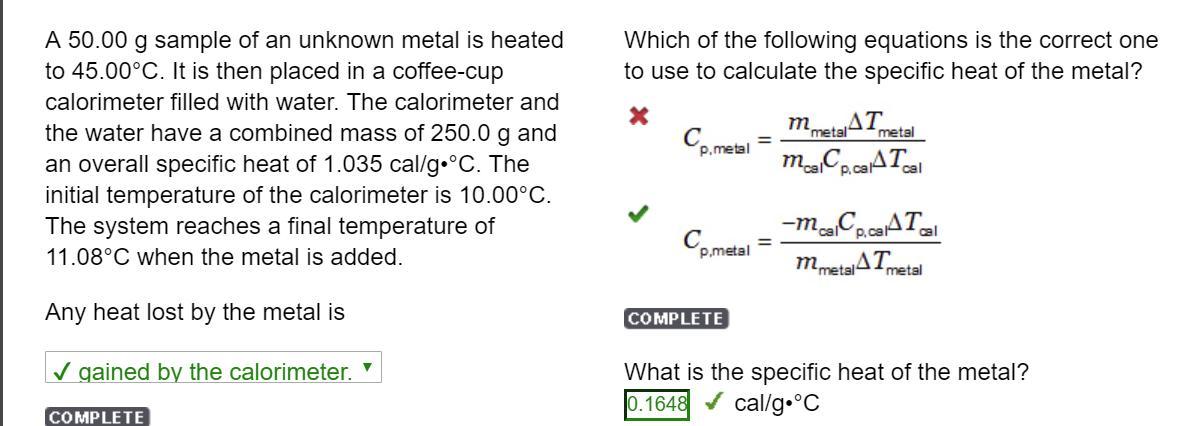
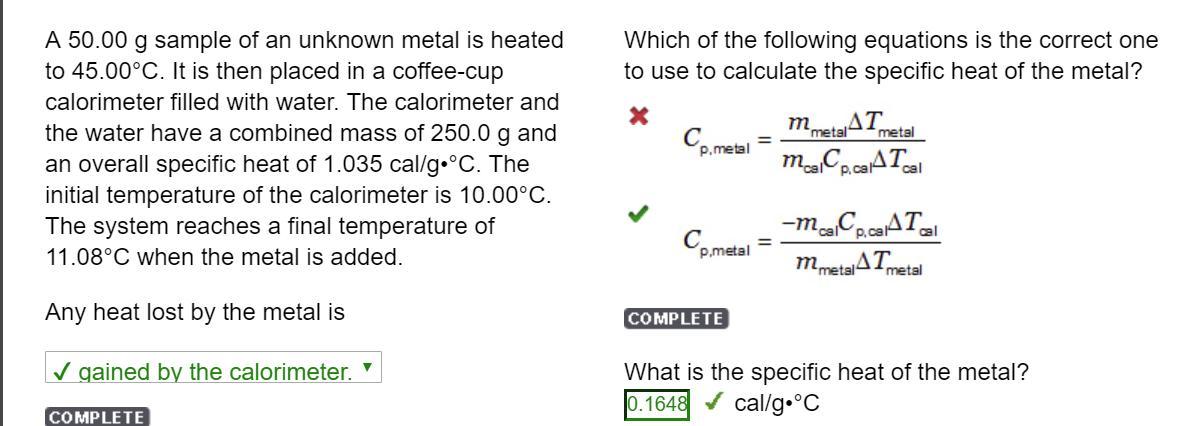
A 50.00 g sample of an unknown metal is heated to 45.00°C. It is then placed in a coffee-cup calorimeter filled with water. The

calorimeter and the water have a combined mass of 250.0 g and an overall specific heat of 1.035 cal/g•°C. The initial temperature of the calorimeter is 10.00°C. The system reaches a final temperature of 11.08°C when the metal is added.

Chemistry
2 answers:
alex41 [277]2 years ago
8 0

Answer:

The three answers are in the attached picture.

Explanation:

True [87]2 years ago
6 0
First, in order to calculate the specific heat capacity of the metal in help in identifying it, we must find the heat absorbed by the calorimeter using:
Energy = mass * specific heat capacity * change in temperature
Q = 250 * 1.035 * (11.08 - 10)
Q = 279.45 cal/g

Next, we use the same formula for the metal as the heat absorbed by the calorimeter is equal to the heal released by the metal.

-279.45 = 50 * c * (11.08 - 45) [minus sign added as energy released]
c = 0.165

The specific heat capacity of the metal is 0.165 cal/gC
You might be interested in
Mass in grams of 6.25 mol of copper (II) nitrate?
podryga [215]
Cu = 63.546
N= 14.001 g/mol
O= 15.999 g/mol * 3 = 47.997

Copper (II) Nitrate has a MW of 125.544 g/mol

6.25 x 125.544

= 784.65 <--- is your answer, if there were was a multiple choice or not :)
8 0
2 years ago
Read 2 more answers
24 how many moles are in 2.04 × 1024 molecules of h2o?
Sergeeva-Olga [200]
The answer is 3.39 mol.

<span>Avogadro's number is the number of molecules in 1 mol of substance.
</span><span>6.02 × 10²³ molecules per 1 mol.
</span>2.04 × 10²⁴<span> molecules per x.

</span>6.02 × 10²³ molecules : 1 mol = 2.04 × 10²⁴ molecules : x
x = 2.04 × 10²⁴ molecules * 1 mol : 6.02 × 10²³ molecules
x = 2.04/ 6.02 × 10²⁴⁻²³ mol
x = 0.339 × 10 mol
<span>x = 3.39 mol
</span>
8 0
2 years ago
ethylene glycol used in automobile antifreeze and in the production of polyester. The name glycol stems from the sweet taste of
Luden [163]

<u>Answer:</u> The empirical and molecular formula for the given organic compound is CH_3O and C_4H_{12}O_4

<u>Explanation:</u>

The chemical equation for the combustion of hydrocarbon having carbon, hydrogen and oxygen follows:

C_xH_yO_z+O_2\rightarrow CO_2+H_2O

where, 'x', 'y' and 'z' are the subscripts of Carbon, hydrogen and oxygen respectively.

We are given:

Mass of CO_2=9.06g

Mass of H_2O=5.58g

We know that:

Molar mass of carbon dioxide = 44 g/mol

Molar mass of water = 18 g/mol

  • <u>For calculating the mass of carbon:</u>

In 44g of carbon dioxide, 12 g of carbon is contained.

So, in 9.06 g of carbon dioxide, \frac{12}{44}\times 9.06=2.47g of carbon will be contained.

  • <u>For calculating the mass of hydrogen:</u>

In 18g of water, 2 g of hydrogen is contained.

So, in 5.58 g of water, \frac{2}{18}\times 5.58=0.62g of hydrogen will be contained.

  • Mass of oxygen in the compound = (6.38) - (2.47 + 0.62) = 3.29 g

To formulate the empirical formula, we need to follow some steps:

  • <u>Step 1:</u> Converting the given masses into moles.

Moles of Carbon =\frac{\text{Given mass of Carbon}}{\text{Molar mass of Carbon}}=\frac{2.47g}{12g/mole}=0.206moles

Moles of Hydrogen = \frac{\text{Given mass of Hydrogen}}{\text{Molar mass of Hydrogen}}=\frac{0.62g}{1g/mole}=0.62moles

Moles of Oxygen = \frac{\text{Given mass of oxygen}}{\text{Molar mass of oxygen}}=\frac{3.29g}{16g/mole}=0.206moles

  • <u>Step 2:</u> Calculating the mole ratio of the given elements.

For the mole ratio, we divide each value of the moles by the smallest number of moles calculated which is 0.206 moles.

For Carbon = \frac{0.206}{0.206}=1

For Hydrogen  = \frac{0.62}{0.206}=3

For Oxygen  = \frac{0.206}{0.206}=1

  • <u>Step 3:</u> Taking the mole ratio as their subscripts.

The ratio of C : H : O = 1 : 3 : 1

Hence, the empirical formula for the given compound is C_1H_{3}O_1=CH_3O

For determining the molecular formula, we need to determine the valency which is multiplied by each element to get the molecular formula.

The equation used to calculate the valency is:

n=\frac{\text{molecular mass}}{\text{empirical mass}}

We are given:

Mass of molecular formula = 124 amu = 124 g/mol

Mass of empirical formula = 31 g/mol

Putting values in above equation, we get:

n=\frac{124g/mol}{31g/mol}=4

Multiplying this valency by the subscript of every element of empirical formula, we get:

C_{(1\times 4)}H_{(3\times 4)}O_{(1\times 4)}=C_4H_{12}O_4

Thus, the empirical and molecular formula for the given organic compound is CH_3O and C_4H_{12}O_4

3 0
2 years ago
When balanced, which equation would have the coefficient 3 in front of any of the reactants? Zn + HCl ZnCl2 + H2 H2SO4 + B(OH)3
Gwar [14]

The correct answer is B. H2SO4 + B(OH)3  B2(SO4)3 + H2O

Hope this helps!

6 0
2 years ago
Read 2 more answers
What is the emperical formula for a compound containing 68.3% lead, 10.6% sulfur, and the remainder oxygen? a. Pb2SO4 b. PbSO3 c
brilliants [131]

Answer:

Molecular formula → PbSO₄ → Lead sulfate

Option c.

Explanation:

The % percent composition indicates that in 100 g of compound we have:

68.3 g of Pb, 10.6 g of S and  (100 - 68.3 - 10.6) = 21.1 g of O

We divide each element by the molar mass:

68.3 g Pb / 207.2 g/mol = 0.329 moles Pb

10.6 g S / 32.06 g/mol = 0.331 moles S

21.1 g O / 16 g/mol = 1.32 moles O

We divide each mol by the lowest value to determine, the molecular formula

0.329 / 0.329 = 1 Pb

0.331 / 0.329 = 1 S

1.32 / 0.329 = 4 O

Molecular formula → PbSO₄ → Lead sulfate

8 0
2 years ago
Read 2 more answers
Other questions:
  • In a blast furnace, elemental iron is produced from a mixture of coke (c), iron ore (fe3o4), and other reactants. an important r
    15·1 answer
  • For the chemical equation SO2(g)+NO2(g)↽−−⇀SO3(g)+NO(g) the equilibrium constant at a certain temperature is 3.80. At this tempe
    7·1 answer
  • Calculate the first and second velocities of the car with one washer attached to the pulley, using the formulas v1 = 0.25 m / t1
    7·2 answers
  • After recrystallization, the final weight of biphenyl is found to be 0.02 g. Assume that all steps were carried out correctly, n
    7·1 answer
  • Balance the following redox reaction occurring in an acidic solution. The coefficient of Cr2O72−(aq) is given. Enter the coeffic
    13·1 answer
  • 3. For the reaction: 2X + 3Y 3Z, the combination of 2.00 moles of X with 2.00
    6·1 answer
  • Completa la siguiente tabla, que indica las temperaturas registradas en un día para algunas ciudades del mundo.
    6·1 answer
  • What types of compounds are CaCl2, Cu, C2H6, respectively.
    6·1 answer
  • The molar mass of an imaginary molecule is is 93.89 g/mol. Determine its density at STP.
    14·1 answer
  • The combustion of ethyne, shown below unbalance, produces heat which can be used to weld metals:
    8·1 answer
Add answer
Login
Not registered? Fast signup
Signup
Login Signup
Ask question!