answer.
Ask question
Login Signup
Ask question
All categories
  • English
  • Mathematics
  • Social Studies
  • Business
  • History
  • Health
  • Geography
  • Biology
  • Physics
  • Chemistry
  • Computers and Technology
  • Arts
  • World Languages
  • Spanish
  • French
  • German
  • Advanced Placement (AP)
  • SAT
  • Medicine
  • Law
  • Engineering
myrzilka [38]
2 years ago
11

Which is the correct Lewis structure for carbononitridic chloride (CNCl)?

Chemistry
2 answers:
polet [3.4K]2 years ago
6 0
<span>The Lewis structure should be this </span>⇒<span> Cl-C­≡N,
accompanied by 3 lone pairs on the Cl and one lone pair on the N.</span>
inessss [21]2 years ago
6 0

Answer :

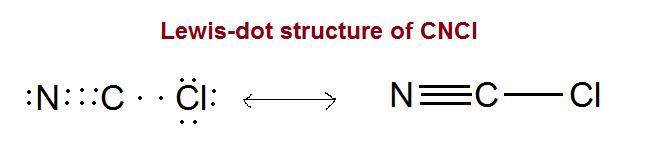
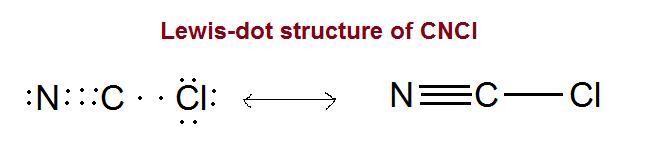
Lewis-dot structure : It represent the number of valance electrons present in the element. It shows the bonding between the atoms of a molecule and it also shows the unpaired electrons present in the molecule.

The given molecule is, CNCl

As we know that, carbon has '4' valence electrons, nitrogen has '5' valence electron and chlorine has '7' valence electrons.

Therefore, the total number of valence electrons in CNCl = 4 + 5 + 7 = 16

According to Lewis-dot structure, there are 8 number of bonding electrons and 8 number of non-bonding electrons.

In the given molecule, carbon is the central atom because it is more electropositive element than the nitrogen and chlorine. The carbon bonded with nitrogen by the triple bond because nitrogen ability to form triple bond and carbon bonded with chlorine by single bond.

The Lewis-dot structure of CNCl is shown below.

You might be interested in
How many moles of KCl will be<br> produced from 15.0 g of KClO3?
slega [8]

Answer:

0.12 mol KCl

Explanation:

2 KClO3 (s)   2 KCl (s) + 3 O2 (g)

15 g                x mol

x g KCl = 15 g KClO3 x[ (1 mol KClO3)/ (122.5 g KClO3) ] x [(2 mol KCl)/ (2 mol KClO3)]

x g KCl = 0.12 mol KCl

7 0
2 years ago
Read 2 more answers
Electroplating is a way to coat a complex metal object with a very thin (and hence inexpensive) layer of a precious metal, such
8_murik_8 [283]

Answer:

0.0164 g

Explanation:

Let's consider the reduction of silver (I) to silver that occurs in the cathode during the electroplating.

Ag⁺(aq) + 1 e⁻ → Ag(s)

We can establish the following relations.

  • 1 A = 1 C/s
  • The charge of 1 mole of electrons is 96,468 C (Faraday's constant)
  • 1 mole of Ag(s) is deposited when 1 mole of electrons circulate.
  • The molar mass of silver is 107.87 g/mol

The mass of silver deposited when a current of 0.770 A circulates during 19.0 seconds is:

19.0s \times \frac{0.770c}{s} \times \frac{1mole^{-} }{96,468C} \times \frac{1molAg}{1mole^{-}} \times \frac{107.87g}{1molAg} = 0.0164 g

5 0
2 years ago
Calculate the freezing point of a 0.08500 m aqueous solution of nano3. the molal freezing-point-depression constant of water is
Citrus2011 [14]
Depression in freezing point (ΔT_{f}) = K_{f}×m×i,
where, K_{f} = cryoscopic constant = 1.86^{0} C/m,
m= molality of solution = 0.0085 m
i = van't Hoff factor = 2 (For NaNO_{3})

Thus, (ΔT_{f}) = 1.86 X 0.0085 X 2 = 0.03162^{0}C

Now, (ΔT_{f}) = T^{0} - T
Here, T = freezing point of solution
T^{0} = freezing point of solvent = 0^{0}C
Thus, T = T^{0} - (ΔT_{f}) = -0.03162^{0}C
8 0
2 years ago
Read 2 more answers
What features of this model will help Armando answer the question?
Scrat [10]

Answer:

The adjustable legs and the table of sand.

<em>Note:The question is incomplete. The complete question is given below.</em>

Using Models to Answer Questions About Systems

Armando’s class was looking at images of rivers formed by flowing water. Most of the rivers were wide and shallow, but one river was narrow and deep. Armando’s class thinks that this river is narrow and deep because:

  • the hill that the water flowed down was very steep, or
  • the sand grains that the water flowed through were very small.

Armando designed the model below to try to answer the question: Why is this river so narrow and deep?

Explanation:

The model designed by Armando will be helpful to answer the question because of the following features it possesses:

1. An adjustable leg- since one of the hypotheses put forward by the class to explain why the river was narrow and deep was that the hill that the water flowed down was very steep, the adjustable legs can be lowered or raised in order to make the slope shallower or steeper so that their hypothesis can be tested.

2. A table of sand- the table of sand serves as the streambed. By adjusting the size of the sand grains to be larger or smaller, the students will be able to to test their second hypothesis that the small size sand grains that the water flowed through was the reason for the river to be narrow and deep.

The results of their experiments will enable them to come to a conclusion.

5 0
2 years ago
Read 2 more answers
The three aspects of the measuring process are units, systems, and instruments.
lawyer [7]

Answer:

the answer for that is false
4 0
1 year ago
Read 2 more answers
Other questions:
  • Why is nonpoint source pollution potentially more harmful than point source pollution?
    7·2 answers
  • jan is holding an ice cube. what causes the ice to melt? thermal energy from the ice is transferred to the air. thermal energy f
    12·2 answers
  • A gas can holds 2.9 gal of gasoline.<br><br><br> What is this quantity in cubic centimeters?
    5·1 answer
  • If 14c-labeled uracil is added to the growth medium of cells, what macromolecules will be labeled?
    7·2 answers
  • if 20.g of a radioactive isotope are present at 1:00 pm and 5.0g remain at 2:00 pm, what is the half life of the isotope?
    9·1 answer
  • Which description correctly characterizes the acidity or basicity of a solution? The higher the pH is, the more the hydroxide io
    14·2 answers
  • An increase in temperature will effect vapor pressure by:
    6·1 answer
  • Suppose a layer of oil is on the top of a beaker of water. Water in many oils is slightly soluble, so its concentration is so lo
    8·1 answer
  • Butter has a specific gravity of 0.86. What is the mass of 2.15 L of butter?
    12·1 answer
  • Stabiliţi numerele de oxidare ale tuturor elementelor prezente în următoarele substanţe chimice, ţinând cont de principalele reg
    10·1 answer
Add answer
Login
Not registered? Fast signup
Signup
Login Signup
Ask question!