answer.
Ask question
Login Signup
Ask question
All categories
  • English
  • Mathematics
  • Social Studies
  • Business
  • History
  • Health
  • Geography
  • Biology
  • Physics
  • Chemistry
  • Computers and Technology
  • Arts
  • World Languages
  • Spanish
  • French
  • German
  • Advanced Placement (AP)
  • SAT
  • Medicine
  • Law
  • Engineering
Bad White [126]
2 years ago
14

Section 1.7 showed that in 1997 los angeles county air had carbon monoxide (co) levels of 15.0 ppm. an average human inhales abo

ut 0.50 l of air per breath and takes about 20 breaths per minute. part a how many milligrams of carbon monoxide does the average person inhale in an 6 hour period for this level of carbon monoxide pollution? assume that the carbon monoxide has a density of 1.2 g/l. (hint: 15.0 ppm co means 15.0 lco per 106l air.)
Chemistry
2 answers:
pochemuha2 years ago
7 0

<u>Given information:</u>

Concentration of CO in air = 15 ppm

Volume of air inhaled per breath = 0.50 l

Number of breaths taken per min = 20

Density of CO = 1.2 g/L

<u>To determine:</u>

mg of CO inhaled in 6 hours

<u>Explanation:</u>

15 ppm of CO (parts per million) implies that there is 15 L of CO in 10⁶ L of air

Therefore, volume of CO inhaled through 0.50 L of air is

= 15 L CO * 0.50 L air/10⁶ L air = 7.5 *10⁻⁶ L CO/breath

Now, there are 20 breaths per minute

Therefore, the number of breaths in a 360 min (i.e. 6 hr) period would be

=360 min * 20 breaths/1 min = 7200 breaths

Thus, the volume of CO inhaled during this time span would be

= 7200 breaths * 7.50*10⁻⁶L/1 breath = 0.054 L

Since the density of CO = 1.2 g/L

The corresponding mass of CO inhaled = Density*Volume

= 0.054 * 1.2 = 0.0648 g = 64.8 mg

Ans: Mass of CO inhaled in a 6 h period is 64.8 mg


Monica [59]2 years ago
4 0
First, let's determine the amount of air a human intakes per minute:

0.5 L/breath * (20 breaths/min) = 10 L/min

So, for 6 hours, the amount of volume would be:

6 hrs = 360 min
10 L/min ( 360 min = 3,600 L of total air inhaled

Next, we convert the concentration to g/L. The solution is as follows:
15 L CO/10⁶ L air * 1.2 g CO/L = 18 g CO/L air
So, we multiply to this the volume of air inhaled.

Amount of CO inhaled = (18 g CO/L air)(3,600 L of total air)(1,000 mg/1 g)
Amount of CO inhaled = 64.8×10⁶ mg of CO inhaled
You might be interested in
Calculate the molarity of 1.0 mol of KCl in 750 ml of solution
Vaselesa [24]

Answer:

[KCl] = 1.33 M

Explanation:

Molarity is mol /L

Mol of solute in 1 L of solution

Volume of solution is 750 mL

750 mL / 1000 = 0.750 L

1 mol / 0.750L = M → 1.33

7 0
2 years ago
Read 2 more answers
The first five ionization energies of an element are as follows (in kJ/mol): 577.9, 1820, 2750, 11600, 14800. Which of the follo
Ne4ueva [31]

Answer:option d==> Si.

Explanation:

The energy required to remove electron from a gaseous atom or ion is what is called an ionization energy. As we remove electrons continually in a gaseous atom or ion, the ionization energy increases which are know as the first ionization energy, the second ionization energy, third ionization energy and so on.

Looking at the electronic configuration of Silicon, Si; Ne 3s2 3p2. We can can see that the first four ionization energies are from the removal of the 3p2 and 3s2 electrons and the fifth ionization energy, which is the highest ionization energy of 14800 kJ/mol is the the electron removed from the core shell.

4 0
2 years ago
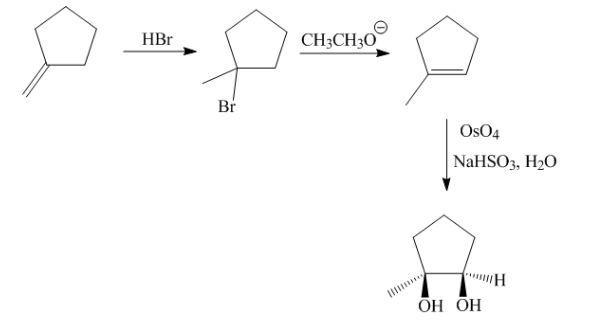
The target diol is synthesized in one step from 1-methylcyclopentene, but your lab partner exhausted the supply of that alkene.
andrezito [222]

Answer:

The reagents are CH_{3}CH_{3}O^{-},OsO_{4},NaHSO_{3}and H_{2}O.

Explanation:

1-Methylenecyclopentene is treated with HBr form 1-bromo-1-methylcyclopentane, which is treated with strong base ethoxide ion and forms 1-methylcyclopent-1-ene.

This alkene is treated with osmium tetraoxide in the presence of sodium bisulfite to form target product.

The chemical reaction is as follows.

4 0
2 years ago
Calculate the empirical formula for each of the following substances. (Express answer as a chemical formula) 1) 2.90 g of Ag and
exis [7]

Answer:

1) Ag3N

2)Na2S

3)NaHSO4

4) KNO3

Explanation:

We divide each mass by the element's relative atomic mass

1) 2.90/108-Ag, 0.125/14-N

0.027-Ag, 0.0089-N

Divide by the lowest ratio

0.027/0.0089-Ag, 0.0089/0.0089 N

3-Ag, 1-N

Empirical formula- Ag3N

2)2.22/23-Na, 1.55/32-S

0.097-Na, 0.048-S

Divide by the lowest ratio

0.097/0.048-Na, 0.048/0.048-S

2-Na, 1-S

Empirical formula- Na2S

3) 2.11/23-Na, 0.0900/1-H, 2.94/32-S,5.86/16-O

0.09-Na, 0.09-H, 0.09-S,0.366-O

Divide by the lowest ratio

0.09/0.09-Na, 0.09/0.09-H, 0.09/0.09-S, 0.366/0.09-O

1-Na, 1-H, 1-S, 4-O

Empirical formula- NaHSO4

4)1.84/39, 0.657/14-N, 2.25/16-O

0.047-K, 0.047-N, 0.14-O

Divide through by the lowest ratio

0.047/0.047-K, 0.047/0.047-N, 0.14/0.047-O

1-K, 1-N, O-3

Empirical formula- KNO3

4 0
2 years ago
Which reactions performed in the experiment involved chemical changes? crushing calcium carbonate mixing calcium carbonate and h
lisov135 [29]
Mixing calcium carbonate and HCl. 
Heating copper sulfate pentahydrate. 
Mixing potassium iodide and lead nitrate. 
Combining magnesium and hcl. 
Burning the candle. 
 Let's look at the available options and see what are chemical changes and what are physical changes. As a side note, line breaks, capitalization, and punctuation are VERY important. I spent almost as much time attempting to actually figure out what your options were as I spent in distinguishing between what were chemical reactions and physical changes. 
 Crushing calcium carbonate.
 * This is a mere physical change. You start with large pieces of calcium carbonate and end up with smaller pieces. So this is a bad choice. 
 Mixing calcium carbonate and HCl.
 * This is a chemical reaction where the calcium carbonate and hydrochloric acid react with each other and produce carbon dioxide plus other compounds. So this is a good choice. 
 Boiling water.
 * Another physical change from liquid to vapor. You can cool down the resulting vapor and end up with the original water. So this is a bad choice. 
 Heating copper sulfate pentahydrate.
 * This is a chemical change in that you're converting CuSO4 . 5H2O(s) into CuSO4 and H2O. So this too is a good choice. 
 Separating iron filing and sulfur.
 * You start out with iron filings and sulfur and end up with iron filings and sulfur. Things are a bit more orderly, but no chemical reactions have occurred. So this is a bad choice. 
 Mixing potassium iodide and lead nitrate. * You start with 2 white solids and upon mixing them, you get a yellow solid.
A chemical reaction has occurred. So this is a good choice. 

 Combining magnesium and hcl.
 * When you combine these two items, you get hydrogen gas as a product. So you have a chemical reaction. And this is a good choice. 
 Burning the candle.
 * Another chemical reaction. The wax combines with the oxygen in the air and produces water vapor and carbon dioxide. So this is a good choice.
5 0
2 years ago
Read 2 more answers
Other questions:
  • Seven vans each hold 6 passengers. Each passenger is carrying 20 candies divided equally among 5 small boxes. How many candies a
    5·1 answer
  • A gas can holds 2.9 gal of gasoline.<br><br><br> What is this quantity in cubic centimeters?
    5·1 answer
  • Which indicator would be the best to use for a titration between 0.20 m hi with 0.10 m ba(oh)2? you will probably need to consul
    5·2 answers
  • ASAP PLEASE HELP:
    11·2 answers
  • A 2.20 g sample of a compound gave 5.63 g CO2 and 2.30 g H2O on combustion in air. The compound is known to contain only C, H, O
    8·1 answer
  • Calculate the amount of heat necessary to raise the temperature of 135.0 g of water from 50.4°F to 85.0°F. The specific heat of
    6·1 answer
  • Why is liquid mercury a good electrical conductor in terms of atomic structure?
    8·2 answers
  • El amoniaco y el fluor reaccionan para formar tetrafluoruro de dinitrogeno y fluoruro de hidrogeno. segun la reaccion: NH3 + F2
    12·1 answer
  • Please use the E/Z notation when specifying stereochemistry remembering to use parentheses and a dash. Reminder - the double bon
    5·1 answer
  • 1. Calculate the molar enthalpy of solidification (ΔHsolidification) when 10.00kJ of energy are lost as 30.00g of water are froz
    14·1 answer
Add answer
Login
Not registered? Fast signup
Signup
Login Signup
Ask question!