answer.
Ask question
Login Signup
Ask question
All categories
  • English
  • Mathematics
  • Social Studies
  • Business
  • History
  • Health
  • Geography
  • Biology
  • Physics
  • Chemistry
  • Computers and Technology
  • Arts
  • World Languages
  • Spanish
  • French
  • German
  • Advanced Placement (AP)
  • SAT
  • Medicine
  • Law
  • Engineering
zalisa [80]
2 years ago
8

What orbitals are used to form each bond in methanol, ch3oh? be sure to answer all parts?

Chemistry
2 answers:
BlackZzzverrR [31]2 years ago
6 0

Orbitals that play a role in bonding to C atoms are sp³ hybridization orbitals, while O atoms, the orbitals used for binding are 2p orbitals

and the H atom, the orbitals used are 1s

<h3>Further explanation </h3>

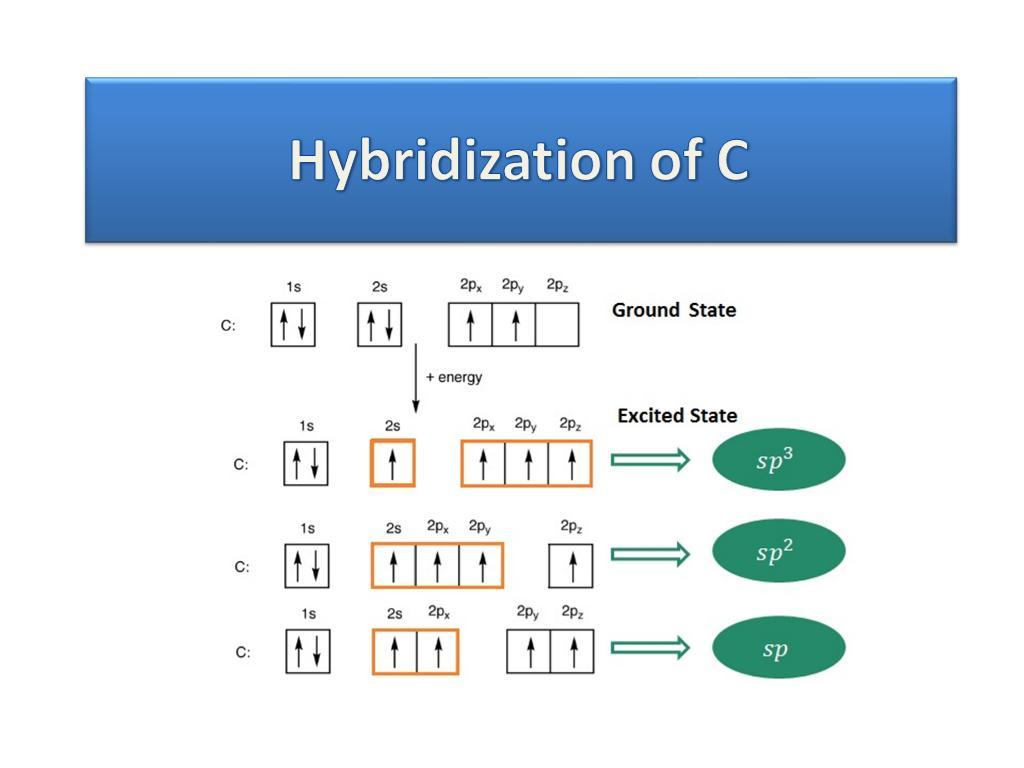
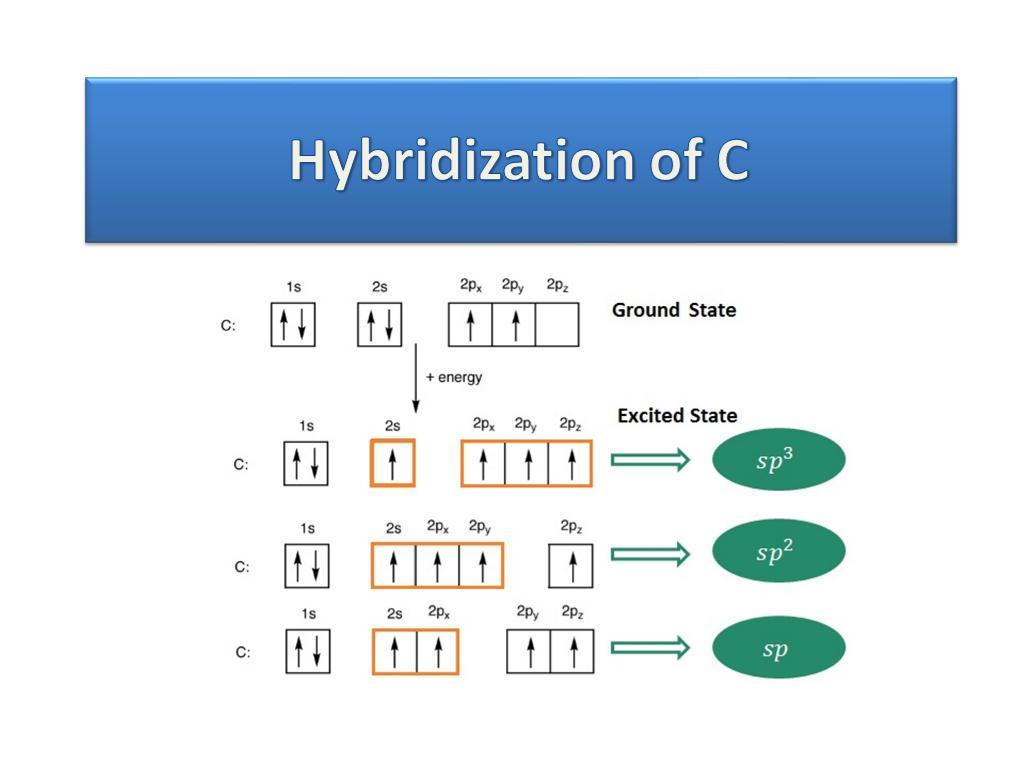
Hybridization is a term used in the formation of chemical bonds or the determination of the geometric shape of a molecule. Hybridization is generally used to describe molecules that have C, N and O atoms

In the formation of bonds between 2 atoms, the valence electrons of the two atoms will play a role in the filling of empty orbitals that are shared and filled with electrons from both atoms.

Hybridization itself is merging of orbitals that have different energy levels so that it is expected to explain the resulting geometric shape according to the length, angle or bond energy

In the compound CH₃OH (methanol) which is one of the alcohols there are 3 atoms in it namely C, H, and O

The electron configurations of each of these atoms are:

C: 1s² 2s² 2p2²

H: 1s1¹

O: 1s² 2s² 2p⁴

In an atom, C hybridization occurs where the electrons in the 2s orbitals are excited into the 2p orbitals to form sp³ hybridization orbitals so that 4 single electrons can bind to other atoms

Whereas on the O atom there are 2 single electrons in the 2p orbitals so that they can bind with 2 other electron atoms to form bonds

Whereas the H atom, there is 1 single electron in 1s orbitals that can bind to 1 electron from another atom

<h3>Learn more </h3>

statement about electrons and atomic orbitals

brainly.com/question/1832385

the formation of a bond.

brainly.com/question/11311275

the hybridization and bonding scheme for xef4

brainly.com/question/6766602

Keywords: the electron configuration, orbitals, hybridization
Sidana [21]2 years ago
5 0

All C-H bonds are formed from C \boxed{s{p^3}} to H \boxed{1s}.

The C-O bond is formed from C   to O \boxed{2p}.

The O-H bond is formed from O \boxed{2p} to \boxed{1s}.

Further explanation:

Hybridization

The process that involves the combination of atomic orbitals of the same atom to form an equal number of hybrid orbitals having the same energy and same shape is known as hybridization. Hybrid orbitals are supposed to be the mixtures of atomic orbitals.

There are three atoms, namely C, H and O that are involved in the formation of {\text{C}}{{\text{H}}_3}{\text{OH}}. The atomic number of carbon is 6 so it has a configuration of 1{s^2}2{s^2}2{p^2}. The atomic number of hydrogen is 1 so its electronic configuration is 1{s^1}. The atomic number of oxygen is 8 and its configuration is 1{s^2}2{s^2}2{p^4}.

One of the 2<em>s</em> electrons in carbon atom gets excited to the 2p orbital and one 2<em>s</em> and three <em>2p</em> orbitals combine with each other to form four   hybrid orbitals. So the hybridization of carbon is s{p^3}.

All C-H bonds are formed from s{p^3} hybrid orbitals of C to 1s orbital of H. So the orbitals involved in C-H bonds are s{p^3} hybrid orbitals of carbon and 1s orbitals of hydrogen.

The C-O bond is formed from s{p^3} hybrid orbitals of C to <em>2p</em> orbital of O. So the orbitals involved in C-O bonds are s{p^3} hybrid orbitals of carbon and <em>2p</em> orbital of oxygen.

The O-H bond is formed from <em>2p</em> orbitals of O to the 1s orbital of H. So the atomic orbitals involved in O-H bond are <em>2p</em> orbital of oxygen and 1s orbital of hydrogen.

Learn more:

  1. Molecular shape around the central atoms in the amino acid glycine: brainly.com/question/4341225
  2. Component of John Dalton’s atomic theory:brainly.com/question/2357175

Answer details:

Grade: Senior School

Chapter: Covalent bonding and molecular structure

Subject: Chemistry

Keywords: hybridization, CH3OH, C, H, O, sp3, 1s, 2p, orbitals, C-H bond, O-H bond, C-O bond.

You might be interested in
1. Electronegativity is the… a. amount of energy required to remove the most loosely bound electron from an atom. b. tendency of
Kitty [74]

Answer: C.

ability of an atom to attract an electron from another atom toward itself.

Explanation:

Electronegativity is the chemical property that describes the ability of an atom to attract electron to itself. It is responsible for bond formation between atoms.

8 0
2 years ago
Read 2 more answers
Question 21 (2 points)
m_a_m_a [10]

Answer:

i would say sensory memory, aka muscle memory.

Explanation:

8 0
2 years ago
Read 2 more answers
A sample of an unknown compound with a mass of 0.847 g has the following composition: 50.51 % fluorine and 49.49 % iron. When th
sergejj [24]

Answer: 0,4278g of F and 0,4191g of Fe

Explanation: it's possible to calculate the mass of each element by multiplying the percentage (decimal) of the element by the mass of the compound.

For Fluorine (F)

0,847g * 0,5051 = 0,4278g of F

For iron (Fe)

0,847 * 0,4949 = 0,4191g of Fe

This is determined because even when the compound is decomposed, due to conservative law of mass, the decomposition process do not affect the amount of matter, so the mass of the elements remain even if they are separated from the original molecule.

At the end, the sum of the elements masses should be the total mass of the compound.

4 0
2 years ago
Read 2 more answers
How many moles of Cobalt are in 27.4 grams of cobalt
xeze [42]
0.4649331785818406 is what 27.4 grams is converted to! You're welcome!! :) 
5 0
2 years ago
Read 2 more answers
Choose the answer in which the three atoms and/or ions are listed in order of increasing EXPECTED size (smallest particle listed
svp [43]

Answer:

Ar < Cl - < S2-

Explanation:

All the species written above are isoelectronic. This means that they all possess the same number of electrons. All the species above possess 18 electrons, the noble gas electron configuration.

However, for isoelectronic species, the greater the atomic number of the specie, the smaller it is. This is because, greater atomic number implies that their are more protons in the nucleus exerting a greater attractive force on the electrons thereby making the specie smaller in size due to high electrostatic attraction.

8 0
2 years ago
Other questions:
  • The number of sp2 hybrid orbitals on the carbon atom in CO32– is
    9·2 answers
  • For the reaction VCl2 + Cl2 → VCl5, what are the reactants, products, and correct coefficients in the balanced equation?
    10·2 answers
  • Water's surface tension and heat storage capacity are accounted for by its ______. A) orbitals B) weight C) hydrogen bonds D) ma
    10·1 answer
  • Which statement best describes the oxidation numbers of the atoms found in magnesium chloride?
    7·1 answer
  • If the kinetic energy of a particle is equal to twice its rest mass, what is the velocity of the particle? Determine if relativi
    6·1 answer
  • Which isoelectronic series is correctly arranged in order of increasing radius?
    6·1 answer
  • If a bouncing ball has a total energy of 20 J and a kinetic energy of 5 J, the ball’s potential energy is____J.
    9·1 answer
  • Which equation represents a reduction half-reaction?
    12·1 answer
  • How many chiral centers does clavulanic acid have?
    5·1 answer
  • A compound has a molecular formular of C12H24O6.What is the compound's empirical formula ​
    15·2 answers
Add answer
Login
Not registered? Fast signup
Signup
Login Signup
Ask question!