answer.
Ask question
Login Signup
Ask question
All categories
  • English
  • Mathematics
  • Social Studies
  • Business
  • History
  • Health
  • Geography
  • Biology
  • Physics
  • Chemistry
  • Computers and Technology
  • Arts
  • World Languages
  • Spanish
  • French
  • German
  • Advanced Placement (AP)
  • SAT
  • Medicine
  • Law
  • Engineering
Gennadij [26K]
2 years ago
4

Chemistry Help Please? 20 points?

Chemistry
1 answer:
Daniel [21]2 years ago
8 0
The electron rides around the nucleus on an electromagnetic wave that the nucleus has formed
<span />
You might be interested in
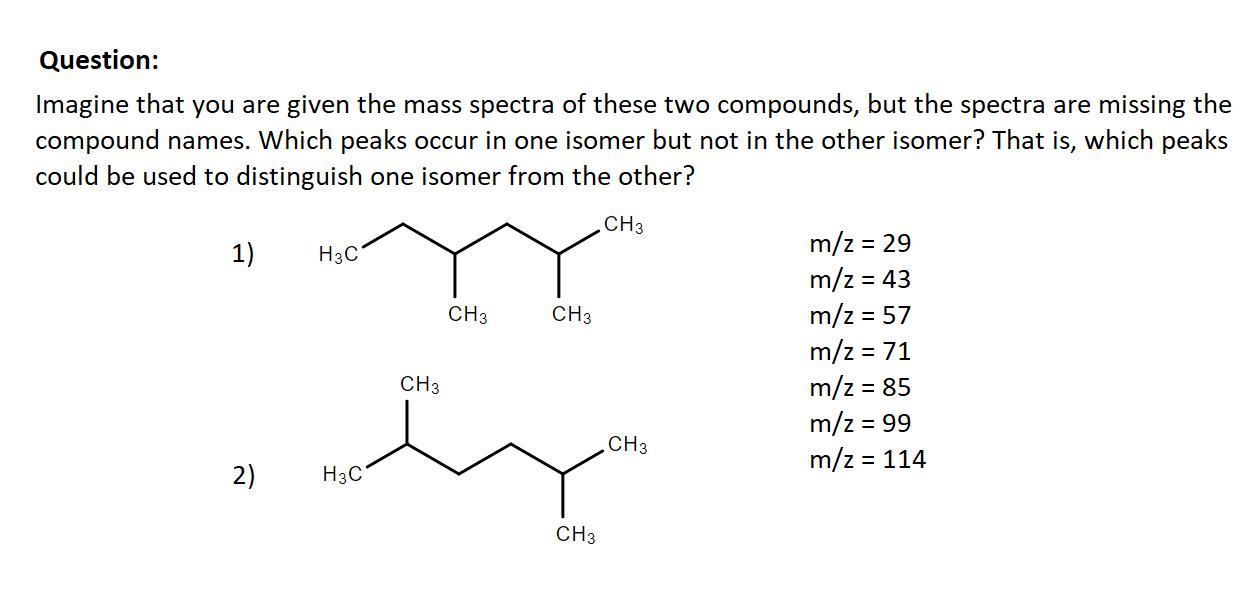
Imagine that you are given the mass spectra of these two compounds, but the spectra are missing the compound names.
12345 [234]

The structures of the isomers and the m/z values of their peaks are not given in the question. The complete question is provided in the attachment

Answer:

Compound 2 (2,5-dimethylhexane) will not have the peaks at 29 and 85 m/z

Explanation:

The fragmentation of molecules by electron ionization of mass spectrometer occurs according to Stevenson's Rule, which states that "The most probable fragmentation is the one that leaves the positive charge on the fragment with the lowest ionization energy". This is much like the Markovnikov's Rule in organic chemistry which has predicted the formation of most stable carbocation and the addition of hydrogen halide to it.

The mass spectra of compound 1 (2,4-dimethylhexane) will contain all the m/z values mentioned in the question. Each peak indicate towards homologous series of fragmentation product of the compound 1. The first peak can be attributed to ethyl carbocation (m/z = 29), with the increase of 14 units the next peak indicates towards propyl carbocation (m/z = 43) and onwards until molecular ion peak of 114 m/z.

Compound 2 (2,5-dimethylhexane) structure shows that the cleavage  of C-C bond will not yield a stable ethyl and hexyl carbocation. Hence, no peaks will be observed at 29 and 85 m/z. The absence of these two peaks can be used to distinguish one isomer from the other.

5 0
2 years ago
Which of the following descriptions best describes a weak base?
Westkost [7]

Answer:

umm.. B. a base that generates a lot of hydroxide ions in water.

5 0
2 years ago
You are eating a pizza. What type of mixture are you consuming?
Hitman42 [59]

Answer:

Explanation:

Cheese, Meat, dough, Sauce

3 0
2 years ago
Read 2 more answers
A 100-W lightbulb is placed in a cylinder equipped with a moveable piston. The lightbulb is turned on for 0.020 h, and the assem
nasty-shy [4]

Answer: The workdone W = 505J

Explanation:

Applying the pressure-volume relationship

W= - PΔV

Where negative sign indicates the power is being delivered to the surrounding

W = - 1.0atm * ( 5.88 - 0.9)L

= - 1.0atm * (4.98)

W = -4.98 atmL

Converting to Joules

1atmL = 101.325J

-4.98atmL = x joules.

Work done in J = -4.98 * 101.325

W= -505J

Therefore the workdone is -505J

5 0
2 years ago
How much heat must be removed from 25.0g of steam at 118.0C in order to form ice at 15C
NemiM [27]

Answer:

-10778.95 J heat must be removed in order to form the ice at 15 °C.

Explanation:

Given data:

mass of steam = 25 g

Initial temperature = 118 °C

Final temperature = 15 °C

Heat released = ?

Solution:

Formula:

q = m . c . ΔT

we know that specific heat of water is 4.186 J/g.°C

ΔT = final temperature - initial temperature

ΔT = 15 °C - 118 °C

ΔT = -103 °C

now we will put the values in formula

q = m . c . ΔT

q = 25 g × 4.186 J/g.°C × -103 °C

q = -10778.95 J

so, -10778.95 J heat must be removed in order to form the ice at 15 °C.

3 0
2 years ago
Other questions:
  • Part a write an equation for the formation of nh3(g) from its elements in its standard states. express your answer as a chemical
    11·2 answers
  • How much heat is required to convert 422 g of liquid h2o at 23.5 °c into steam at 150 °c?
    11·2 answers
  • 0.9775 grams of an unknown compound is dissolved in 50.0 ml of water. Initially the water temperature is 22.3 degrees Celsius. A
    6·1 answer
  • Elements whose names end with âium are usually metals; sodium is one example. Identify a nonmetal whose name also ends with âium
    14·1 answer
  • A solution is 0.010 M in each of Pb(NO3)2, Mn(NO3)2, and Zn(NO3)2. Solid NaOH is added until the pH of the solution is 8.50. Whi
    15·1 answer
  • Calculate the initial molarity of MCHM in the river, assuming that the first part of the river is 7.60 feet deep, 100.0 yards wi
    10·1 answer
  • The phosphorylation of glucose to glucose 6-phosphate Group of answer choices is so strongly exergonic that it does not require
    6·1 answer
  • In hypothetical element, two energy levels are separated by an energy of 282 kj/mol. what wavelength of light (in nm) is involve
    7·1 answer
  • Please help me please
    14·2 answers
  • In what type of environment would you most likely find Fish Species 1? Explain your answer.
    5·2 answers
Add answer
Login
Not registered? Fast signup
Signup
Login Signup
Ask question!