answer.
Ask question
Login Signup
Ask question
All categories
  • English
  • Mathematics
  • Social Studies
  • Business
  • History
  • Health
  • Geography
  • Biology
  • Physics
  • Chemistry
  • Computers and Technology
  • Arts
  • World Languages
  • Spanish
  • French
  • German
  • Advanced Placement (AP)
  • SAT
  • Medicine
  • Law
  • Engineering
DENIUS [597]
2 years ago
6

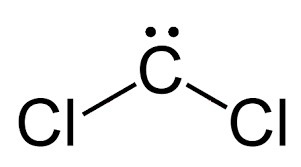
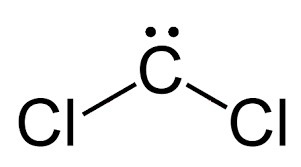
A compound composed of only carbon and chlorine is 85.5% chlorine by mass. propose a lewis structure for the lightest of the pos

sible compounds that allows each atom to have a complete octet without formal charges. draw the molecule by placing atoms on the grid and connecting them with bonds. include all lone pairs of electrons.

Chemistry
2 answers:
Margaret [11]2 years ago
7 0

$$\boxed{{\text{CC}}{{\text{l}}_{\text{2}}}}$$ is the lightest possible compound formed in the given case. Its structure is attached in the image.

Further explanation:

Lewis structure:

The bonding between the different atoms in covalent molecules is shown by some diagrams known as the Lewis structures. These also show the presence of lone pairs in the molecule. These are also known as Lewis dot diagrams, electron dot diagrams, Lewis dot structures or Lewis dot formula. In covalent compounds, the geometry, polarity, and reactivity are predicted by these structures.

Formal charge:

It is the charge that an atom acquires in a molecule by considering that the chemical bonds are shared equally between the two atoms, irrespective of their electronegativities.

Consider the mass of the compound to be 100 g.

Amount of chlorine in the compound is 85.5 %. So its mass can be calculated as follows:

$${\text{Mass of chlorine}}=\left({\frac{{{\text{\%  of chlorine}}}}{{{\text{100 \% }}}}}\right)\left({{\text{Mass of compound}}}\right)$$                 …………….(1)

Substitute 85.5 % for the percentage of chlorine and 100 g for the mass of the compound in equation (1).

$$\align{{\text{Mass of chlorine}}&=\left({\frac{{{\text{85}}{\text{.5 \% }}}}{{{\text{100\%}}}}}\right)\left({{\text{100g}}}\right)\cr&=85.5\;{\text{g}}\cr}$$

As the compound contains only carbon and chlorine. The total mass of the compound is calculated by using the following expression:

$${\text{Mass of compound}}={\text{Mass of carbon}}+{\text{Mass of chlorine}}$$                 …… (2)

Rearrange equation (2) to calculate the mass of carbon.

$${\text{Mass of carbon}}={\text{Mass of compound}}-{\text{Mass of chlorine}}$$                 …… (3)

Mass of chlorine is 85.5 g.

Mass of the compound is 100 g.

Substitute these values in equation (3).

\begin{aligned}\text{Mass of Carbon}&=100\text{ g}-85.5\text{ g}\\&=14.5\text{ g}\end{aligned}

The formula to calculate the moles of compound is,

{\text{Number of moles}} = \frac{{{\text{Given mass}}}}{{{\text{Molar mass}}}}                    …… (4)

The given mass of chlorine is 85.5 g.

The molar mass of chlorine atom is 35.45 g/mol.

Substitute these values in equation (4) to calculate the moles of chlorine in the compound.

$$\align{{\text{Moles of chlorine}}&=\left({{\text{85}}{\text{.5 g}}}\right)\left({\frac{{{\text{1 mol}}}}{{{\text{35}}{\text{.45g}}}}}\right)\cr&={\bf{2}}{\bf{.41}}\;{\bf{mol}}\cr}$$

The given mass of carbon is 14.5 g.

The molar mass of carbon is 12 g/mol.

Substitute these values in equation (4) to calculate the moles of carbon in the compound.

$$\align{{\text{Moles of carbon}}&=\left({{\text{14}}{\text{.5g}}}\right)\left({\frac{{{\text{1 mol}}}}{{{\text{12g}}}}}\right)\cr&=1.208\;{\text{mol}}\cr&\approx{\bf{1}}{\bf{.21 mol}}\cr}$$                   …… (5)

The moles of chlorine are 2.41 mol.

The moles of carbon are 1.41 mol.

Substitute these values in equation (5).

$$\align{{\text{Required ratio}}&=\frac{{{\text{2}}{\text{.41 mol}}}}{{{\text{1}}{\text{.21 mol}}}}\cr&=1.99:1\cr&\approx{\bf{2:1}}\cr}$$

The ratio of chlorine to carbon is 2:1. So the formula of the given compound is $${\bf{CC}}{{\bf{l}}_{\bf{2}}}$$

Carbon has four valence electrons and it forms two single bonds with two chlorine atoms. While each chlorine atom has seven valence electrons and forms single bond with carbon atom to complete its octet. (Refer to the structure in the attached image)

Learn more:

1. Carbon dioxide and water have the same geometry or not? <u>brainly.com/question/2176581</u>

2. Which molecule is not described by a single Lewis structure? <u>brainly.com/question/6786947</u>

Answer details:

Grade: Senior School

Subject: Chemistry

Chapter: Chemical bonding and molecular structure.

Keywords: Lewis structure, chlorine, carbon, 85.5 %, 100 %, 85.5 g, 14.5 g, CCl2, 2:1, formal charge, bonds, lone pairs, possible compounds, given mass, molar mass, 100 g, 35.45 g/mol, 12 g/mol.
aivan3 [116]2 years ago
4 0

Answer is in picture below.

Use 100 grams of the compound:

ω(Cl) = 85.5% ÷ 100%.

ω(Cl) = 0.855; mass percentage of the chlorine in the compound.

m(Cl) = 0.855 · 100 g.

m(Cl) = 85.5 g; mass of chlorine.

m(C) = 100 g - 85.5 g.

m(C) = 14.5 g; mass of carbon.

n(Cl) = m(Cl) ÷ M(Cl).

n(Cl) = 85.5 g ÷ 35.45 g/mol.

n(Cl) = 2.41 mol; amount of chlorine.

n(C) = 14.5 g ÷ 12 g/mol.

n(C) = 1.21 mol; amount of carbon.

n(Cl) : n(C) = 2.41 mol : 1.21 mol = 2 : 1.

This compound is dichlorocarbene CCl₂.

You might be interested in
when switch s is closed positive ions will undergo 1) oxidation at electrode B 2) oxidation at electrode A 3) reduction at elect
stepladder [879]

Answer:

reduction at electrode B

Explanation:

4 0
2 years ago
How much maleic anhydride would you need to react 178 mg of anthracene? Assume 1:1 ratio from maleic anhydride to anthracene.
Licemer1 [7]

Answer:

(1) 0.10      (2) 17.8 g

Explanation:

Since the reaction ratio is 1:1 what we need is to convert the given masses to moles and you will have the answer:

MW anthracene = 178.23 g/mol

MW maleic anhydride = 98.06 g/mol

a) mass anthracene = 178 mg x 1 g/ 1000 mg = 0.178 g anthracene

Moles anthracene = 0.178 g anthracene/ 178.23 g/mol

= 0.001 mol anthracene

0.001 mol anthracene x 1 mol maleic acid/mol anthracene

= 0.001 mol maleic anhydride

mass maleic anhydride  = 0.001 mol x 98.06 g/mol =  0.10 g

b) moles maleic anhydride = 9.8 g/ 98.06 g/mol = 0.099 moles

0.099 moles maleic anhydride x 1 mol anthracene/mol  maleic anhydride =

0.099 mol anthracene

g anthracene = 0.10mol x 178 g/mol = 17.8 g

8 0
2 years ago
The nutrition label on the back of a package of hotdogs (purchased within the US) indicates that one hotdog contains 100 calorie
Olenka [21]

Answer:

C. 100

Explanation:

Biochemical researches and studies have found out that an average health hotdog has a calorie of between 100 and 150 which is usually dependent on the additives.

Since the nutrition label on the back of a package of hotdogs (purchased within the US) indicates that one hotdog contains 100 calories then it truly contains such amount of calories. The standard number of calories present in a hotdog is independent of the amount eaten by individuals.

5 0
2 years ago
A bar of gold is 5.0mm thick, 10.0cm long and 2.0cm wide. It has a mass of exactly 193.0g. What is the desity of gold?
Tanzania [10]
<h3>Answer:</h3>

19.3 g/cm³

<h3>Explanation:</h3>

Density of a substance refers to the mass of the substance per unit volume.

Therefore, Density = Mass ÷ Volume

In this case, we are given;

Mass of the gold bar = 193.0 g

Dimensions of the Gold bar = 5.00 mm by 10.0 cm by 2.0 cm

We are required to get the density of the gold bar

Step 1: Volume of the gold bar

Volume is given by, Length × width × height

Volume =  0.50 cm × 10.0 cm × 2.0 cm

             = 10 cm³

Step 2: Density of the gold bar

Density = Mass ÷ volume

Density of the gold bar = 193.0 g ÷ 10 cm³

                                      = 19.3 g/cm³

Thus, the density of the gold bar is 19.3 g/cm³

3 0
2 years ago
When an athlete gets hurt they apply sometimes an instant cold pack to the injury. The instant cold pack works by mixing two che
NeX [460]

Answer:

The evidence showing that there is a chemical reaction taking place is the instantaneous temperature drop once the cold pack is shaken.

Explanation:

When an athlete applies a cold pack to the injury, they shake it before, mixing the water and <em>ammonium-nitrate fertilizer</em> inside the cold pack. This mixing is an endothermic reaction, which means it absorbs heat. In turn, the temperature falls to 35 F for around 10 minutes.

3 0
2 years ago
Other questions:
  • The fuel used in many disposable lighters is liquid butane, C4H10. Butane has a molecular weight of 58.1 grams in one mole. How
    13·2 answers
  • Consider the following balanced equation: Fe + 2Ag+ Fe2+ + 2Ag Which statement is true?
    12·1 answer
  • Janet observes that the shape of a dented table tennis ball is restored by heating the ball gently in warm water. Which of the f
    13·1 answer
  • Air pressure is lower at high altitudes. An airplane cabin can adjust, but as the plane rises, passengers can experience tempora
    14·2 answers
  • The partial pressures in an equilibrium mixture of NO, Cl2, and NOCI at 500 K are as follows: PNo = 0.240 atm, Pel2 = 0.608 atm,
    9·1 answer
  • A 1.800-g sample of solid phenol (C6H5OH(s)) was burned in a bomb calorimeter, which has a total heat capacity of 11.66 kJ/∘C. T
    10·1 answer
  • Determine the percent yield for the reaction between 6.92 g K and 4.28g of oxygen gas if 7.36 g of potassium oxide is produced.
    5·1 answer
  • Imagine you had to sort all of the living things on earth into groups. How would you sort them?
    14·2 answers
  • 7. If you fill a balloon with 5.2 moles of gas and it creates a balloon with a volume of 23.5 liters, how many moles are in a ba
    12·1 answer
  • The energy gap between the valence band and the conduction band in the widely-used semiconductor gallium arsenide (GaAs) is Δ =
    13·1 answer
Add answer
Login
Not registered? Fast signup
Signup
Login Signup
Ask question!
