answer.
Ask question
Login Signup
Ask question
All categories
  • English
  • Mathematics
  • Social Studies
  • Business
  • History
  • Health
  • Geography
  • Biology
  • Physics
  • Chemistry
  • Computers and Technology
  • Arts
  • World Languages
  • Spanish
  • French
  • German
  • Advanced Placement (AP)
  • SAT
  • Medicine
  • Law
  • Engineering
BartSMP [9]
2 years ago
8

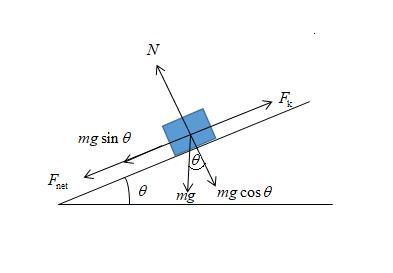
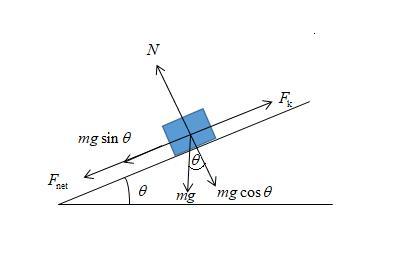
Suppose the ski patrol lowers a rescue sled and victim, having a total mass of 90.0 kg, down a 60.0° slope at constant speed, a

s shown below. the coefficient of friction between the sled and the snow is 0.100. (a) how much work is done by friction as the sled moves 30.0 m along the hill? (b) how much work is done by the rope on the sled in this distance? (c) what is the work done by the gravitational force on the sled? (d) what is the total work done?

Physics
2 answers:
inessss [21]2 years ago
8 0

A. how much work is done by friction as the sled moves 30.0 m along the hill

We use the formula:

friction work = -µmgdcosΘ 

friction work = -0.100 * 90 kg * 9.8 m/s^2 * 30 m * cos 60

friction work = - 1,323 J


B. how much work is done by the rope on the sled in this distance?

We use the formula:

rope work = -mgd(sinΘ - µcosΘ) <span>
</span>rope work = - 90 kg * 9.8 m/s^2 * 30 m (sin 60 – 0.100 * cos 60)

rope work = 21,592 J


C. what is the work done by the gravitational force on the sled?

We use the formula:

gravity work = mgdsinΘ 

gravity work = 90 kg * 9.8 m/s^2 * 30 m * sin 60

gravity work = 22,915 J


D. what is the total work done?

We add everything:

total work = - 1,323 J + 21,592 J + 22,915 J

<span>total work = 43,184 J</span>

zlopas [31]2 years ago
8 0

Part (a): the work done by friction is \boxed{1324.35\text{ J}}

Part (b): the work done by rope is \boxed{21614.07\text{ J}}.

Part (c): the work done by gravitational force is \boxed{22938.42\text{ J}}.

Part (d): total work done is \boxed{43228.14\text{ J}}.

Further Explanation:

The rope is doing work against the gravity. The friction always acts against the direction of motion. Therefore, the friction is in direction of gravity.

Given:

Mass of victim is 90\text{ kg}.

The inclination of plane is 60^\circ.

The coefficient of plane is 0.1.

The distance travelled on plane is 30\text{ m}.

Concept:

Equations for free body diagram of victim:

Force equation:

Normal force on sled is mgcos\theta.

Friction force:

f=\mu N  

Substitute mgcos\theta for N in above equation.

f=\mu mgcos\theta    

Here, f is the friction force, m is the mass of victim, g is the gravitational acceleration, \mu is the coefficient of friction and \theta is the inclination of plane.

The gravitational force on the sled is mgsin\theta.

Work equation:

(a)

Work done by friction:

W_f=-fd  

Substitute \mu mgcos\theta for f in above equation.

\boxed{W_f=-\mu mdgcos\theta}  

Substitute 90\text{ kg} for m, 30\text{ m} for d, 9.81\text{ m}/\text{s}^2 for g, 0.1 for \mu and 60^\circ for \theta in above equation.

\begin{aligned}W_f&=-0.1\times90\times30\times9.81\times cos\theta\\&=-1324.35\text{ J}\end{aligned}  

Negative sign shows that friction is acting against the motion.

Thus, the work done by friction is \boxed{1324.35\text{ J}}

(b)  

Work done by rope:

\boxed{W_r=mdgsin\theta+W_f}  

Substitute 90\text{ kg} for m, 30\text{ m} for d, 9.81\text{ m}/\text{s}^2 for g, 60^\circ for \theta and -1324.35\text{ J} for W_f in above equation.

\begin{aligned}W_r&=90\times30\times9.81\times sin60^\circ-1324.35\text{ J}\\&=21614.07\text{ J}\end{aligned}  

Thus, the work done by rope is \boxed{21614.07\text{ J}}.

(c)

Work done by gravitational force:

\boxed{W_w=mdgsin\theta}  

Substitute 90\text{ kg} for m, 30\text{ m} for d, 9.81\text{ m}/\text{s}^2 for g and 60^\circ for \theta in above equation.

\begin{aligned}W_w&=90\times30\times9.81\times sin60^\circ\\&=22938.42\text{ J}\end{aligned}  

Thus, the work done by gravitational force is \boxed{22938.42\text{ J}}.

(d)

Total work done:

\boxed{W=W_r+W_w+W_f}  

Substitute 21614.07\text{ J} for W_r, 22938.42\text{ J} for W_w and \boxed{-1324.35\text{ J}} for W_f in above equation.

\begin{aligned}W&=21614.07+22938.42-1324.35\text{ J}\\&=43228.14\text{ J}\end{aligned}

Thus, total work done is \boxed{43228.14\text{ J}}

Learn more:

1. Motion on a rough surface: brainly.com/question/7031524

2. Motion under the gravitational force: brainly.com/question/10934170

3. Principle of conservation of momentum: brainly.com/question/9484203

Answer Details:

Grade: College

Subject: Physics

Chapter: Kinematics

Keywords:

Ski patrol, rescue, sled, victim, mass, 90.0 kg, 60.0°, slope, coefficient, friction, snow, 0.100, work, 30.0 m, along, hill, distance and gravitational force
You might be interested in
A person on a cruise ship is doing laps on the promenade deck. on one portion of the track the person is moving north with a spe
Dmitry [639]
The resultant motion is given by pithagoras, since the two components (north and east) are perpendicular to each other.
They are asking you about the direction so you have to use trigonometry, finding that the direction is Ф=arctan(3.8/12)=17.57° north of east.
4 0
2 years ago
Read 2 more answers
A 3.45-kg centrifuge takes 100 s to spin up from rest to its final angular speed with constant angular acceleration. A point loc
Dafna11 [192]

Answer:

(a) 18.75 rad/s²

(b) 14920.78 rev

Explanation:

(a)

First we find the acceleration of the centrifuge using,

a = (v-u)/t......................... Equation 1

Where v = final velocity, u = initial velocity, t = time.

Given: v = 150 m/s,  u = 0 m/s ( from rest), t = 100 s

Substitute into equation 1

a = (150-0)/100

a = 1.5 m/s²

Secondly we calculate for the angular acceleration using

α = a/r..................... Equation 2

Where α = angular acceleration, r = radius of the centrifuge

Given: a = 1.5 m/s², r = 8 cm = 0.08 m

substitute into equation 2

α = 1.5/0.08

α = 18.75 rad/s²

(b)

Using,

Ф = (ω'+ω).t/2........................... Equation 3

Where Ф = number of revolution of the centrifuge, ω' = initial angular velocity, ω = Final angular velocity.

But,

ω = v/r and ω' = u/r

therefore,

Ф = (u/r+v/r).t/2

where u = 0 m/s (at rest),  = 150 m/s, r = 0.08 m, t = 100 s

Ф = [(0/0.08)+(150/0.08)].100/2

Ф = 93750 rad

If,

1 rad = 0.159155 rev,

Ф = (93750×0.159155) rev

Ф = 14920.78 rev

6 0
2 years ago
: Two containers have a substantial amount of the air evacuated out of them so that the pressure inside is half the pressure at
ser-zykov [4K]

Complete Question

Two containers have a substantial amount of the air evacuated out of them so that the pressure inside is half the pressure at sea level. One container is in Denver at an altitude of about 6,000 ft and the other is in New Orleans (at sea level). The surface area of the container lid is A=0.0155 m. The air pressure in Denver is PD = 79000 Pa. and in New Orleans is PNo = 100250 Pa. Assume the lid is weightless.

Part (a) Write an expression for the force FNo required to remove the container lid in New Orleans.

Part (b) Calculate the force FNo required to lift off the container lid in New Orleans, in newtons.

Part (c) Calculate the force Fp required to lift off the container lid in Denver, in newtons.

Part (d) is more force required to lift the lid in Denver (higher altitude, lower pressure) or New Orleans (lower altitude, higher pressure)?

Answer:

a

The  expression is   F_{No} =   A [P_{No} - \frac{P_{sea}}{2}]

b

F_{No}= 7771.125 \ N

c

 F_p = 2.2*10^{6} N

d

From the value obtained we can say the that the force required to open the lid is higher at Denver

Explanation:

          The altitude of container in Denver is  d_D = 6000 \ ft = 6000 * 0.3048 = 1828.8m

           The surface area of the container lid is A = 0.0155m^2

           The altitude of container in New Orleans  is sea-level

           The air pressure in Denver is  P_D = 79000 \ Pa

            The air pressure in new Orleans is P_{ro} = 100250 \ Pa

Generally force is mathematically represented as

            F_{No} = \Delta P A

  So we are told the pressure inside is  is half the pressure the at sea level so the  the pressure acting on the container would

   The  pressure at sea level is a constant with a  value of  

               P_{sea} = 101000 Pa

So the \Delta P which is the difference in pressure within and outside the container is  

           \Delta P = P_{No} - \frac{P_{sea}}{2}

Therefore

                F_{No} =   A [P_{No} - \frac{P_{sea}}{2}]

Now substituting values

                F_{No} =   0.0155 [100250 - \frac{101000}{2}]

                       F_{No}= 7771.125 \ N

The force to remove the lid in Denver is  

           F_p = \Delta P_d A

So we are told the pressure inside is  is half the pressure the at sea level so the  the pressure acting on the container would

 The  pressure at sea level is a constant with a  value of  

               P_{sea} = 101000 Pa    

 At  sea level the air pressure in Denver is mathematically represented as

              P_D = \rho g h

     =>     g = \frac{P_D}{\rho h}      

Let height at sea level is h = 1

  The air pressure at height d_D

             P_d__{D}} = \rho gd_D

    =>     g = \frac{P_d_D}{\rho d_D}

  Equating the both

                 \frac{P_D}{\rho h}  = \frac{P_d_D}{\rho d_D}

                 P_d_D =  P_D * d_D

Substituting value  

                   P_d__{D}} = 1828.2 * 79000

                    P_d__{D}} = 1.445*10^{8} Pa

    So

              \Delta P_d  = P_{d} _D - \frac{P_{sea}}{2}

=>          \Delta P_d  = 1.445 *10^{8} - \frac{101000}{2}    

                        \Delta P_d = 1.44*10^{8}Pa

  So

               F_p = \Delta P_d A

                  = 1.44*10^8 * 0.0155

              F_p = 2.2*10^{6} N


6 0
3 years ago
A diver explores a shallow reef off the coast of Belize. She initially swims d1 = 74.8 m north, makes a turn to the east and con
Nataly [62]

Answer:R=1607556m

θ=180degrees

Explanation:

d1=74.8m

d2=160.7km=160.7km*1000

d2=160700m

d3=80m

d4=198.1m

Using analytical method :

Rx=-(160700+75*cos(41.8))= -160755.9m

Ry= -(74.8+75sin(41.8))-198.1=73m

Magnitude, R:

R=√Rx+Ry

R=√160755.9^2+20^2=160755.916

R=160756m

Direction,θ:

θ=arctan(Rx/Ry)

θ=arctan(-73/160755.9)

θ=-7.9256*10^-6

Note that θ is in the second quadrant, so add 180

θ=180-7.9256*10^6=180degrees

8 0
2 years ago
The equation for the change in the position of a train (measured in units of length) is given by the following expression: x = ½
mel-nik [20]

Answer:

(B) (length)/(time³)

Explanation

The equation x = ½ at² + bt³ has to be dimensionally correct. In other words the term bt³ and ½ at² must have units of change of position = length.

We solve in order to find the dimension of b:

[x]=[b]*[t]³

length=[b]*time³

[b]=length/time³

6 0
2 years ago
Read 2 more answers
Other questions:
  • A cave explorer travels 3.0 m eastward, then 2.5 m northward, and finally 15.0 m westward. use the graphical method to find the
    8·2 answers
  • A varying force is given by F=Ae ^-kx, where x is the position;A and I are constants that have units of N and m^-1 , respectivel
    11·1 answer
  • Suppose a NASCAR race car rounds one end of the Martinsville Speedway. This end of the track is a turn with a radius of approxim
    12·1 answer
  • Suppose you are driving a car and your friend, who is with you in the car, tosses a softball up and down from her point of view.
    7·1 answer
  • A thin ring of radius 73 cm carries a positive charge of 610 nC uniformly distributed over it. A point charge q is placed at the
    9·1 answer
  • All of these are examples of pseudopsychology EXCEPT:
    15·2 answers
  • It requires 49 J of work to stretch an ideal very light spring from a length of 1.4 m to a length of 2.9 m. What is the value of
    8·2 answers
  • Planetary orbits... are spaced more closely together as they get further from the Sun. are evenly spaced throughout the solar sy
    5·1 answer
  • Suppose a ray of light traveling in a material with an index of refraction n a reaches an interface with a material having an in
    12·1 answer
  • Look at the two question marks between zinc (Zn) and arsenic (As). At the time, no elements were known
    9·1 answer
Add answer
Login
Not registered? Fast signup
Signup
Login Signup
Ask question!
