answer.
Ask question
Login Signup
Ask question
All categories
  • English
  • Mathematics
  • Social Studies
  • Business
  • History
  • Health
  • Geography
  • Biology
  • Physics
  • Chemistry
  • Computers and Technology
  • Arts
  • World Languages
  • Spanish
  • French
  • German
  • Advanced Placement (AP)
  • SAT
  • Medicine
  • Law
  • Engineering
KatRina [158]
2 years ago
4

A child's toy consists of a spherical object of mass 50 g attached to a spring. one end of the spring is fixed to the side of th

e baby's crib so that when the baby pulls on the toy and lets go, the object oscillates horizontally with a simple harmonic motion. the amplitude of the oscillation is 6 cm and the maximum velocity achieved by the toy is 3.2 m/s . what is the kinetic energy k of the toy when the spring is compressed 4.5 cm from its equilibrium position?

Physics
1 answer:
siniylev [52]2 years ago
7 0
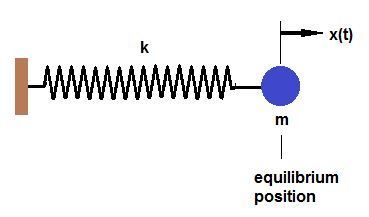
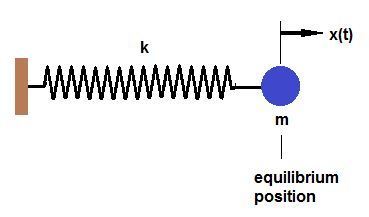
Refer to the diagram shown below.

m = 50 g = 0.05 kg, the mass of the ball
A = 6 cm = 0.06 m, the amplitude

The oscillatory motion relative to the equilibrium position is
x(t) = A cos(ωt)
where 
x =  displacement at time t
A = amplitude, 0.06 m
ω = circular frequency

Therefore
x(t) = A cos(ωt) 
The velocity function is
v(t) = - ωA sin(ωt)

The maximum velocity occurs when sin(ωt) = 1. Because the maximum velocity is 3.2 m/s, therefore
(ω 1/s)*(0.06 m) = (3.2 m/s)
w = 53.33 1/s

Therefore
x(t) = 0.06 cos(53.33t)
v(t) = 3.2 sin(53.33t)

When the spring is compressed by 4.5 cm (0.045 m) from the equilibrium position, then
0.06 cos(53.33t) = -0.045
cos(53.33t) = -0.75
53.33t = cos⁻¹ (-0.75) = 2.4189
t = 0.0454 s

The velocity when t = 0.0454 s is
v = 3.2 sin(53.33*0.0454) = 2.111 m/s

The kinetic energy is
KE = (1/2)*m*v²
     = 0.5*(0.05 kg)*(2.111 m/s)²
     = 0.1114 J

Answer:  0.1114 J
You might be interested in
Driving a motor vehicle requires many coordinated functions which are impacted by alcohol and other drugs
Anni [7]

I am assuming this is a true or false question, to which the answer would be True.

6 0
2 years ago
A person is working on a steel structure while standing on the ground. An accident occurred where 5 A pass through the structure
matrenka [14]

Answer:

35mA

Explanation:

Hello!

To solve this problem we must use the following steps

1. Find the electrical resistance of the metal rod using the following equation

R=\alpha  \frac{l}{a}

WHERE

α=

metal rod resistivity=2x10^-4 Ωm

l=leght=2m

A=  Cross-sectional area

A=\frac{\pi }{4} d^2=\frac{\pi }{4} (0.06)^2=0.00283

solving

R=(2x10^-4)\frac{2}{0.00283} =0.14

2. Now we model the system as a circuit with parallel resistors, where we will call 1 the metal rod and 2 the man(see attached image)

3.we know that the sum of the currents in 1 and 2 must be equal to 5A, by the law of conservation of energy

I1+I2=5

4.as the voltage on both nodes is the same we can use ohm's law in resitance 1 and 2 (V=IR)

V1=V2

(0.14I1)=2000(i2)

solving for i1

I1=14285.7i2

5.Now we use the equation found in step 3

14285.7i2+i2=5

i2=\frac{5}{14285.7+1} =3.5x10^-4A=35mA

6 0
2 years ago
According to the work-energy theorem, if work is done on an object, its potential and/or kinetic energy changes. Consider a car
Leni [432]

Answer:

The force of the car engine.

Explanation:

The work- energy theorem states that the work done on an object is equal to the change in its kinetic energy. Its expression is given by :

W=\dfrac{1}{2}m(v^2-u^2)

Also, W = F.d

Fd=\dfrac{1}{2}m(v^2-u^2)

Where

F is the force applied by the engine of car

d is the displacement

m is the mass of an object

u is the initial speed

v is the final speed

So, the force of the car engine increased the car’s kinetic energy. Hence, this is the required solution.

6 0
2 years ago
Which of these shows unbalanced forces at work on an object? A. an ice skater turning as he skates around an ice rink B. a bicyc
rosijanka [135]
I’m pretty sure the answer is a
4 0
2 years ago
Read 2 more answers
At 25 °C, a bottle contains 2.00 L of water in its liquid state. What is the volume of the water after it freezes (at 0 °C)? The
Alex73 [517]

Answer:

  • 2.175 L

Explanation:

temperature (T) = 25 degrees

volume of water (v) = 2 L = 2000 mL

density of water = 0.997 g/mL

density of ice = 0.917 g/mL

we can get the mass of the water and the use it to get the volume when it freezes to ice, this is because the mass remains the same irrespective of the change of state.

  • mass of water = volume x density  = 2000 x 0.997 = 1994 g
  • volume of ice = mass/density = 1994 / 0.917 = 2174.5 mL = 2.175 L
6 0
2 years ago
Other questions:
  • a bobsled has a momentum of 1500 kg*m/s to the south. Air resistance reduces its momentum to 750 kg*m/s to the south. What impul
    11·2 answers
  • Block 1 of mass m1 slides along a frictionless floor and into a one-dimensional elastic collision with stationary block 2 of mas
    5·1 answer
  • The voltage entering a transformer’s primary winding is 120 volts. The primary winding is wrapped around the iron core 10 times.
    13·2 answers
  • What visible signs indicate a precipitation reaction when two solutions are mixed?
    6·1 answer
  • Two ropes in a vertical plane exert equal-magnitude forces on a hanging weight but pull with an angle of 72.0° between them. Wha
    6·1 answer
  • A horizontal spring with spring constant 750 N/m is attached to a wall. An athlete presses against the free end of the spring, c
    6·2 answers
  • Two students are playing paddle ball with a 5 kg spongy ball. If the ball is thrown at the batter with a speed of 5 m/s and boun
    15·1 answer
  • Two sources emit beams of light of wavelength 550 nm. The light from source A has an intensity of 10 μW/m2, and the light from s
    6·1 answer
  • If you wanted to find the area of the hot filament in a light bulb, you would have to know the temperature (determinable from th
    5·1 answer
  • POINTS + BRAINLIEST TO CORRECT ANSWER
    5·1 answer
Add answer
Login
Not registered? Fast signup
Signup
Login Signup
Ask question!